
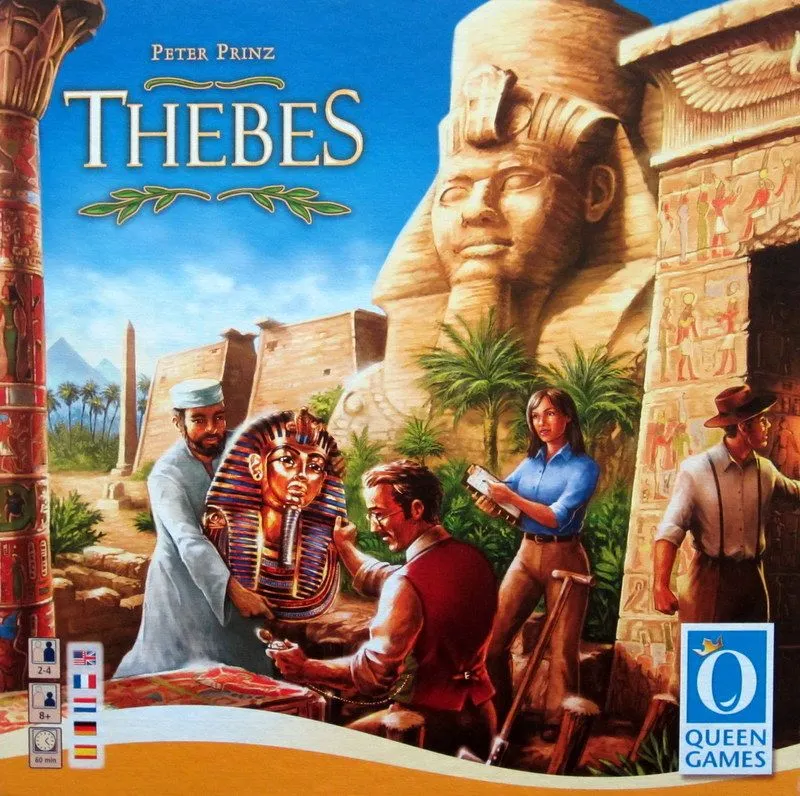
- Posizione BGG
- BGG #773
- Valutazione BGG
- 7,1
Thebes
- 2–4 giocatori
- 60 min
- Complessità 2,2/5
- 2007
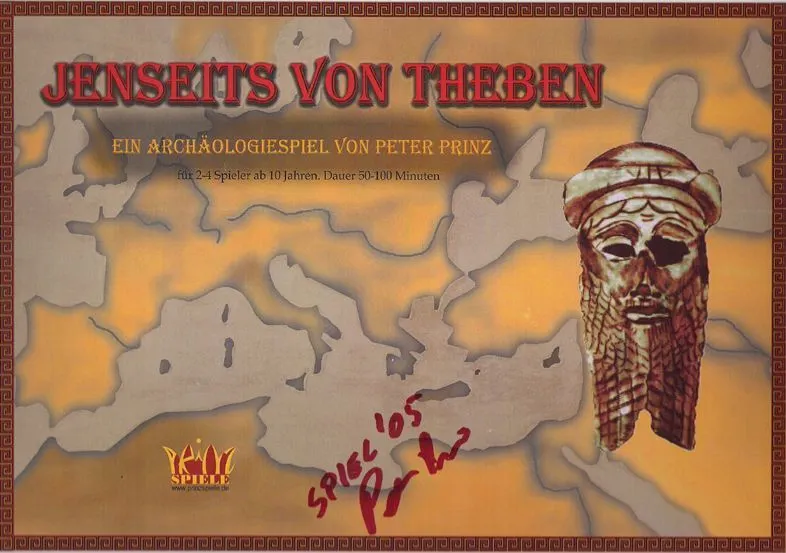
2004
Aiuto con le regole di Jenseits von Theben
Spiegazioni chiare di turni, effetti delle carte e situazioni dubbie, con riferimenti alle fonti ufficiali e cronologia delle domande salvata.
Per 2 giocatori
Cosa vuoi sapere?
Le risposte vengono dal regolamento ufficiale, con la pagina da verificare.
Jenseits von Theben è un gioco da tavolo pubblicato nel 2004 per 2–4 giocatori, con partite da 75 minuti e dai 10 anni in su. È stato ideato da Peter Prinz e le sue meccaniche principali sono Turn Order: Time Track.






In inglese
This entry is for the original Jenseits von Theben; for the new printing by Queen, go to Thebes. Jenseits von Theben is a game of competitive archeology. Players are archaeologists who must travel around Europe to acquire knowledge about five ancient civilizations -- the Greeks, the Cretans, the Egyptians, the Palestinians, and the Macedonians -- and then must use this knowledge to excavate historical sites in the areas of these civilizations. Periodically, there are expositions at major European cities, and the archaeologist who shows up on time with the best collection of artifacts (plus a minor die roll) wins the purse. The archaeologist who learns the most about the civilizations, claims the greatest-valued artifacts, and presents the biggest collection to the European exhibitions will win out over his or her colleagues. The key element to the game is that it is played out over a period of two (or three) years, and each action a player performs takes a certain amount of time -- traveling is a week between cities, gathering knowledge takes time for the level of the knowledge, and actually digging at a cultural site takes time to yield a certain number of artifact cards. The game uses a novel mechanic to keep track of this -- there is a track of 52 spaces around the outside of the board, and each time a player moves and takes an action, he or she moves their player token forward in time. Players take turns based on being the one who is furthest back in "time". So, a player can go to an excavation site and spend 10 weeks digging for artifacts, but that will also mean that the other players will likely be taking several actions in the interim while that player waits for the "time" to catch up. In addition, the artifact cards in each civilization are a hidden number. The deck for each civilization contains twelve treasures of varying point values and two knowledge cards, with another sixteen cards of dirt. At the beginning of the game, seven cards are removed from each deck without the players seeing them. Through the course of the game, when a player excavates at a site, he or she keeps the artifacts that are revealed from a site, but the dirt is shuffled back into the remaining cards. Both the imperfect information element as well as the recycled dirt make for a random chance element that is overcome somewhat by digging at a site where a player has much knowledge -- more knowledge means that more cards will be revealed in a shorter period of time, and a greater chance of revealing treasures that may yet remain after another player has already recovered some treasures from that site. The original run of Jenseits von Theben was hand-produced by Prinz Spiele in a first edition of 100, and a second edition of 300. Re-implemented by: Thebes
Secondo il catalogo, Jenseits von Theben supporta da 2 a 4 giocatori. L’intervallo corrisponde al numero di giocatori indicato dall’editore, quindi il gioco si può preparare per qualsiasi gruppo entro quei limiti. Preparazione, alcune regole e punteggio possono comunque variare in base al numero di giocatori: controlla la configurazione esatta nel regolamento della tua edizione.
La durata indicata per Jenseits von Theben è di 75 minuti, la stima dell’editore per una partita completa. La durata effettiva dipende dal gruppo, dal numero di giocatori e dalla conoscenza delle regole: le prime partite durano di più, i gruppi esperti finiscono prima. Preparazione e spiegazione delle regole non sono comprese nella stima.
Il catalogo indica Jenseits von Theben dai 10 anni in su. È la raccomandazione dell’editore e tiene conto della lettura richiesta, della complessità delle regole e dei componenti piccoli, non solo del tema. I più giovani spesso possono giocare con l’aiuto di un adulto: controlla l’età consigliata sulla tua edizione e l’esperienza del tuo gruppo con i giochi da tavolo.
Jenseits von Theben ha un punteggio di complessità di 2,4 su 5 secondo i giocatori di BoardGameGeek, il che lo rende un gioco piuttosto leggero. Il punteggio riflette quanta conoscenza delle regole, pianificazione e decisioni richiede una partita tipica. I giochi impegnativi richiedono una prima spiegazione più lunga, quindi conviene usare una guida di preparazione.
Jenseits von Theben appartiene a queste categorie: Travel e Exploration. Le sue meccaniche principali sono Turn Order: Time Track. Le categorie descrivono il tema e l’ambientazione di un gioco, mentre le meccaniche descrivono ciò che i giocatori fanno davvero nel proprio turno. Ogni meccanica porta a una pagina del catalogo con giochi simili.
Gli autori accreditati di Jenseits von Theben sono: Peter Prinz. Questi crediti provengono dai dati pubblicati del gioco e indicano le persone responsabili della sua progettazione, non gli illustratori o gli editori. Le pagine degli autori su MeepleRules raccolgono altri titoli degli stessi autori, utili quando un gioco ti piace e ne cerchi di simili.
Il catalogo classifica Jenseits von Theben come gioco base. Si gioca da solo con i componenti presenti nella scatola e non richiede altri titoli. Le espansioni, se esistono, aggiungono nuovo contenuto o nuove regole e sono elencate separatamente nel catalogo con un collegamento a questo gioco base.