
- Valutazione BGG
- 4,3
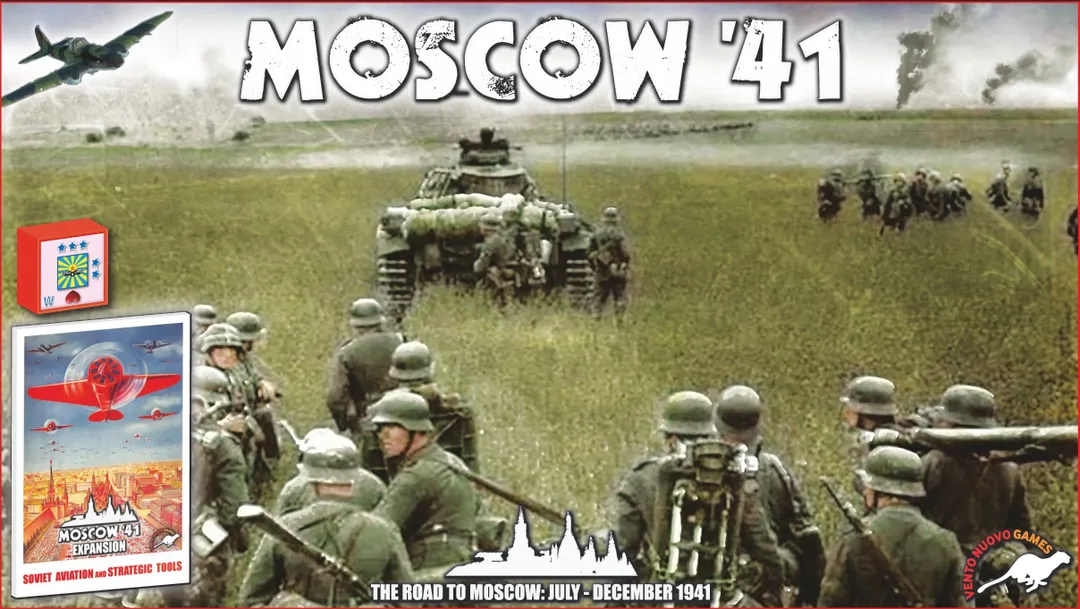
Moscow '41: Soviet Aviation and Strategic Tools
- 1–4 giocatori
- 60–240 min
- 2025

2016
Aiuto con le regole di Moscow '41
Spiegazioni chiare di turni, effetti delle carte e situazioni dubbie, con riferimenti alle fonti ufficiali e cronologia delle domande salvata.
Per 1 giocatore
Cosa vuoi sapere?
Le risposte vengono dal regolamento ufficiale, con la pagina da verificare.
Moscow '41 è un gioco da tavolo pubblicato nel 2016 per 1–2 giocatori, con partite da 60 a 120 minuti e dai 14 anni in su. È stato ideato da Emanuele Santandrea e le sue meccaniche principali sono Area Movement, Dice Rolling e Variable Set-up.





In inglese
Released July 8, 2016 - 3 months ahead. Second Edition released in 2020, Expansion in 2025: Moscow '41: Soviet Aviation and Strategic Tools Moscow '41 is the first chapter of the Barbarossa Trilogy (the other two are Leningrad '41 and Kiev '41). MOSCOW '41 is a light/medium wargame covering the German Army Group Centre offensive aimed to seize Moscow, after having successfully defeated several Soviet armies in the great encirclement battles at the frontier and established two bridgeheads on the Dnieper. Although based on a historical event, the two players can modify the course of the operations, with the Germans trying to achieve a decisive victory before the winter comes, and the Soviets playing a fighting withdrawal, until ready to strike a decisive blow at the invaders. The game is recommended for two players, but has excellent solitaire suitability. Historical Introduction "At the beginning of each campaign, one pushes a door into a dark, unseen room. One can never know what is hiding inside." - Adolf Hitler, June '41 In December of 1940, Hitler made the decision to invade Russia and set the date for the middle of 1941. He had good reason to be confident that Russia would collapse under an uncompromising assault. Since the outbreak of hostilities, the German Wehrmacht had accomplished a stunning and unparalleled series of victories: Poland had fallen in one month, Denmark in one day; France, till then regarded as the strongest power in Europe, had capitulated in under six weeks, Holland in under six days; Belgium, Norway, Yugoslavia and Greece took less than three weeks each. The German military might was at its peak and the word Blitzkrieg had entered the language. Russia, on the other hand had taken over three months to bring Finland to heel, despite overwhelming strength of numbers. The Russian army had not yet recovered from Stalin's purges of 1937-1938 where 400 generals were “removed” including three field marshals and 13 Army commanders. It was well that Hitler could say, “Before three months have passed, we shall witness a collapse in Russia, the like of which has never been seen in history. We have only to kick in the front door and the whole rotten Russian edifice will come tumbling down.” On the 22nd of June, 1941, Operation Barbarossa - the invasion of Russia, began. Three million Axis troops in three Army Groups attacked on a front that stretched from the Baltic to the Black Sea: Army Group North under Field Marshal von Leeb was tasked with taking Leningrad; Army Group South under Field Marshal von Rundstedt was to capture Kiev and seize the Caucasus; Field Marshal von Bock's Army Group Centre, the one that concerns us, had Moscow as an objective, with Timoshenko undertaking the task of defending the capital. Initially, the operation succeeded beyond Hitler's wildest dreams. Within a day, the Russian Air Force was destroyed on the ground, then vast inroads were made on all fronts accompanied by large scale surrenders of encircled Russian troops. Army Group Centre with its four armies consisting of a total of 48 Divisions, of which nine were armoured, and backed by the Second Air Fleet, had reached the outskirts of Smolensk by the 15th July. This was two-thirds of the way to Moscow and it seemed that nothing could stop von Bock from blowing up the Kremlin within another three or four weeks... or could something stand in his way? Four things could now cause problems to von Bock: firstly, his supply line is stretched and had almost reached breaking point; secondly, Russian resistance is stiffening; thirdly, his infantry divisions are having difficulty keeping up with the Panzers and finally, a new Russian ally is about to enter the field: General Winter. Additional concerns may come in November, with three-quarters of a million experienced Siberian veterans freed by garrisoning Soviet Far East, thanks to Stalin's spies in Tokyo revealing Japanese intentions to attack America, and not Russia. As the German Commander, you must push on to Moscow before it is too late. As the Russian Commander you must re-evoke the Patriotic War and stop the invaders at any cost.
Secondo il catalogo, Moscow '41 supporta da 1 a 2 giocatori. L’intervallo corrisponde al numero di giocatori indicato dall’editore, quindi il gioco si può preparare per qualsiasi gruppo entro quei limiti. Preparazione, alcune regole e punteggio possono comunque variare in base al numero di giocatori: controlla la configurazione esatta nel regolamento della tua edizione.
La durata indicata per Moscow '41 è di 60–120 minuti, la stima dell’editore per una partita completa. La durata effettiva dipende dal gruppo, dal numero di giocatori e dalla conoscenza delle regole: le prime partite durano di più, i gruppi esperti finiscono prima. Preparazione e spiegazione delle regole non sono comprese nella stima.
Il catalogo indica Moscow '41 dai 14 anni in su. È la raccomandazione dell’editore e tiene conto della lettura richiesta, della complessità delle regole e dei componenti piccoli, non solo del tema. I più giovani spesso possono giocare con l’aiuto di un adulto: controlla l’età consigliata sulla tua edizione e l’esperienza del tuo gruppo con i giochi da tavolo.
Moscow '41 ha un punteggio di complessità di 2,9 su 5 secondo i giocatori di BoardGameGeek, il che lo rende un gioco piuttosto leggero. Il punteggio riflette quanta conoscenza delle regole, pianificazione e decisioni richiede una partita tipica. I giochi impegnativi richiedono una prima spiegazione più lunga, quindi conviene usare una guida di preparazione.
Moscow '41 appartiene a queste categorie: Wargame e World War II. Le sue meccaniche principali sono Area Movement, Dice Rolling e Variable Set-up. Le categorie descrivono il tema e l’ambientazione di un gioco, mentre le meccaniche descrivono ciò che i giocatori fanno davvero nel proprio turno. Ogni meccanica porta a una pagina del catalogo con giochi simili.
Gli autori accreditati di Moscow '41 sono: Emanuele Santandrea. Questi crediti provengono dai dati pubblicati del gioco e indicano le persone responsabili della sua progettazione, non gli illustratori o gli editori. Le pagine degli autori su MeepleRules raccolgono altri titoli degli stessi autori, utili quando un gioco ti piace e ne cerchi di simili.
Il catalogo classifica Moscow '41 come gioco base. Si gioca da solo con i componenti presenti nella scatola e non richiede altri titoli. Le espansioni, se esistono, aggiungono nuovo contenuto o nuove regole e sono elencate separatamente nel catalogo con un collegamento a questo gioco base.