

- Posizione BGG
- BGG #226
- Valutazione BGG
- 7,5
Memoir '44
- 2–4 giocatori
- 30–45 min
- Complessità 2,3/5
- 2004
2018
Aiuto con le regole di Normandy: The Beginning of the End
Spiegazioni chiare di turni, effetti delle carte e situazioni dubbie, con riferimenti alle fonti ufficiali e cronologia delle domande salvata.
Per 2 giocatori
Cosa vuoi sapere?
Le risposte vengono dal regolamento ufficiale, con la pagina da verificare.
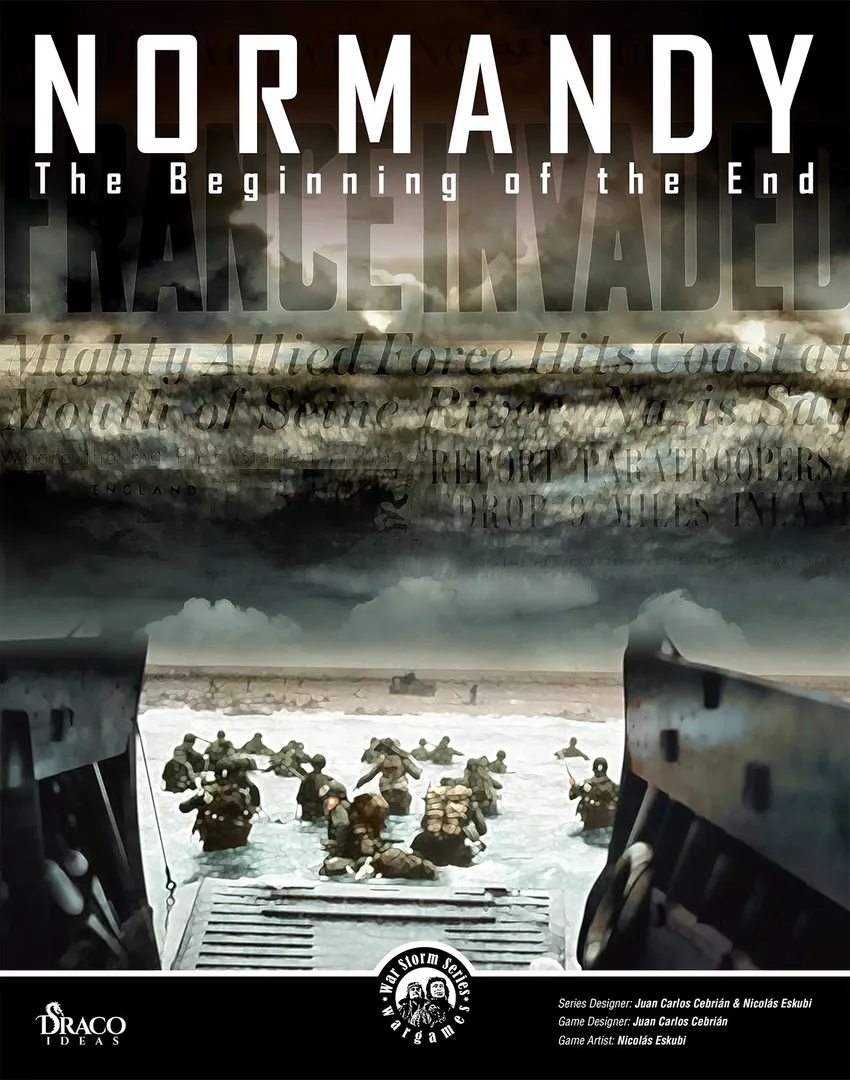
Normandy: The Beginning of the End è un gioco da tavolo pubblicato nel 2018 per 2 giocatori, con partite da 60 a 120 minuti e dai 12 anni in su. È stato ideato da Juan Carlos Cebrián e Nicolás Eskubi e le sue meccaniche principali sono Dice Rolling, Modular Board e Hexagon Grid.






In inglese
Normandy: The Beginning of the End is a standalone game in the War Storms series. Recreates the events of those days and allows the players to reproduce the most famous battles of the D-Day on the American beaches at a tactical level. Players take command of either the Allied or Axis forces (or can play solitaire) in the tactical battles of each scenario. Normandy: The Beginning of the End, while utilizing "Paths to Hell" standard rules, incorporates new and adapted rules and additions for this new front. The WSS promises many hours of fierce fighting between the infantry, tanks, artillery and aircraft belonging to the armies enveloped in this conflict. Just a few of the additions include: Landings Battalion officers Paratroopers rules Recon rules Amphibious Tanks Waffen SS Fallschirmjäger Free French troops One A4 chart with many overlays including a whole beach making a large map. Normandy: The Beginning of the End has a moderate complexity with good solitaire suitability. The system emphasizes the role of officers. Officers can activate units, coordinate with other officers and their units, call for artillery support, air support, smoke screens, influence moral checks, coordinate assaults, and much more. Rules for special actions. Based on the principle of simultaneous execution, or simply "WE GO", a hybrid system of turns and "real time". The players must activate unit officers to perform many actions (fire, assault, move, coordinate, etc). A turn ends when both players have completed all their activations. The scale is platoon level with units. Representing groups of between 30 and 40 soldiers, weapons units represents groups of 3-4 weapons and their accompanying crews (20-25 soldiers), and the AFvs-Transports representing groups of 3 to 5 vehicles and their corresponding crews. Scenarios are divided into turns representing about 12-15 minutes of action. Turns are divided into the following phases: Command Phase, Initiative Phase, Activation Phase and Marker Removal Phase The game uses isomorphic mapboards, each of which are aligned to any edge of equal length on any other mopboard. This allows for an almost unlimited number of combinations to create any terrain situation, including player designed scenarios. Each map hex represents a distance of approximately 150 to 200 metres. The following components are included in this game: • 2 3/4” countersheets with German/American and Free French vehicles (AFV and transports) and weapon units (Mortars, MG, AT, AA guns, infantry guns, artillery,…). • 2 5/8” countersheets with German/American and Free French troops and officers. • 1 5/8” countersheet with common markers. • 4 Isomorphic mapboards. • 8 Overlays. • 3 Charts & Tables cards. • 2 Battalion Battle Stress Charts • 17 scenarios. • 1 Standard rulebook. • 1 Exclusive rules booklet. • 2 Six-sided dice.
Secondo il catalogo, Normandy: The Beginning of the End supporta 2 giocatori. È il numero di giocatori indicato dall’editore, quindi il gioco è pensato esattamente per quel numero di partecipanti. Le varianti per gruppi di altre dimensioni, se esistono, sono descritte nel regolamento della tua edizione: consultalo prima di preparare una configurazione diversa.
La durata indicata per Normandy: The Beginning of the End è di 60–120 minuti, la stima dell’editore per una partita completa. La durata effettiva dipende dal gruppo, dal numero di giocatori e dalla conoscenza delle regole: le prime partite durano di più, i gruppi esperti finiscono prima. Preparazione e spiegazione delle regole non sono comprese nella stima.
Il catalogo indica Normandy: The Beginning of the End dai 12 anni in su. È la raccomandazione dell’editore e tiene conto della lettura richiesta, della complessità delle regole e dei componenti piccoli, non solo del tema. I più giovani spesso possono giocare con l’aiuto di un adulto: controlla l’età consigliata sulla tua edizione e l’esperienza del tuo gruppo con i giochi da tavolo.
Normandy: The Beginning of the End ha un punteggio di complessità di 3,9 su 5 secondo i giocatori di BoardGameGeek, il che lo rende un gioco impegnativo. Il punteggio riflette quanta conoscenza delle regole, pianificazione e decisioni richiede una partita tipica. I giochi impegnativi richiedono una prima spiegazione più lunga, quindi conviene usare una guida di preparazione.
Normandy: The Beginning of the End appartiene a queste categorie: Wargame e World War II. Le sue meccaniche principali sono Dice Rolling, Modular Board e Hexagon Grid. Le categorie descrivono il tema e l’ambientazione di un gioco, mentre le meccaniche descrivono ciò che i giocatori fanno davvero nel proprio turno. Ogni meccanica porta a una pagina del catalogo con giochi simili.
Gli autori accreditati di Normandy: The Beginning of the End sono: Juan Carlos Cebrián e Nicolás Eskubi. Questi crediti provengono dai dati pubblicati del gioco e indicano le persone responsabili della sua progettazione, non gli illustratori o gli editori. Le pagine degli autori su MeepleRules raccolgono altri titoli degli stessi autori, utili quando un gioco ti piace e ne cerchi di simili.
Il catalogo classifica Normandy: The Beginning of the End come gioco base. Si gioca da solo con i componenti presenti nella scatola e non richiede altri titoli. Le espansioni, se esistono, aggiungono nuovo contenuto o nuove regole e sono elencate separatamente nel catalogo con un collegamento a questo gioco base.