

- Posizione BGG
- BGG #3216
- Valutazione BGG
- 7,7
The Great Battles of Alexander: Deluxe Edition
- 1–4 giocatori
- 240 min
- Complessità 3,6/5
- 1995
1998
Aiuto con le regole di Phalanx: Great Battles of Alexander Module
Spiegazioni chiare di turni, effetti delle carte e situazioni dubbie, con riferimenti alle fonti ufficiali e cronologia delle domande salvata.
Cosa vuoi sapere?
Le risposte vengono dal regolamento ufficiale, con la pagina da verificare.
Phalanx: Great Battles of Alexander Module è un’espansione per gioco da tavolo pubblicata nel 1998 per 2 giocatori, con partite da 240 minuti e dai 12 anni in su. È stato ideato da Richard H. Berg e Mark Herman e le sue meccaniche principali sono Dice Rolling, Grid Movement e Hexagon Grid.






In inglese
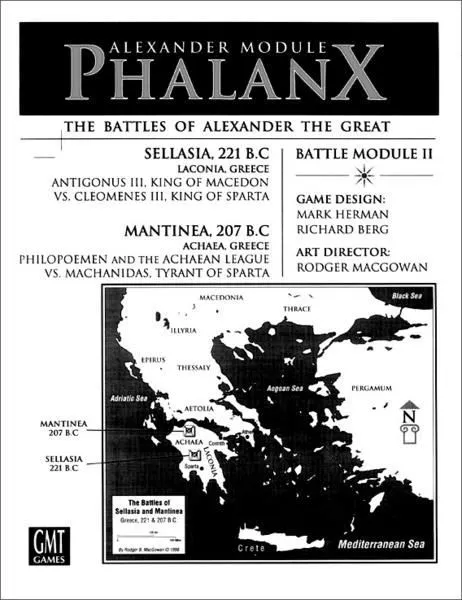
Sellasia, 221 BC Mantinea, 207 BC Phalanx covers two of the major battles in the waning days of the Successor Wars, in which the Greek city-states and leagues and the descendants of the original Diadochoi were still fighting for Hellenic supremacy, and in which the phalanx -- the massive, heavy infantry formation brought to peak efficiency by Alexander -- was still in its heyday. The armies in these battles are very Macedonian in style, with a lot of mixing of unit types and capabilities, with the exception that, because of the terrain, reliance on cavalry is almost non-existent. The phalanx itself was still the army's anchor, although it was only a generation away from its initial comeuppance at the hands of a Roman army at Cynoscephalae. To play Phalanx, you need a copy of The Great Battles of Alexander / Great Battles of Alexander, Deluxe Edition. (from GMT website)
Secondo il catalogo, Phalanx: Great Battles of Alexander Module supporta 2 giocatori. È il numero di giocatori indicato dall’editore, quindi il gioco è pensato esattamente per quel numero di partecipanti. Le varianti per gruppi di altre dimensioni, se esistono, sono descritte nel regolamento della tua edizione: consultalo prima di preparare una configurazione diversa.
La durata indicata per Phalanx: Great Battles of Alexander Module è di 240 minuti, la stima dell’editore per una partita completa. La durata effettiva dipende dal gruppo, dal numero di giocatori e dalla conoscenza delle regole: le prime partite durano di più, i gruppi esperti finiscono prima. Preparazione e spiegazione delle regole non sono comprese nella stima.
Il catalogo indica Phalanx: Great Battles of Alexander Module dai 12 anni in su. È la raccomandazione dell’editore e tiene conto della lettura richiesta, della complessità delle regole e dei componenti piccoli, non solo del tema. I più giovani spesso possono giocare con l’aiuto di un adulto: controlla l’età consigliata sulla tua edizione e l’esperienza del tuo gruppo con i giochi da tavolo.
Phalanx: Great Battles of Alexander Module ha un punteggio di complessità di 3,3 su 5 secondo i giocatori di BoardGameGeek, il che lo rende un gioco di media complessità. Il punteggio riflette quanta conoscenza delle regole, pianificazione e decisioni richiede una partita tipica. I giochi impegnativi richiedono una prima spiegazione più lunga, quindi conviene usare una guida di preparazione.
Phalanx: Great Battles of Alexander Module appartiene a queste categorie: Wargame, Ancient e Expansion for Base-game. Le sue meccaniche principali sono Dice Rolling, Grid Movement e Hexagon Grid. Le categorie descrivono il tema e l’ambientazione di un gioco, mentre le meccaniche descrivono ciò che i giocatori fanno davvero nel proprio turno. Ogni meccanica porta a una pagina del catalogo con giochi simili.
Gli autori accreditati di Phalanx: Great Battles of Alexander Module sono: Richard H. Berg e Mark Herman. Questi crediti provengono dai dati pubblicati del gioco e indicano le persone responsabili della sua progettazione, non gli illustratori o gli editori. Le pagine degli autori su MeepleRules raccolgono altri titoli degli stessi autori, utili quando un gioco ti piace e ne cerchi di simili.
Il catalogo classifica Phalanx: Great Battles of Alexander Module come espansione. Le espansioni aggiungono contenuti, regole o scenari a un gioco base esistente e di solito non si possono giocare da sole. Controlla sulla scatola o nella descrizione dell’editore quale gioco base serve e assicurati che la tua edizione di quel gioco sia compatibile con questa espansione.