

- Posizione BGG
- BGG #638
- Valutazione BGG
- 7,7
Space Empires 4X
- 1–4 giocatori
- 60–240 min
- Complessità 3,4/5
- 2011
2020
Aiuto con le regole di Stellar Horizons
Spiegazioni chiare di turni, effetti delle carte e situazioni dubbie, con riferimenti alle fonti ufficiali e cronologia delle domande salvata.
Per 1 giocatore
Cosa vuoi sapere?
Le risposte vengono dal regolamento ufficiale, con la pagina da verificare.
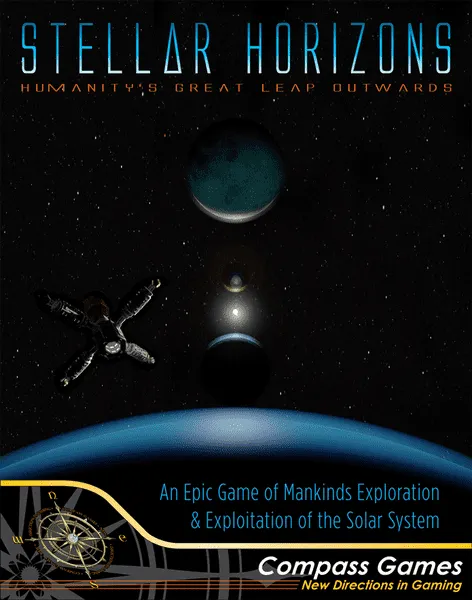
Stellar Horizons è un gioco da tavolo pubblicato nel 2020 per 1–7 giocatori, con partite da 120 a 240 minuti e dai 14 anni in su. È stato ideato da Andrew Rader e le sue meccaniche principali sono Income, Dice Rolling e Simulation.



In inglese
Stellar Horizons is a "build your own space program" game in which you lead one of seven Earth factions to explore and develop our solar system. Designed by a real-life space engineer with a PhD in long-duration spaceflight from MIT, Stellar Horizons is intended to be a plausible representation of the first steps of humanity towards the stars between 2030 and 2169, with each turn representing a year of time. You control your faction's space program, outposts, and fleets spanning across the solar system, although you also have some influence over your faction's politics back home on Earth as space development becomes more important. Movement is based on real physics. You move from orbit to orbit, or conduct long range transfers to move between planetary systems like Earth, Mars, or Jupiter. As you send out robotic explorers and crewed vehicles to explore the solar system, they bring back valuable data to further your scientific research. Technologies are intended to represent plausible extrapolations of existing development during the next 150 years: there are no transporters or warp drive, but you will be able to develop rockets powered by fusion and even anti-matter. In the engineering and biology domains, you'll eventually be able to construct space elevators and put your crews into safe hibernation for long journeys. You'll have access to a wide variety of robot explorers and crewed ships. These range from tiny probes intended to merely take photographs as you fly past Jupiter, to giant destroyers, cruisers, and battleships which ply the space lanes with peaceful or hostile intentions. New ship types become available as you gain access to better technology over the course of the game. You'll be given a budget to spend on Earth and can also build bases to harvest minerals, organics, and fuel to expands your economy. You can also forge diplomatic relationships with players and non-player factions alike, and trade resources at their bases to earn extra cash. Each of the seven factions has different strengths, weaknesses, abilities, and available ships based on their unique geopolitical situation. Military conflict is certainly possible but not always encouraged. Stellar Horizons features more diplomatic, technological, and economic competition than outright combat, although neglecting warships entirely leaves you vulnerable to pirates, trade embargoes, and sneak attacks by rogue players and factions. Stellar Horizons includes short co-operative and competitive scenarios lasting an hour or more, and campaigns lasting a day up to about a full weekend for experienced players. Up to seven players can play at a time and the game is most fun with at least two, but there are also one-player scenarios, and the campaigns are highly suited for solo play. There are three ways to win the campaign: be the first to develop an Interstellar Colonizer, terraform a world, or achieve dominance in space over your rivals.
Secondo il catalogo, Stellar Horizons supporta da 1 a 7 giocatori. L’intervallo corrisponde al numero di giocatori indicato dall’editore, quindi il gioco si può preparare per qualsiasi gruppo entro quei limiti. Preparazione, alcune regole e punteggio possono comunque variare in base al numero di giocatori: controlla la configurazione esatta nel regolamento della tua edizione.
La durata indicata per Stellar Horizons è di 120–240 minuti, la stima dell’editore per una partita completa. La durata effettiva dipende dal gruppo, dal numero di giocatori e dalla conoscenza delle regole: le prime partite durano di più, i gruppi esperti finiscono prima. Preparazione e spiegazione delle regole non sono comprese nella stima.
Il catalogo indica Stellar Horizons dai 14 anni in su. È la raccomandazione dell’editore e tiene conto della lettura richiesta, della complessità delle regole e dei componenti piccoli, non solo del tema. I più giovani spesso possono giocare con l’aiuto di un adulto: controlla l’età consigliata sulla tua edizione e l’esperienza del tuo gruppo con i giochi da tavolo.
Stellar Horizons ha un punteggio di complessità di 3,9 su 5 secondo i giocatori di BoardGameGeek, il che lo rende un gioco impegnativo. Il punteggio riflette quanta conoscenza delle regole, pianificazione e decisioni richiede una partita tipica. I giochi impegnativi richiedono una prima spiegazione più lunga, quindi conviene usare una guida di preparazione.
Stellar Horizons appartiene a queste categorie: Economic, Wargame e Exploration. Le sue meccaniche principali sono Income, Dice Rolling e Simulation. Le categorie descrivono il tema e l’ambientazione di un gioco, mentre le meccaniche descrivono ciò che i giocatori fanno davvero nel proprio turno. Ogni meccanica porta a una pagina del catalogo con giochi simili.
Gli autori accreditati di Stellar Horizons sono: Andrew Rader. Questi crediti provengono dai dati pubblicati del gioco e indicano le persone responsabili della sua progettazione, non gli illustratori o gli editori. Le pagine degli autori su MeepleRules raccolgono altri titoli degli stessi autori, utili quando un gioco ti piace e ne cerchi di simili.
Il catalogo classifica Stellar Horizons come gioco base. Si gioca da solo con i componenti presenti nella scatola e non richiede altri titoli. Le espansioni, se esistono, aggiungono nuovo contenuto o nuove regole e sono elencate separatamente nel catalogo con un collegamento a questo gioco base.