
- Posizione BGG
- BGG #8831
- Valutazione BGG
- 8,8
1985: Under an Iron Sky
- 2–6 giocatori
- 120–8640 min
- Complessità 4,2/5
- 2018
2024
Aiuto con le regole di The Fate of All
Spiegazioni chiare di turni, effetti delle carte e situazioni dubbie, con riferimenti alle fonti ufficiali e cronologia delle domande salvata.
Per 2 giocatori
Cosa vuoi sapere?
Le risposte vengono dal regolamento ufficiale, con la pagina da verificare.
The Fate of All è un gioco da tavolo pubblicato nel 2024 per 2 giocatori, con partite da 240 a 1200 minuti e dai 14 anni in su. È stato ideato da Fabrizio Vianello e le sue meccaniche principali sono Dice Rolling, Secret Unit Deployment e Hexagon Grid.







In inglese
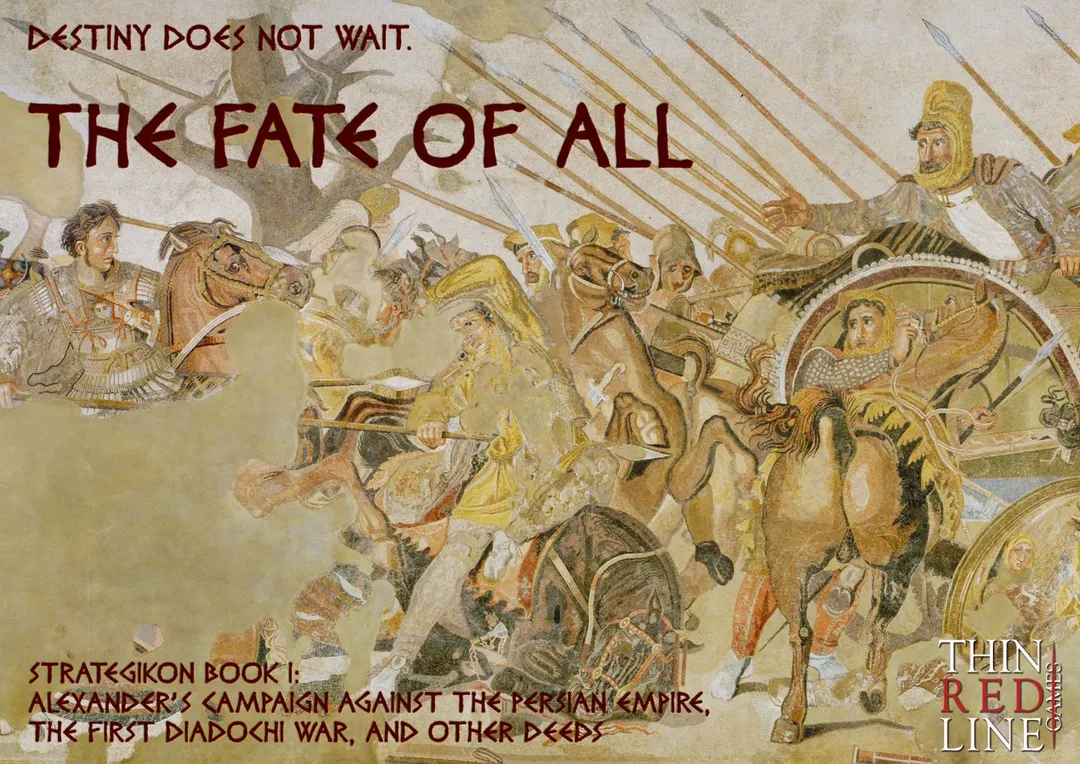
Loosely inspired on SPI’s “The Conquerors”, The Fate of All is an operational / tactical simulation covering the first four years of the campaign led by Alexander the Great against the Achaemenid Empire ruled by Darius III, and other related conflicts. The final goal is to give a realistic representation of ancient warfare, without strange salads of godly interventions, auguries and Homeric duels. In the end, players will find that the problems faced were similar to those encountered during the Napoleonic era or the American Civil War. Counters are 5/8″, each one representing a formation, from a Macedonian Phalanx Taxis (approx. 1500 soldiers) to a Cavalry Ile (200 – 300 mounted soldiers). Commanders and naval forces are also represented and will be key elements for the final victory. Rules are centred on the problems of army organisation, supply and morale: Commanders are essentials, armies must be organised in a balanced way or they will move slowly, cavalry must be used for foraging, raid and reconnaissance, morale must be kept under control using sound military achievements or donations. Political aspects are also a key element: Actions like Plundering and Sacking will have a negative impact on the local support by the ruling class and population, and both sides will have to use money or threats to gain it back. Last but not least, treason, revolts and dubious allies will be a problem too. The four maps cover Greece, part of the Balkans, Anatolia, Egypt and the Middle East up to Babylon. The scale is 30 km per hex with monthly turns. The maps are designed using the latest archaeological studies and findings, but despite centuries of research several things are still only vaguely known: Some examples are the extension and path of the Persian Royal Roads, the location of several important cities and the exact route of Alexander’s Army. In these cases, the “most accepted theory” rule has been used. Battles can be fought using Strategic Combat, still realistic but quicker, or to their full extent using the Tactical Rules and Map – probably the best choice for a decisive battle. All the classical sources and several modern military-focused studies have been used during development. In particular, The Anabasis of Alexander by Arrian was chosen as the main and most reliable classical source for two reasons: Arrian based most of his writing on the now lost Ptolemy’s account of the campaign, and he was himself a military commander, thus having a better understanding of the problems and key facts of a military campaign. Game Highlights 30 km per hex, one month per turn Units representing various formations, from Phalanx to Chariots Order of battle and commanders based on primary sources and the most recent historical research Realistic supply problems with realistic and possibly violent solutions Cavalry Reconnaissance, Foraging and Raiding Reaction Movement, not so easy retreats and catastrophic routs Attrition and Army Morale, your first problems in the morning Naval Warfare Satrapies, Taxation and Bribes Revolts, Treachery and worse Five different scenarios: The Anger of Achilles - The four decisive years of Alexander’s campaign, 334 BCE Ten Thousand, Again - Parmenion’s preparatory expedition in Anatolia, 336 BCE Arise, Hellas! - The Greek revolt following Alexander’s death, 323 BCE It All Comes to This - The final clash between Alexander and Darius, 331 BCE The Shattered Bonds - The first Diadochi war, 320 BCE Winner of the 2024 Charles Roberts Award in the Ancient category. —description from the publisher
Secondo il catalogo, The Fate of All supporta 2 giocatori. È il numero di giocatori indicato dall’editore, quindi il gioco è pensato esattamente per quel numero di partecipanti. Le varianti per gruppi di altre dimensioni, se esistono, sono descritte nel regolamento della tua edizione: consultalo prima di preparare una configurazione diversa.
La durata indicata per The Fate of All è di 240–1200 minuti, la stima dell’editore per una partita completa. La durata effettiva dipende dal gruppo, dal numero di giocatori e dalla conoscenza delle regole: le prime partite durano di più, i gruppi esperti finiscono prima. Preparazione e spiegazione delle regole non sono comprese nella stima.
Il catalogo indica The Fate of All dai 14 anni in su. È la raccomandazione dell’editore e tiene conto della lettura richiesta, della complessità delle regole e dei componenti piccoli, non solo del tema. I più giovani spesso possono giocare con l’aiuto di un adulto: controlla l’età consigliata sulla tua edizione e l’esperienza del tuo gruppo con i giochi da tavolo.
The Fate of All ha un punteggio di complessità di 3,0 su 5 secondo i giocatori di BoardGameGeek, il che lo rende un gioco di media complessità. Il punteggio riflette quanta conoscenza delle regole, pianificazione e decisioni richiede una partita tipica. I giochi impegnativi richiedono una prima spiegazione più lunga, quindi conviene usare una guida di preparazione.
The Fate of All appartiene a queste categorie: Wargame, Nautical e Ancient. Le sue meccaniche principali sono Dice Rolling, Secret Unit Deployment e Hexagon Grid. Le categorie descrivono il tema e l’ambientazione di un gioco, mentre le meccaniche descrivono ciò che i giocatori fanno davvero nel proprio turno. Ogni meccanica porta a una pagina del catalogo con giochi simili.
Gli autori accreditati di The Fate of All sono: Fabrizio Vianello. Questi crediti provengono dai dati pubblicati del gioco e indicano le persone responsabili della sua progettazione, non gli illustratori o gli editori. Le pagine degli autori su MeepleRules raccolgono altri titoli degli stessi autori, utili quando un gioco ti piace e ne cerchi di simili.
Il catalogo classifica The Fate of All come gioco base. Si gioca da solo con i componenti presenti nella scatola e non richiede altri titoli. Le espansioni, se esistono, aggiungono nuovo contenuto o nuove regole e sono elencate separatamente nel catalogo con un collegamento a questo gioco base.