
- Posizione BGG
- BGG #3403
- Valutazione BGG
- 6,8
Tao Long: La Via del Dragone
- 2 giocatori
- 10–30 min
- Complessità 2,7/5
- 2017

Aiuto con le regole di Toğızqumalaq
Spiegazioni chiare di turni, effetti delle carte e situazioni dubbie, con riferimenti alle fonti ufficiali e cronologia delle domande salvata.
Per 2 giocatori
Cosa vuoi sapere?
Le risposte vengono dal regolamento ufficiale, con la pagina da verificare.
Toğızqumalaq è un gioco da tavolo per 2 giocatori e con partite da 20 minuti. Le sue meccaniche principali sono Mancala.







In inglese
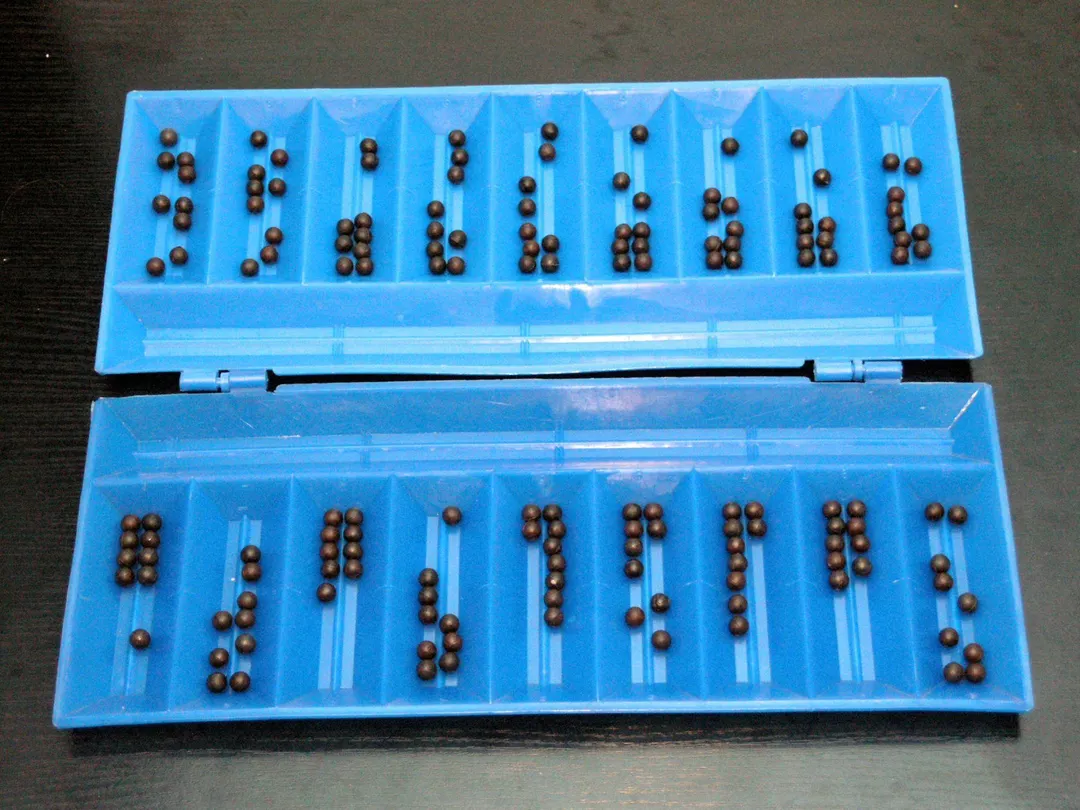
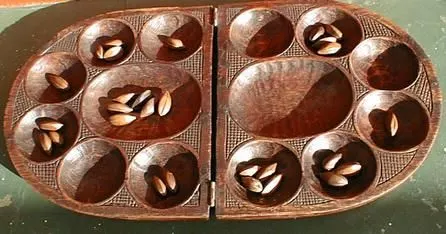
A game of the mancala family. Тоғызқұмалақ (toğızqumalaq, sometimes spelled toghyzqumalaq or togyzqumalaq or toguz kumalak, "nine balls") is the Kazakh name of a mancala game also known as toguz korgool in Kyrgyz. It is played traditionally in Kazakhstan, Kyrgyzstan, Tajikistan, Uzbekistan, Turkmenistan, parts of Russia (Altay, Khakassia, Tuva), Western Mongolia and in China in regions close to the aforementioned countries. There are regular toğızqumalaq championships held in Kazakhstan, Kyrgyzstan and Russia. The first western tournament was in August 2006 at the Mindsports Olympiad (MSO) in London, England. It was won by Aidos Seitzhanov from Kazakhstan. Rules: Toğızqumalaq is played board made of two rows of nine holes, plus two kazans ("boilers"), either in the middle of the board or one at each end of it. The players own the kazan at their right, if at the ends, or the one on the other half of their board, if in the middle. As captures are made by pairs, the holes are usually made in a way so it is evident whether the contents are odd or even. To begin the game, there must be nine balls per hole, except the kazans, which are empty. That is, 162 balls are needed. On his turn, a player takes all the balls of a hole on his side of the board, and distribute them anticlockwise, one per hole, on the following holes, starting from the very same hole he has taken them. If the movement is done from a hole containing just a single ball, it is moved to the next hole, leaving the starting hole empty. If the last ball falls into a hole on the opponent's side… …and this hole afterward contains an even number of balls, these are captured and stored on the player's kazan. …and this hole afterward contains precisely three balls, the hole becomes your тұздық, tuzdyq (or түз үй according to Maksat Shotayev, tüz üy, i.e. "sacred place" in Kazakh; or tuz in Kyrgyz which means "salt"), and it is marked as such. ** Each player can only make one tuzdyq in a game. A tuzdyq cannot be made on the opponent's last hole (ninth, the one on his right). A tuzdyq cannot be made if it is symmetrical to the opponent's one (if the opponent has his tuzdyq in our first hole, we can not make ours on his first hole). In the cases a tuzdyq cannot be done, we can finish a movement there, but the hole simply does not become a tuzdyq. A movement cannot begin from a tuzdyq. The balls that fall into a tuzdyq are captured by its owner. If it is overcharged, we can take the balls and store them in the kazan. The game ends when a player cannot move on his turn, because all the holes on his side (except a possible tuzdyq) are empty. When the game is over, the player who still has balls on his side (except in a possible tuzdyq) gets them and adds them to his kazan. Both players add the contents of their tuzdyq (the one on their opponent's side) to their kazan. The winner is the player with more balls in his kazan at the end of the game. If both players have captured 81 balls, the game is a draw.
Secondo il catalogo, Toğızqumalaq supporta 2 giocatori. È il numero di giocatori indicato dall’editore, quindi il gioco è pensato esattamente per quel numero di partecipanti. Le varianti per gruppi di altre dimensioni, se esistono, sono descritte nel regolamento della tua edizione: consultalo prima di preparare una configurazione diversa.
La durata indicata per Toğızqumalaq è di 20 minuti, la stima dell’editore per una partita completa. La durata effettiva dipende dal gruppo, dal numero di giocatori e dalla conoscenza delle regole: le prime partite durano di più, i gruppi esperti finiscono prima. Preparazione e spiegazione delle regole non sono comprese nella stima.
Toğızqumalaq ha un punteggio di complessità di 3,8 su 5 secondo i giocatori di BoardGameGeek, il che lo rende un gioco impegnativo. Il punteggio riflette quanta conoscenza delle regole, pianificazione e decisioni richiede una partita tipica. I giochi impegnativi richiedono una prima spiegazione più lunga, quindi conviene usare una guida di preparazione.
Toğızqumalaq appartiene a queste categorie: Abstract Strategy. Le sue meccaniche principali sono Mancala. Le categorie descrivono il tema e l’ambientazione di un gioco, mentre le meccaniche descrivono ciò che i giocatori fanno davvero nel proprio turno. Ogni meccanica porta a una pagina del catalogo con giochi simili.
Il catalogo classifica Toğızqumalaq come gioco base. Si gioca da solo con i componenti presenti nella scatola e non richiede altri titoli. Le espansioni, se esistono, aggiungono nuovo contenuto o nuove regole e sono elencate separatamente nel catalogo con un collegamento a questo gioco base.