

- Posizione BGG
- BGG #7195
- Valutazione BGG
- 6,8
Cobra: Game of the Normandy Breakout
- 2 giocatori
- 120–480 min
- Complessità 2,8/5
- 1977
1993
Aiuto con le regole di Victory in the West: Plan Yellow, The French Campaign 1940
Spiegazioni chiare di turni, effetti delle carte e situazioni dubbie, con riferimenti alle fonti ufficiali e cronologia delle domande salvata.
Per 2 giocatori
Cosa vuoi sapere?
Le risposte vengono dal regolamento ufficiale, con la pagina da verificare.
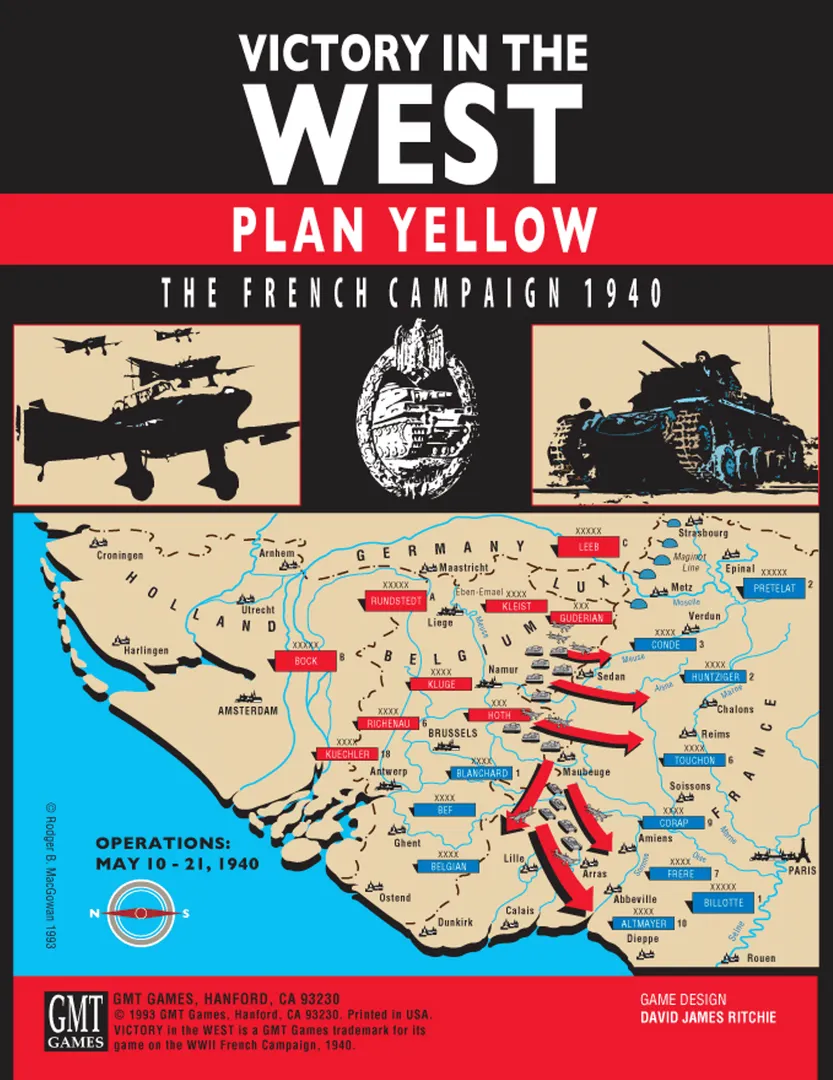
Victory in the West: Plan Yellow, The French Campaign 1940 è un gioco da tavolo pubblicato nel 1993 per 2 giocatori, con partite da 360 minuti e dai 14 anni in su. È stato ideato da David James Ritchie e le sue meccaniche principali sono Dice Rolling, Variable Set-up e Hexagon Grid.






In inglese
Victory in the West: Plan Yellow, The French Campaign 1940, is a realistic two-player game that accurately recreates the 1940 campaign in all its aspects except one: the outcome is totally up to you. The game's centerpiece is an options system that lets the Allied player trade Victory Points for changes to his armies and policies that might (or might not) have changed history. Can you, as the Allied commander, repel the Germans with the forces on hand in 1940? How about if you train them better? Or give them a better command structure? Or provide them with more and better anti-aircraft an anti-tank guns? What do you think is the key to victory in the west? Can you, as the German commander, still beat the Allies if the French Army is motorized like the BEF? And how does your strategy change if the French don't build their Maginot Line, but do build a bigger and better air force? Do you still try to sneak through the Ardennes forest with your Panzers? Or do you ignore Allied bombers and wheel across the open plains of northern Belgium in a repeat of the 1914 Schlieffen Plan? Or do you do the unexpected and land a left hook through the Alsace? Your commanders await your orders. The future of Europe is in your hands. 10 May, 1940 ... The German Wehrmacht opened its long-awaited campaign in the West by smashing across the frontiers of Belgium and Holland. For the German High Command, it was seen as a daring move. Hitler's fledgling legions faced the combined armies of France, Britain, Belgium and the Netherlands. These Allied forces had more and better weapons of almost every type, and at least two of the opposing armies, those of France and Britain, were considered to be the best in the world. The Germans had the element of surprise and the new Blitzkrieg tactics of mobile warfare. Six weeks later, it was all over. The British Expeditionary Force (BEF) had been driven from the continent and the French, Belgians, and Dutch had all capitulated. Hitler had achieved a victory in the west, and the world would never be the same. But, what if? It didn't have to happen that way ... Bad generalship and correctable flaws in their armies hastened the Allied defeat. What if the High Command had bothered to stay in radio contact with its armies on the frontier? And had then reacted promptly to the developing situation? What if the Maginot Line had been extended to cover the Meuse crossings at Sedan where Guderian's Panzers broke into the Allied rear? What if the BEF had included a strong British mobile corps that could have fought Rommel's Panzers on even terms at Arras? What if the French had prepared to meet the Blitzkrieg by building eight tank divisions instead of three? Or by mechanizing their cavalry the way the Germans did after the Polish campaign? Or even by developing their own blitzkrieg doctrine? The Allies could have taken any or all of these actions, and any of them would have altered the campaign's course. But which ones would have changed the outcome? Game Scale: Game Turn: 2 days Hex: 6.8 miles / 11 kilometer Units: Battalion to Army Game Inventory: One 22 x 34" full color mapsheet One 17 x 22" full color mapsheet Three dual-side printed countersheets (720 1/2" counters) One 32-page Victory in the West rulebook One 8-page Victory in the West Example of Play booklet One 4-page Victory in the West Design Notes booklet Five dual-side printed Player Aid Cards One 10-sided dice Solitaire Playability: High Complexity Level: Medium Players: 2 or more Playing Time: 2-20 hours DESIGNER: David James Ritchie DEVELOPER: Kevin Boylan and Gene Billingsley ART DIRECTOR: Rodger B. MacGowan MAP ART: Mark Simonitch
Secondo il catalogo, Victory in the West: Plan Yellow, The French Campaign 1940 supporta 2 giocatori. È il numero di giocatori indicato dall’editore, quindi il gioco è pensato esattamente per quel numero di partecipanti. Le varianti per gruppi di altre dimensioni, se esistono, sono descritte nel regolamento della tua edizione: consultalo prima di preparare una configurazione diversa.
La durata indicata per Victory in the West: Plan Yellow, The French Campaign 1940 è di 360 minuti, la stima dell’editore per una partita completa. La durata effettiva dipende dal gruppo, dal numero di giocatori e dalla conoscenza delle regole: le prime partite durano di più, i gruppi esperti finiscono prima. Preparazione e spiegazione delle regole non sono comprese nella stima.
Il catalogo indica Victory in the West: Plan Yellow, The French Campaign 1940 dai 14 anni in su. È la raccomandazione dell’editore e tiene conto della lettura richiesta, della complessità delle regole e dei componenti piccoli, non solo del tema. I più giovani spesso possono giocare con l’aiuto di un adulto: controlla l’età consigliata sulla tua edizione e l’esperienza del tuo gruppo con i giochi da tavolo.
Victory in the West: Plan Yellow, The French Campaign 1940 ha un punteggio di complessità di 3,4 su 5 secondo i giocatori di BoardGameGeek, il che lo rende un gioco di media complessità. Il punteggio riflette quanta conoscenza delle regole, pianificazione e decisioni richiede una partita tipica. I giochi impegnativi richiedono una prima spiegazione più lunga, quindi conviene usare una guida di preparazione.
Victory in the West: Plan Yellow, The French Campaign 1940 appartiene a queste categorie: Wargame e World War II. Le sue meccaniche principali sono Dice Rolling, Variable Set-up e Hexagon Grid. Le categorie descrivono il tema e l’ambientazione di un gioco, mentre le meccaniche descrivono ciò che i giocatori fanno davvero nel proprio turno. Ogni meccanica porta a una pagina del catalogo con giochi simili.
Gli autori accreditati di Victory in the West: Plan Yellow, The French Campaign 1940 sono: David James Ritchie. Questi crediti provengono dai dati pubblicati del gioco e indicano le persone responsabili della sua progettazione, non gli illustratori o gli editori. Le pagine degli autori su MeepleRules raccolgono altri titoli degli stessi autori, utili quando un gioco ti piace e ne cerchi di simili.
Il catalogo classifica Victory in the West: Plan Yellow, The French Campaign 1940 come gioco base. Si gioca da solo con i componenti presenti nella scatola e non richiede altri titoli. Le espansioni, se esistono, aggiungono nuovo contenuto o nuove regole e sono elencate separatamente nel catalogo con un collegamento a questo gioco base.