
- Pozycja w BGG
- BGG #11 590
- Ocena BGG
- 7,1
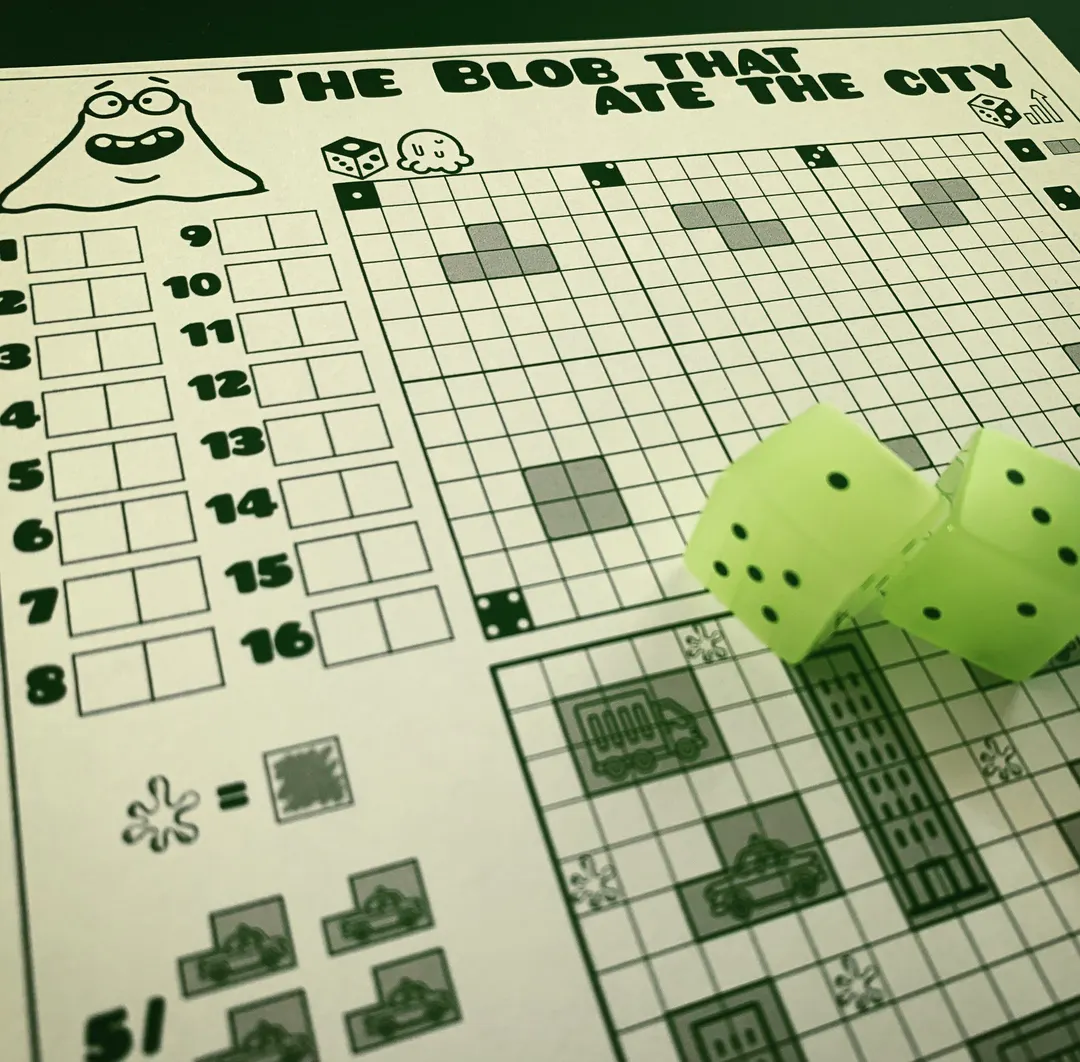
The Blob that Ate the City
- 1–99 graczy
- 20–30 min
- Złożoność 1,3/5
- 2022
2020
Pomoc w zasadach gry Abstract
Zrozumiałe wyjaśnienia tur, efektów kart i spornych sytuacji z odnośnikami do oficjalnych źródeł i zapisaną historią pytań.
Dla 1 gracza
Co chcesz wiedzieć?
Odpowiedzi pochodzą z oficjalnej instrukcji, ze stroną do sprawdzenia.
Abstract to gra planszowa wydana w 2020 roku dla 1–100 graczy, z rozgrywką trwającą 15–20 minut i dla osób od 8 lat. Projekt gry: Joe Hout. Główne mechaniki: Dice Rolling i Paper-and-Pencil.




Po angielsku
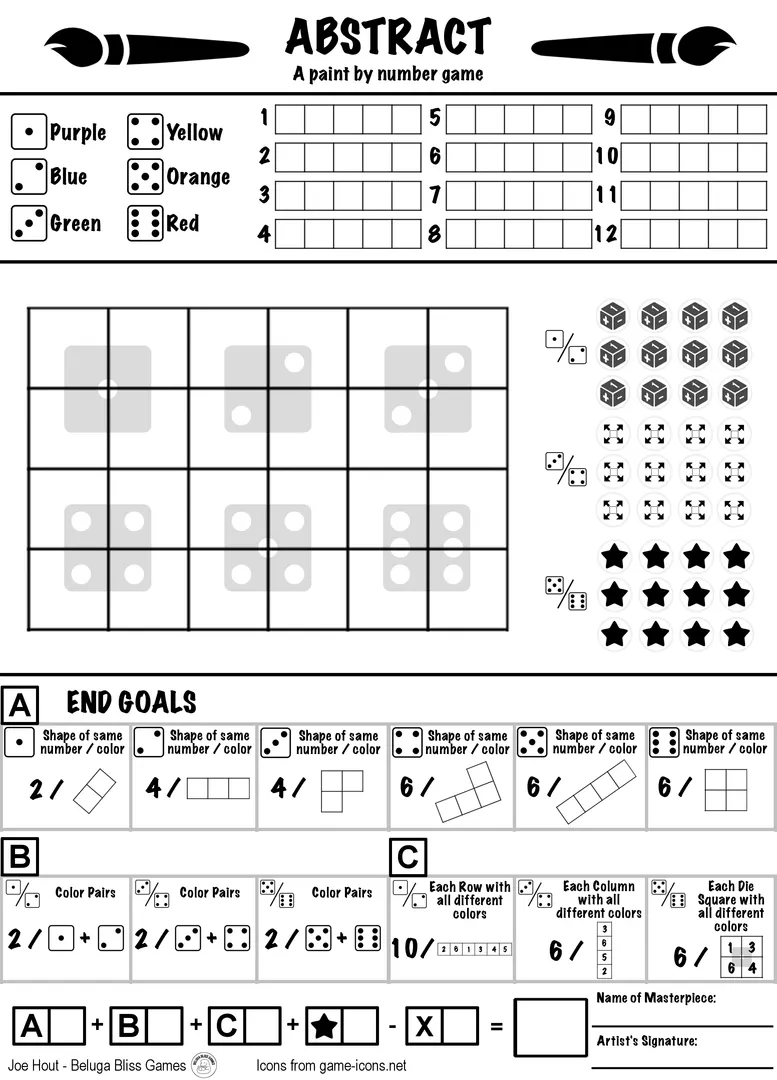
Abstract - a paint by number game Overview: You are a talented artist who specializes in abstract art. Paint/Roll your way to the next masterpiece! Players: 1 - 100+ Game Time: 20 minutes Items needed: 5 six-sided dice Optional - Markers/Crayons/Pencils of the 6 colors to make your work of art beautiful (Purple, Blue, Green, Yellow, Orange, and Red) Setup: Determine the End Goals for this game. Roll a die for each of the three end goals (A, B, C). These three goals are how to earn points from your painting, the other goals that were not rolled are ignored for this game. The game is played over 12 rounds, with players playing simultaneously, trying to earn the most points. All players will use the same dice pool for each roll, assigning however each player determines. Gameplay: Each Round you will Roll 5 dice and then use the dice to mark two numbers on your painting and also gain a bonus. From the 5 dice, two of those dice will be used to place a number on your painting, then another two dice will be used to place another number on your painting, and the 5th die will be used to gain the corresponding bonus. These markings can be done in any order. - Roll 5 dice - Roll the 5 dice. Write the numbers in the top right corner on the current round’s track. This is just used as a helpful reference. - Use dice for painting two numbers and gaining a bonus In any order, do these three actions without using the same die more than once: Paint a number in a square - use two dice, one for the placement location and the other for the number/paint color used. Example: You choose a die with a 1 and a die with a 3. You use the 1 for the placement location, so the number placed will need to be in one of the unused squares in the “1” grid. You choose the 3 as the number/paint color used in that square. You write a 3 in one of the open squares in the 1 grid. If you there are no available squares in a die’s location, you may not choose that. Paint a number in a square - Do this again, same as above. You must use dice that have not been used. Gain a Bonus - use a die to gain one of the three bonuses. Use a 1 or 2 to gain a “+/- 1” to use now or later, use a 3 or 4 to gain a “place anywhere” to use now or later, and use a 5 or 6 to gain a Star. Each star is worth 1 point at the end of the game and gives no other bonus. Reminder: you can do these three actions in any order. There are times when gaining the bonus first allows you to paint a more helpful square for your painting. Repeat this each round (rolling 5 dice and using those 5 dice) until 12 rounds have been completed. Important Note: If you ever cannot place one of your numbers on your painting, mark an X anywhere you choose in a square on your painting. Each X’ed space on your painting is negative 1 point at the end of the game. Using your Bonuses: You may use your bonuses at any time during the game. When you gain a bonus, circle it. When used, cross it off to show it has been used. You may spend multiple bonuses in the same round. As your painting fills up, it becomes more difficult to place your numbers. It can be especially helpful to save some bonuses to use in the last rounds of the game. Using +/- 1 Dice Bonus: When used, you may increase or decrease one of the dice numerically by one. This can be used to change a die to help with placing the die, the number/color of the die, or for gaining a bonus. Using Place Anywhere Bonus: When used, you may use one of your dice to place the number of another die anywhere. Example: You have a 1 and a 3 for placement and number/color. All of your squares are filled in your “1 grid” and your “3 grid”. You spend a Place Anywhere bonus to change your 1 die to a Place Anywhere. You then choose to place the number/color 3 in the 5 grid, where it is advantageous for your end goals and where there is also an available square. Star Bonus: Each star is worth 1 point at the end of the game and gives no other bonus. You’re a star! Each End Goal Explained: End Goal A: Earn points for matching shapes of the same number/color. The orientation of the shape can be mirrored and/or flipped in any way, as long as it is the same shape. You cannot use the same number twice for shapes. You can use these numbers for B and C end goals End Goal B: Earn points for each pair of these numbers anywhere on your painting. These two numbers do not need to be connected. Example: You have placed three 1’s and five 2’s in your painting. You have three pairs (set of 1&2, 1&2, and 1&2), so you earn 6 points; 2 per pair. End Goal C: This goal is looking at unique numbers in either rows, columns, or grids. If you fulfill this goal in multiple rows/columns/grids, you score each time it is fulfilled. End of Game: After you have completed the 12th roll/round, total your points earned from each End Goal, one point for each Star bonus, and subtract one point for each X on your painting (unpainted squares). The player with the most points is the winner! Look at your amazing masterpiece and name it and autograph it. For those who want to take it to the next level: When marking numbers, you can use coordinating colors (color key in top left of page). After finishing, you can fill in the boxes completely with the corresponding colors to beautify your work of art. -description from designer
Według katalogu Abstract obsługuje od 1 do 100 graczy. Ten zakres odpowiada liczbie graczy podanej przez wydawcę, więc grę można przygotować dla dowolnej grupy w jego granicach. Przygotowanie, niektóre zasady i punktacja mogą jednak różnić się w zależności od liczby graczy; dokładną konfigurację sprawdź w instrukcji swojego wydania.
Podany czas rozgrywki w Abstract wynosi 15–20 minut. To szacunek wydawcy dla pełnej partii. Rzeczywisty czas zależy od grupy, liczby graczy i znajomości zasad: pierwsze partie zwykle trwają dłużej, a doświadczone grupy kończą szybciej. Przygotowanie gry i tłumaczenie zasad nie są wliczone w ten szacunek.
Katalog podaje dla Abstract wiek od 8 lat. To zalecenie wydawcy, które uwzględnia wymagania dotyczące czytania, złożoność zasad i drobne elementy, a nie tylko tematykę. Młodsi gracze często mogą dołączyć z pomocą dorosłego; sprawdź zalecenie wiekowe swojego wydania i weź pod uwagę doświadczenie grupy z grami planszowymi.
Abstract ma ocenę złożoności 2,0 na 5 według graczy BoardGameGeek, co czyni ją grą raczej lekką. Ocena pokazuje, ile znajomości zasad, planowania i podejmowania decyzji wymaga typowa rozgrywka. Cięższe gry wymagają dłuższego pierwszego tłumaczenia, dlatego przed wieczorem z grami warto skorzystać z przewodnika przygotowania.
Abstract należy do tych kategorii: Print & Play i Dice. Główne mechaniki to Dice Rolling i Paper-and-Pencil. Kategorie opisują temat i świat gry, a mechaniki to, co gracze faktycznie robią w swojej turze. Każda mechanika prowadzi do strony katalogu z podobnymi grami, co pomaga znaleźć coś porównywalnego na kolejny wieczór.
Autorzy wymienieni przy Abstract to: Joe Hout. Te informacje pochodzą z opublikowanych danych gry i wskazują osoby odpowiedzialne za jej projekt, a nie ilustratorów czy wydawców. Strony autorów w MeepleRules zbierają inne tytuły tych samych twórców, co pomaga, gdy gra ci się podoba i szukasz podobnych.
W katalogu Abstract figuruje jako gra podstawowa. Można w nią grać samodzielnie, korzystając z elementów z pudełka, bez żadnego innego tytułu. Dodatki, jeśli istnieją, dokładają nową zawartość lub zasady i są wymienione w katalogu osobno, z odnośnikiem do tej gry podstawowej.