- Ocena BGG
- 8,2
Blocks in the East: Card Deck
- 1–4 graczy
- 200 min
- Złożoność 3,0/5
- 2013
2012
Pomoc w zasadach gry Blocks in the East
Zrozumiałe wyjaśnienia tur, efektów kart i spornych sytuacji z odnośnikami do oficjalnych źródeł i zapisaną historią pytań.
Dla 1 gracza
Co chcesz wiedzieć?
Odpowiedzi pochodzą z oficjalnej instrukcji, ze stroną do sprawdzenia.
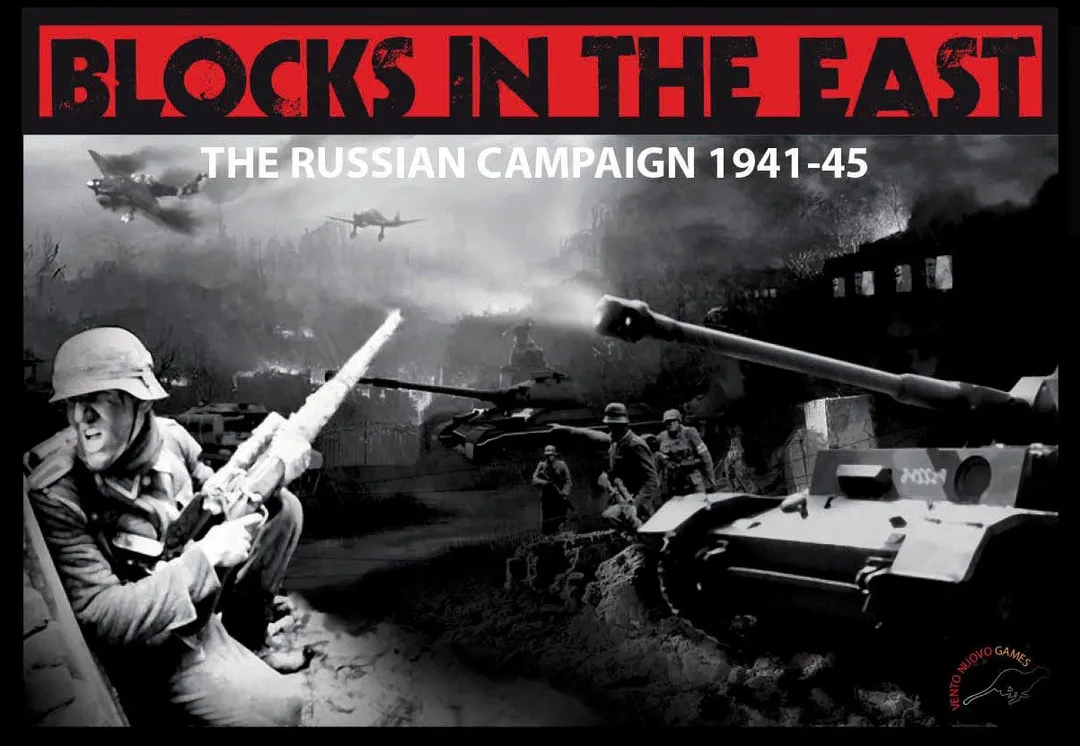
Blocks in the East to gra planszowa wydana w 2012 roku dla 1–4 graczy, z rozgrywką trwającą 120 minut i dla osób od 14 lat. Projekt gry: Emanuele Santandrea. Główne mechaniki: Dice Rolling, Grid Movement i Hexagon Grid.











Po angielsku
On 22 June 1941, under the codeword "Dortmund", the German Wehrmacht and other Axis powers started the invasion of the Soviet Union. Over 150 divisions – ca. 3,6 million troops – of the Axis invaded the USSR along a front of 2,900 km. In addition to troops, Barbarossa involved 600,000 motor vehicles, 750,000 horses, 3350 tanks, 7300 guns, and nearly 2000 planes – the largest invasion in the history of warfare. BLOCKS IN THE EAST is a game of World War II conflict simulation at the strategic level. It recalls the most decisive battles fought on the Eastern Front from the beginning of the invasion in summer 1941 until the dramatic end in Berlin in spring 1945. Although based on historical events and battles, the players in command of the two factions can modify the evolution of World War II. The game is recommended for two or four players: one/two control the Soviet Red Army and the other one/two control Germany and the other Axis powers. In a threesome, one player controls one faction while the other two players control the other faction. The game is furthermore suitable for solitary play: the single player just controls both sides. In this case, a play with Fog of War is suggested. Developed with a system of wooden blocks and cubes and played out over an astonishing 125x87 cm (49"x34") full laminated multicolor mapboard, the only paper component in the box is the rules manual. In total, more than 600 wooden/plastic components have been created by the best Italian artisinal industry and painted "A buratto", a technique usually adopted for painting car parts and accessories. The rules are divided into three major sections which can be learned one at a time: • The Basic Game Rules introduce the basic concepts of BITE and enable players to start playing the game without too many rules to remember. • The Advanced Game Rules provide more specific and detailed rules for enhanced realism, such as the use of Fuel and the Advanced Production System. • The Optional Rules are for those who want to get the most out of the game, with rules for Technology Research, Strategic Warfare with the bombing of Germany and U-boat campaigns in the oceans, Amphibious Landings, Airborne Assaults, and more. In BLOCKS IN THE EAST, a hexagon is approximately 53 miles (70 km) across, a turn is 1 month long, and a full-strength counter represents a major military formation (normally corps size) with 300 planes, 300 tanks, or 30,000 men, depending on the unit type, equipment, nationality, etc. The game can be played with "Fog of War" on (with the faces of wooden blocks hidden from the opponent) or off (all units are visible). Players can compete in the full 1941 Codeword Dortmund Campaign, in one of four six-turn scenarios ("Operation Barbarossa 1941", "Case Blue - The Drive to Baku 1942", "Operation Citadel - The Battle of Kursk 1943" and "Bagration Offensive in Summer 1944"), or one of the shorter, easy-to-learn scenarios ("Road to Rostov", which lasts six turns, or any of these scenarios: "Road to Leningrad", "Road to Moscow" or "Short Barbarossa"). Each scenario has different victory conditions and length, with a playing time from 1 to 49 turns. BLOCKS IN THE EAST can be played standalone or combined with Blocks in the West and Blocks in Afrika.
Według katalogu Blocks in the East obsługuje od 1 do 4 graczy. Ten zakres odpowiada liczbie graczy podanej przez wydawcę, więc grę można przygotować dla dowolnej grupy w jego granicach. Przygotowanie, niektóre zasady i punktacja mogą jednak różnić się w zależności od liczby graczy; dokładną konfigurację sprawdź w instrukcji swojego wydania.
Podany czas rozgrywki w Blocks in the East wynosi 120 minut. To szacunek wydawcy dla pełnej partii. Rzeczywisty czas zależy od grupy, liczby graczy i znajomości zasad: pierwsze partie zwykle trwają dłużej, a doświadczone grupy kończą szybciej. Przygotowanie gry i tłumaczenie zasad nie są wliczone w ten szacunek.
Katalog podaje dla Blocks in the East wiek od 14 lat. To zalecenie wydawcy, które uwzględnia wymagania dotyczące czytania, złożoność zasad i drobne elementy, a nie tylko tematykę. Młodsi gracze często mogą dołączyć z pomocą dorosłego; sprawdź zalecenie wiekowe swojego wydania i weź pod uwagę doświadczenie grupy z grami planszowymi.
Blocks in the East ma ocenę złożoności 3,7 na 5 według graczy BoardGameGeek, co czyni ją grą średnio złożoną. Ocena pokazuje, ile znajomości zasad, planowania i podejmowania decyzji wymaga typowa rozgrywka. Cięższe gry wymagają dłuższego pierwszego tłumaczenia, dlatego przed wieczorem z grami warto skorzystać z przewodnika przygotowania.
Blocks in the East należy do tych kategorii: Wargame i World War II. Główne mechaniki to Dice Rolling, Grid Movement i Hexagon Grid. Kategorie opisują temat i świat gry, a mechaniki to, co gracze faktycznie robią w swojej turze. Każda mechanika prowadzi do strony katalogu z podobnymi grami, co pomaga znaleźć coś porównywalnego na kolejny wieczór.
Autorzy wymienieni przy Blocks in the East to: Emanuele Santandrea. Te informacje pochodzą z opublikowanych danych gry i wskazują osoby odpowiedzialne za jej projekt, a nie ilustratorów czy wydawców. Strony autorów w MeepleRules zbierają inne tytuły tych samych twórców, co pomaga, gdy gra ci się podoba i szukasz podobnych.
W katalogu Blocks in the East figuruje jako gra podstawowa. Można w nią grać samodzielnie, korzystając z elementów z pudełka, bez żadnego innego tytułu. Dodatki, jeśli istnieją, dokładają nową zawartość lub zasady i są wymienione w katalogu osobno, z odnośnikiem do tej gry podstawowej.