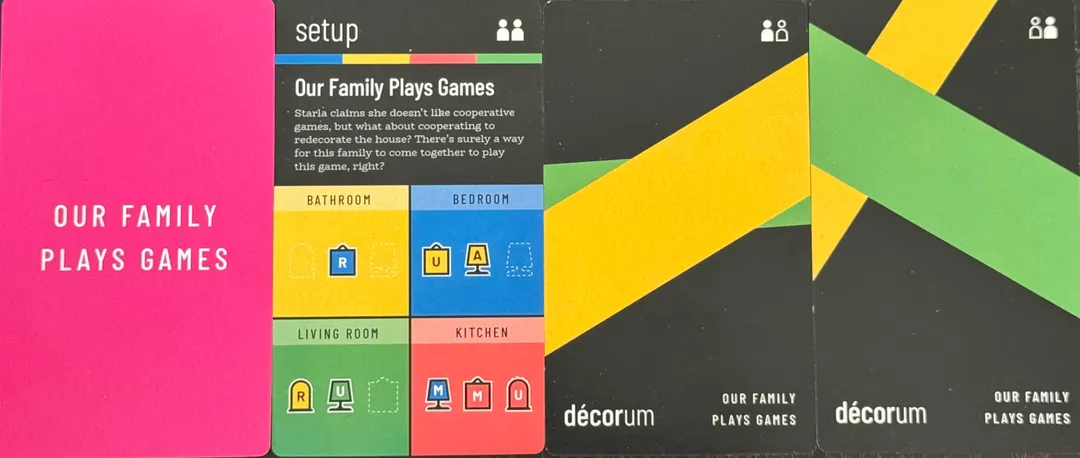
Décorum: Our Family Plays Games Scenario
- 2–4 graczy
- 2023
2022
Pomoc w zasadach gry Décorum
Zrozumiałe wyjaśnienia tur, efektów kart i spornych sytuacji z odnośnikami do oficjalnych źródeł i zapisaną historią pytań.
Dla 2 graczy
Co chcesz wiedzieć?
Odpowiedzi pochodzą z oficjalnej instrukcji, ze stroną do sprawdzenia.
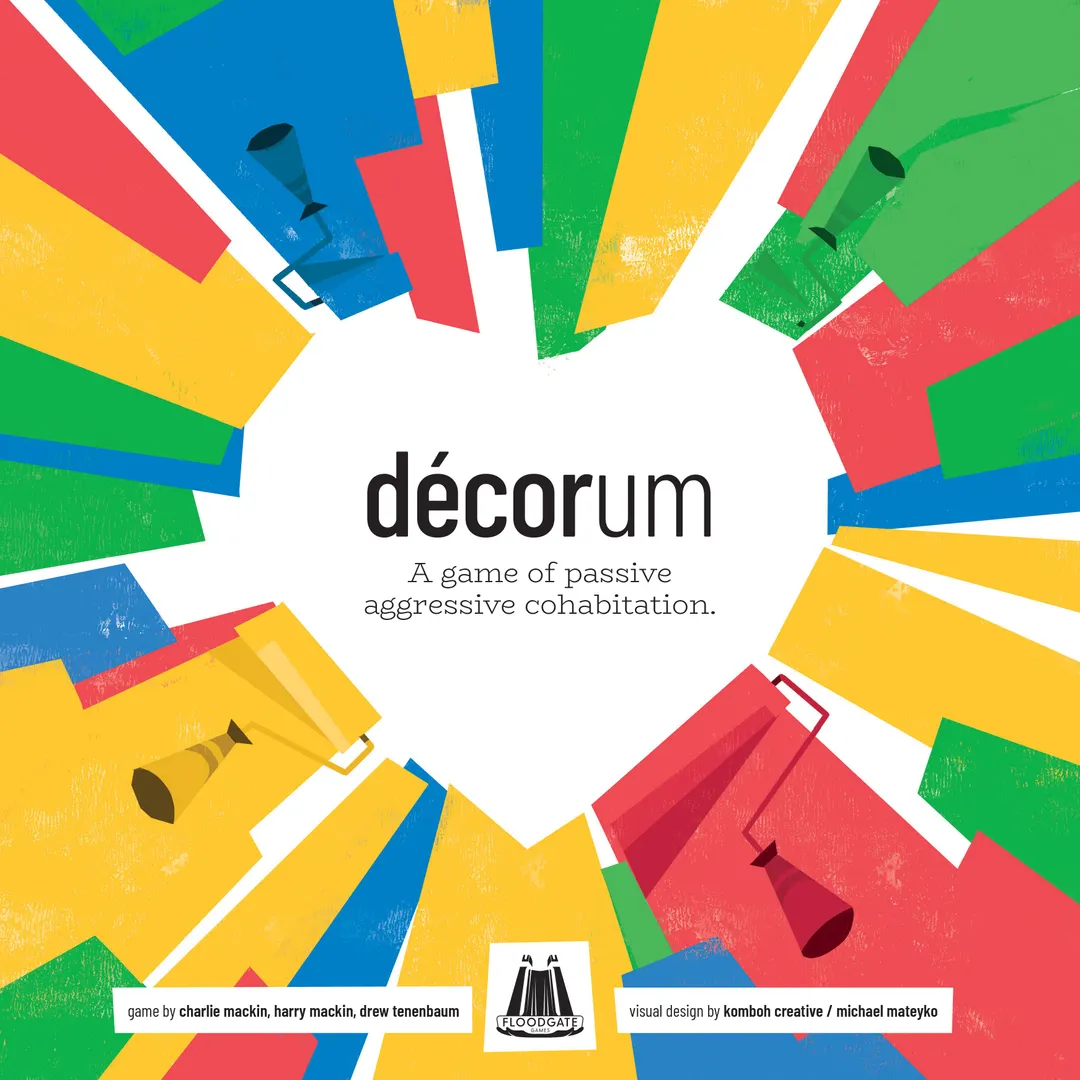
Décorum to gra planszowa wydana w 2022 roku dla 2–4 graczy, z rozgrywką trwającą 30–45 minut i dla osób od 13 lat. Projekt gry: Charlie Mackin, Harry Mackin i Drew Tenenbaum. Główne mechaniki: Deduction, Cooperative Game i Communication Limits.






Po angielsku
Decorum is a cooperative, hidden information game where you and your partner share the same objective: decorate your home in a way that makes you both happy. The problem is, different things make each of you happy and nobody says exactly what they need. Can you find a happy compromise, or is it time to move out?! -Play through 30 unique scenarios, each introducing new twists and challenges. -Keep your conditions a secret, they say how you want the house decorated. -Add, remove, and swap objects or repaint rooms to make the house look just right… for you. -Respond with “Love it”, “Hate it”, or “Fine with it” to work together toward a perfectly decorated home. -There is a solution for each scenario, the trick is figuring it out in time. At its heart, Décorum is a pretty straightforward logic puzzle. There are a small number of ways to arrange the internal pieces that meet all the requirements listed on the player’s rule sheets simultaneously. The twist of Décorum is that it’s also a hidden information game. No player has all of the rules. While playing, the players will have to watch their partner’s moves just as carefully as they’re planning their own. Even more crucially, they’ll have to communicate why they’re making the moves they’re making–using the very limited means we’ve provided them. Décorum might be about solving a puzzle, but it’s really a game about communication and compromise. The real challenge isn’t just solving the problem with the limited information you and your players have; it’s dealing with the frustrations that will inevitably occur when your partner does something that messes up your plan. In order to be successful in Décorum, there will come a point where both players will have to let go of their initial strategy for how they were going to finish the board and start paying attention to what their partner is doing instead. By introducing and providing an incentive to resolve conflict, Décorum mechanically encourages (or even requires) a positive form of compromise. Each player draws a "Scenario" card that lists a set of criteria of what types of décor a room must have or cannot have. For example "No room may contain a lamp" or "Every room must contain a wall hanging". Players keep their criteria secret. The play surface is a board displaying various rooms in a house. Each room has multiple items that can potentially be placed in the room. Players take turns placing, moving, or removing colored tokens on the board, where each token represents an item of home décor. Each token placed may conform with, or violate, the other players' criteria. After each token is placed, other players may state they like the item of décor, as placed, or they do not like the item of décor, as placed. Further discussion or explanation is not allowed. The game ends when all players' criteria are satisfied.
Według katalogu Décorum obsługuje od 2 do 4 graczy. Ten zakres odpowiada liczbie graczy podanej przez wydawcę, więc grę można przygotować dla dowolnej grupy w jego granicach. Przygotowanie, niektóre zasady i punktacja mogą jednak różnić się w zależności od liczby graczy; dokładną konfigurację sprawdź w instrukcji swojego wydania.
Podany czas rozgrywki w Décorum wynosi 30–45 minut. To szacunek wydawcy dla pełnej partii. Rzeczywisty czas zależy od grupy, liczby graczy i znajomości zasad: pierwsze partie zwykle trwają dłużej, a doświadczone grupy kończą szybciej. Przygotowanie gry i tłumaczenie zasad nie są wliczone w ten szacunek.
Katalog podaje dla Décorum wiek od 13 lat. To zalecenie wydawcy, które uwzględnia wymagania dotyczące czytania, złożoność zasad i drobne elementy, a nie tylko tematykę. Młodsi gracze często mogą dołączyć z pomocą dorosłego; sprawdź zalecenie wiekowe swojego wydania i weź pod uwagę doświadczenie grupy z grami planszowymi.
Décorum ma ocenę złożoności 2,0 na 5 według graczy BoardGameGeek, co czyni ją grą raczej lekką. Ocena pokazuje, ile znajomości zasad, planowania i podejmowania decyzji wymaga typowa rozgrywka. Cięższe gry wymagają dłuższego pierwszego tłumaczenia, dlatego przed wieczorem z grami warto skorzystać z przewodnika przygotowania.
Décorum należy do tych kategorii: Puzzle. Główne mechaniki to Deduction, Cooperative Game i Communication Limits. Kategorie opisują temat i świat gry, a mechaniki to, co gracze faktycznie robią w swojej turze. Każda mechanika prowadzi do strony katalogu z podobnymi grami, co pomaga znaleźć coś porównywalnego na kolejny wieczór.
Autorzy wymienieni przy Décorum to: Charlie Mackin, Harry Mackin i Drew Tenenbaum. Te informacje pochodzą z opublikowanych danych gry i wskazują osoby odpowiedzialne za jej projekt, a nie ilustratorów czy wydawców. Strony autorów w MeepleRules zbierają inne tytuły tych samych twórców, co pomaga, gdy gra ci się podoba i szukasz podobnych.
W katalogu Décorum figuruje jako gra podstawowa. Można w nią grać samodzielnie, korzystając z elementów z pudełka, bez żadnego innego tytułu. Dodatki, jeśli istnieją, dokładają nową zawartość lub zasady i są wymienione w katalogu osobno, z odnośnikiem do tej gry podstawowej.