
- Ocena BGG
- 7,9
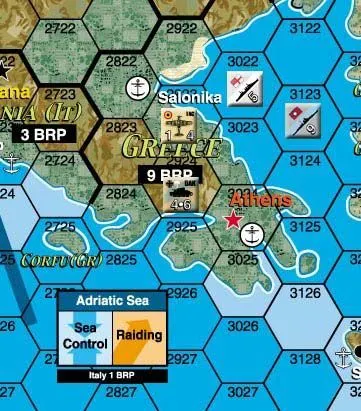
John Prados' Third Reich: Deluxe Map
- Złożoność 3,0/5
- 2004
2001
Pomoc w zasadach gry John Prados' Third Reich
Zrozumiałe wyjaśnienia tur, efektów kart i spornych sytuacji z odnośnikami do oficjalnych źródeł i zapisaną historią pytań.
Dla 2 graczy
Co chcesz wiedzieć?
Odpowiedzi pochodzą z oficjalnej instrukcji, ze stroną do sprawdzenia.
John Prados' Third Reich to gra planszowa wydana w 2001 roku dla 2–5 graczy, z rozgrywką trwającą 360 minut i dla osób od 12 lat. Projekt gry: John Prados i Brian L. Knipple. Główne mechaniki: Dice Rolling, Hexagon Grid i Simulation.






Po angielsku
(from Avalanche Press website:) Third Reich interweaves not only the land, naval and air struggles, but also the equally important economic and political battles. Players must guide their nation to victory by capturing key objectives while making sure no one else — in particular their allies — gets there first. Players take on the leadership of Britain, France, Italy, Germany, the United States or the Soviet Union. Each of these major powers, in turn, can influence smaller countires like Turkey, Greece or Romania to join the war on their side. They can offer bribes or territory, and sometimes it’s more important to decrease someone else’s influence than to build up your own. The currency of the game is the Basic Resource Point, or BRP. This represents the financial, industrial and agricultural production needed to wage war. BRP’s are used to build new units, to pay for offensives, to replace losses suffered in battle, to bribe minor countries, and for a host of other purposes. Each country’s production can be affected by conquering or losing territory, or through strategic warfare (chiefly, attacks by submarines and bombers). Once activated (usually at a cost in BRP’s), land, naval and air units can move and attack enemy units. Combat is resolved by rolling dice, with a result of 6 usually equalling a hit. There are no Combat Results Tables; every factor counts and there are no “perfect numbers” of units to commit to battle as in some wargames. When a land unit is hit, BRP’s can be used to absorb some of the damage, but too many hits and it is reduced in strength or destroyed. Naval and air units pack a greater punch, but don’t bounce back from damage as easily. Scenarios, or game situations, begin the game in 1938, 1939, 1940, 1941, 1942, 1943, 1944 or 1945. Political markers are randomly chosen to determine what events might take place outside the players’ control: Poland might capitulate to Germany in 1939, Mussolini, Churchill or Hitler might unleash some stupid scheme the Italian, British or German player will have to execute, oil could be found in Libya, the French navy could rally to the Allies or the Axis, jets can be developed, good Germans might kill Hitler — dozens of such events are possible. As one of the most popular games of all time, our edition of Third Reich has also spawned a sequel, Great Pacific War. The two games can be played together or separately. (BGG description:)Avalanche Press' re-release of the original classic. This is a significant overhaul based on the Avalon Hill Third Reich, and has nothing to do with the later Advanced Third Reich. There has been dramatic simplification and streamlining, however. Gone is the CRT, replaced by a Columbia-esque "roll lots of dice" combat resolution system. The whole front/option system has been revised with an "HQ activation marker" system: each nation buys activation markers for HQs, land, and air units, and puts them in a cup. Turn order is then determined by draws. Naval and air systems have been overhauled and simplified: sea zones now regulate movement. Tactical air support is now limited to being equal to the strength of the attacker/defender, not three times. Also includes 1938 (Spanish Civil War boils over to a general European conflict) and 1945 scenarios (Western Allies and Russia fall out after collapse of Germany).
Według katalogu John Prados' Third Reich obsługuje od 2 do 5 graczy. Ten zakres odpowiada liczbie graczy podanej przez wydawcę, więc grę można przygotować dla dowolnej grupy w jego granicach. Przygotowanie, niektóre zasady i punktacja mogą jednak różnić się w zależności od liczby graczy; dokładną konfigurację sprawdź w instrukcji swojego wydania.
Podany czas rozgrywki w John Prados' Third Reich wynosi 360 minut. To szacunek wydawcy dla pełnej partii. Rzeczywisty czas zależy od grupy, liczby graczy i znajomości zasad: pierwsze partie zwykle trwają dłużej, a doświadczone grupy kończą szybciej. Przygotowanie gry i tłumaczenie zasad nie są wliczone w ten szacunek.
Katalog podaje dla John Prados' Third Reich wiek od 12 lat. To zalecenie wydawcy, które uwzględnia wymagania dotyczące czytania, złożoność zasad i drobne elementy, a nie tylko tematykę. Młodsi gracze często mogą dołączyć z pomocą dorosłego; sprawdź zalecenie wiekowe swojego wydania i weź pod uwagę doświadczenie grupy z grami planszowymi.
John Prados' Third Reich ma ocenę złożoności 4,0 na 5 według graczy BoardGameGeek, co czyni ją grą ciężką. Ocena pokazuje, ile znajomości zasad, planowania i podejmowania decyzji wymaga typowa rozgrywka. Cięższe gry wymagają dłuższego pierwszego tłumaczenia, dlatego przed wieczorem z grami warto skorzystać z przewodnika przygotowania.
John Prados' Third Reich należy do tych kategorii: Economic, Wargame i World War II. Główne mechaniki to Dice Rolling, Hexagon Grid i Simulation. Kategorie opisują temat i świat gry, a mechaniki to, co gracze faktycznie robią w swojej turze. Każda mechanika prowadzi do strony katalogu z podobnymi grami, co pomaga znaleźć coś porównywalnego na kolejny wieczór.
Autorzy wymienieni przy John Prados' Third Reich to: John Prados i Brian L. Knipple. Te informacje pochodzą z opublikowanych danych gry i wskazują osoby odpowiedzialne za jej projekt, a nie ilustratorów czy wydawców. Strony autorów w MeepleRules zbierają inne tytuły tych samych twórców, co pomaga, gdy gra ci się podoba i szukasz podobnych.
W katalogu John Prados' Third Reich figuruje jako gra podstawowa. Można w nią grać samodzielnie, korzystając z elementów z pudełka, bez żadnego innego tytułu. Dodatki, jeśli istnieją, dokładają nową zawartość lub zasady i są wymienione w katalogu osobno, z odnośnikiem do tej gry podstawowej.