
- Ocena BGG
- 7,4
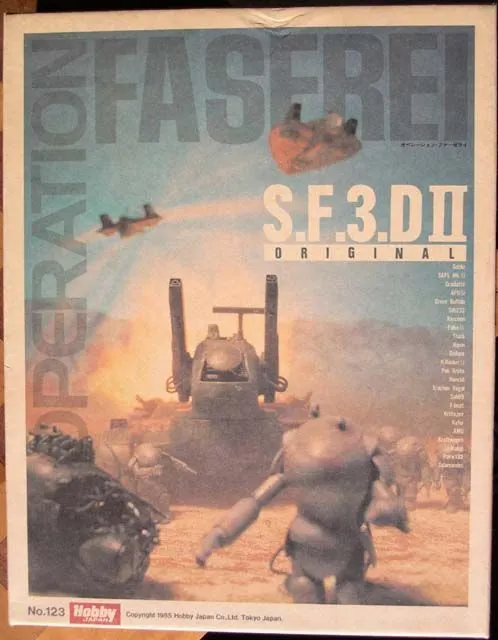
S.F.3.D II Operation Faserei
- 2 graczy
- 360 min
- Złożoność 3,3/5
- 1986
1984
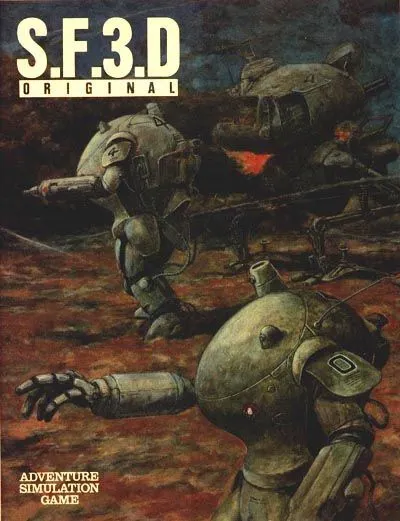
Pomoc w zasadach gry S.F.3.D. Original
Zrozumiałe wyjaśnienia tur, efektów kart i spornych sytuacji z odnośnikami do oficjalnych źródeł i zapisaną historią pytań.
Dla 2 graczy
Co chcesz wiedzieć?
Odpowiedzi pochodzą z oficjalnej instrukcji, ze stroną do sprawdzenia.
S.F.3.D. Original to gra planszowa wydana w 1984 roku dla 2 graczy, z rozgrywką trwającą 120 minut i dla osób od 12 lat. Projekt gry: Yasunori Sekiyama. Główne mechaniki: Hexagon Grid.




Po angielsku
SF3D began as a feature in the May 1982 issue of Hobby Japan under the name, “Wonderful Junk Kit.” Included in that early feature was a scratch-built kit built by Kow Yokoyama of a powersuit pieced together from a Microman action figure, ping pong balls, and salvaged model kit parts. The response to Yokoyama’s design was huge — the era of “realistic” mecha was just taking off, after all — and so a regular feature in Hobby Japan was born. This new series, dubbed SF3D Original, featured story and background details by Hiroshi Ichimura alongside kits created by Yokoyama. Yokoyama’s kits would later be joined by those of other scratch builders, like Makoto Kobayashi, as the workload increased under the demands of a regular column. SF3D ran regularly in Hobby Japan through 1985. SF3D takes place in the distant future, following a cataclysmic World War IV that all but wiped-out life on Earth. Human settlers return to Earth, specifically Australia, and soon find themselves unhappy with their overlords in the Galactic Federation. Crime runs amok and the settlers are unable to restore order themselves, so the Galactic Federation tasks the Strahl Democratic Republic (SDR) with straightening things out down under. The SDR’s methods are heavy-handed and the settlers soon find themselves thrown under the boot of vaguely Germanic totalitarianism. In turn, the unhappy settlers hire mercenary forces to get rid of the SDR and war breaks out in post-apocalyptic Australia. (from the Box:) The storm which is World War IV engulfs the continent of Australia. War sparks ingenuity. Ingenuity birth technology. Technology is escalation. The puppet regime which is called Shuttoral World Government is the enemy. The Australian-led resistance grows in strength with the advent of the HAFS ‘Jerry’, a tow-legged tank with a ground speed of 54 km/hr. War continues… January 11, 2885: New Canberra City falls to Australian forces. The Germans retreat south skirting the desert. February 3, 2885: Shuttoral forces, isolated, make an abortive drive on the township of Gibson. A beachhead rescue saves most ot the force. April 25, 2885: Shuttoral scientists make a secret presentation to Command of the prototype Krachen vogel, armed drone recon. This weapon will be particularly nasty to the Allies because of its similarity to the un-armed Neuspotter. April 26, 2885: Plans begin for a new Shuttoral offensive towards New Canberra City. The directive is “Take, or destroy”. SF3D is a Fast-Moving, Realistic 2-player Game of War, Inspired by the award-winning series of plastic model kits, by Nitto of Japan. This game has been thoroughly playtested in the U.S. Limited, Numbered Edition of 2,040 480 Superb, die-cut doubled-sided oversized counters 4 folding, full-color, semi-geomorphic map boards 20-page Japanese rulebook, numbered 10 Scenario Cards, plus variants 1 Combat Chart Card, 2 Air Commitment Cards 2 six-sided dice (BGG description:) With all of the science fiction wargames that were published in Japan, almost all were based off anime shows, and none used original designs (even the US Battletech just used robots from JPN anime shows at first). This one does use its own story and designs. The game includes 4 mounted maps, and many scenarios that are each given their own scenario cards (ala the US Squad Leader wargame). Includes slightly larger counters than are usually used in Japanese wargames. There was an expansion/sequel to this produced.
Według katalogu S.F.3.D. Original obsługuje 2 graczy. To liczba graczy podana przez wydawcę, więc gra jest zaprojektowana dokładnie dla takiej liczby uczestników. Warianty dla grup innej wielkości, jeśli w ogóle istnieją, opisano w instrukcji twojego wydania; sprawdź ją uważnie, zanim przygotujesz inną konfigurację stołu.
Podany czas rozgrywki w S.F.3.D. Original wynosi 120 minut. To szacunek wydawcy dla pełnej partii. Rzeczywisty czas zależy od grupy, liczby graczy i znajomości zasad: pierwsze partie zwykle trwają dłużej, a doświadczone grupy kończą szybciej. Przygotowanie gry i tłumaczenie zasad nie są wliczone w ten szacunek.
Katalog podaje dla S.F.3.D. Original wiek od 12 lat. To zalecenie wydawcy, które uwzględnia wymagania dotyczące czytania, złożoność zasad i drobne elementy, a nie tylko tematykę. Młodsi gracze często mogą dołączyć z pomocą dorosłego; sprawdź zalecenie wiekowe swojego wydania i weź pod uwagę doświadczenie grupy z grami planszowymi.
S.F.3.D. Original ma ocenę złożoności 2,3 na 5 według graczy BoardGameGeek, co czyni ją grą raczej lekką. Ocena pokazuje, ile znajomości zasad, planowania i podejmowania decyzji wymaga typowa rozgrywka. Cięższe gry wymagają dłuższego pierwszego tłumaczenia, dlatego przed wieczorem z grami warto skorzystać z przewodnika przygotowania.
S.F.3.D. Original należy do tych kategorii: Wargame i Science Fiction. Główne mechaniki to Hexagon Grid. Kategorie opisują temat i świat gry, a mechaniki to, co gracze faktycznie robią w swojej turze. Każda mechanika prowadzi do strony katalogu z podobnymi grami, co pomaga znaleźć coś porównywalnego na kolejny wieczór.
Autorzy wymienieni przy S.F.3.D. Original to: Yasunori Sekiyama. Te informacje pochodzą z opublikowanych danych gry i wskazują osoby odpowiedzialne za jej projekt, a nie ilustratorów czy wydawców. Strony autorów w MeepleRules zbierają inne tytuły tych samych twórców, co pomaga, gdy gra ci się podoba i szukasz podobnych.
W katalogu S.F.3.D. Original figuruje jako gra podstawowa. Można w nią grać samodzielnie, korzystając z elementów z pudełka, bez żadnego innego tytułu. Dodatki, jeśli istnieją, dokładają nową zawartość lub zasady i są wymienione w katalogu osobno, z odnośnikiem do tej gry podstawowej.