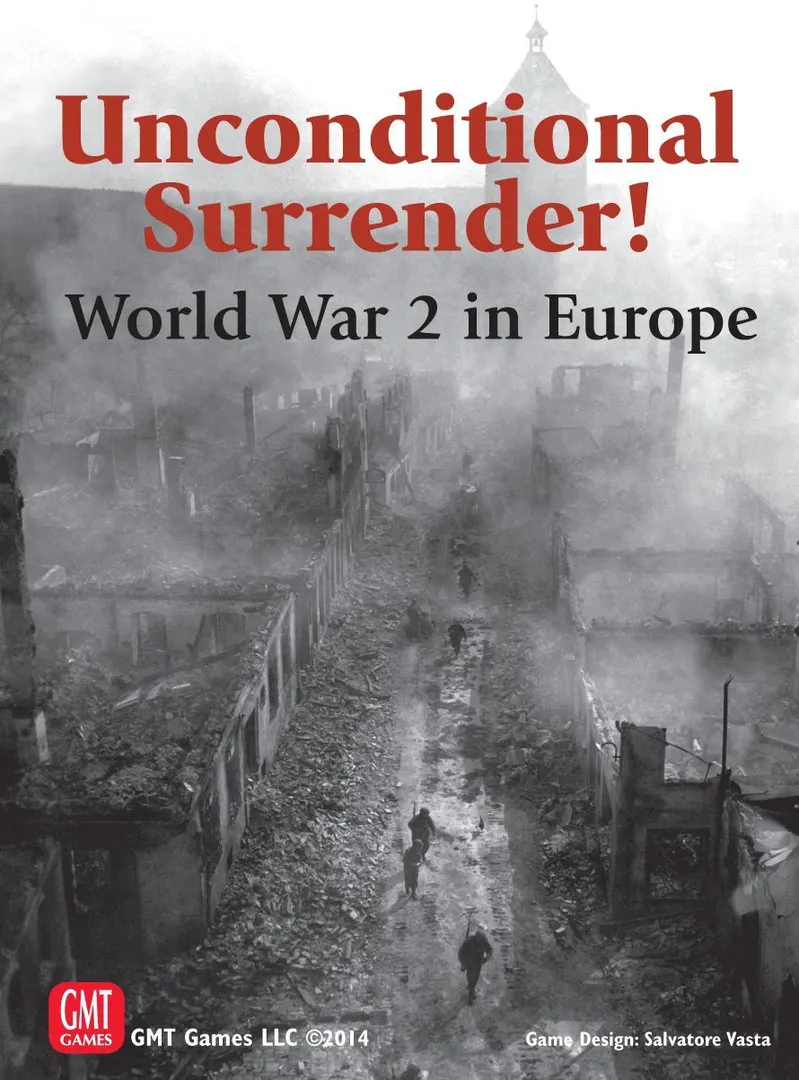
- Pozycja w BGG
- BGG #2276
- Ocena BGG
- 8,0
Unconditional Surrender! World War 2 in Europe
2014
Pomoc w zasadach gry Unconditional Surrender! World War 2 in Europe
Zrozumiałe wyjaśnienia tur, efektów kart i spornych sytuacji z odnośnikami do oficjalnych źródeł i zapisaną historią pytań.
- 2–4 graczy
- 60–3000 min
- 14+
- Złożoność 3,8/5

Dla 2 graczy
Asystent zasad gry Unconditional Surrender! World War 2 in Europe
Co chcesz wiedzieć?
Odpowiedzi pochodzą z oficjalnej instrukcji, ze stroną do sprawdzenia.
Unconditional Surrender! World War 2 in Europe to gra planszowa wydana w 2014 roku dla 2–4 graczy, z rozgrywką trwającą 60–3000 minut i dla osób od 14 lat. Projekt gry: Salvatore Vasta. Główne mechaniki: Dice Rolling, Hexagon Grid i Simulation.
O grze
Po angielsku
Unconditional Surrender! World War 2 in Europe (USE) is a strategic level game covering the World War II European Theater. Players make the political decisions and control the military forces of the three major factions that struggled for European dominance and survival. With its emphasis on force projection and decision making, players remain focused on the big picture of managing their front lines and political opportunities. Through simple mechanics and low on-map counter density, players easily handle the strategic action without a myriad of complicated subsystems or tall stacks of counters. As one gamer put it, "It is a delight to be spending my limited brain power on making (or agonizing over) operational decisions that are as dependent upon guts as they are gray matter. This game is not a series of arithmetic exercises, and the only variable in these algorithms is nerve." Though the focus is on the big picture, Unconditional Surrender! still delivers historical detail. Each country has an historical army level order of battle, and its relative economic strength and national will to fight are effectively and simply modeled. Also represented are such World War II events as airdrops, Free Forces, jets, naval evacuation, partisans, radar, railroad artillery guns, and ULTRA; all neatly woven into the game's core mechanics for ease of play The game has many scenarios ranging from quick playing individual campaigns to longer ones covering up to the entire war. Design Highlights Scale: army, fleet, or air wing level units; 30-60 miles per hex; monthly turns Players: 2-4 Playing Time: 30 minutes to 50 hours, depending on the scenario Low On-Map Counter Density: The number of counters on the map is relatively low. Simple Stacking: No more than one air, ground, convoy, or warship unit per hex. No Factors on Counters: There are no combat or movement factors on counters. Single Combat System: One combat resolution sequence and Combat Results Table covers all types of combat, yet the results differ for air/naval, ground, or strategic combat. Integrated Movement/Combat System: Units move and fight in a combined activation. "Use it or Lose it" Economic System: Simple math with minimal record keeping Historical or Variable Entry: Units and events can enter play using an historical or variable time line. Variable Politics: Most countries’ belligerence and faction alliance is not predetermined. Solitaire Friendly: Though not designed with solitaire rules, the mechanics easily allow one player to play the game. PBEM Capable: The game can be played using PBEM software, but its mechanics require frequent exchanges. COMPONENTS: 840 counters on 3 countersheets Two 22"x34" maps Three 11"x17" Player Aid Sheets Three 8.5"x11" Faction cards Two 8.5"x11" Flowchart cards Rulebook Playbook Three six-sided dice TIME SCALE: Monthly Turns MAP SCALE: 30 to 40 miles per hex UNIT SCALE: Army, Fleet or Wing DESIGNER: Salvatore Vasta DEVELOPER: Mark Dey MAP ART: Salvatore Vasta & Mark Simonitch COUNTER ART: Charlie Kibler (from the designer and GMT Games website)
Kategorie
Mechaniki
Autorzy
Wydawcy
- GMT Games
Pytania i odpowiedzi
Według katalogu Unconditional Surrender! World War 2 in Europe obsługuje od 2 do 4 graczy. Ten zakres odpowiada liczbie graczy podanej przez wydawcę, więc grę można przygotować dla dowolnej grupy w jego granicach. Przygotowanie, niektóre zasady i punktacja mogą jednak różnić się w zależności od liczby graczy; dokładną konfigurację sprawdź w instrukcji swojego wydania.
Podany czas rozgrywki w Unconditional Surrender! World War 2 in Europe wynosi 60–3000 minut. To szacunek wydawcy dla pełnej partii. Rzeczywisty czas zależy od grupy, liczby graczy i znajomości zasad: pierwsze partie zwykle trwają dłużej, a doświadczone grupy kończą szybciej. Przygotowanie gry i tłumaczenie zasad nie są wliczone w ten szacunek.
Katalog podaje dla Unconditional Surrender! World War 2 in Europe wiek od 14 lat. To zalecenie wydawcy, które uwzględnia wymagania dotyczące czytania, złożoność zasad i drobne elementy, a nie tylko tematykę. Młodsi gracze często mogą dołączyć z pomocą dorosłego; sprawdź zalecenie wiekowe swojego wydania i weź pod uwagę doświadczenie grupy z grami planszowymi.
Unconditional Surrender! World War 2 in Europe ma ocenę złożoności 3,8 na 5 według graczy BoardGameGeek, co czyni ją grą ciężką. Ocena pokazuje, ile znajomości zasad, planowania i podejmowania decyzji wymaga typowa rozgrywka. Cięższe gry wymagają dłuższego pierwszego tłumaczenia, dlatego przed wieczorem z grami warto skorzystać z przewodnika przygotowania.
Unconditional Surrender! World War 2 in Europe należy do tych kategorii: Wargame i World War II. Główne mechaniki to Dice Rolling, Hexagon Grid i Simulation. Kategorie opisują temat i świat gry, a mechaniki to, co gracze faktycznie robią w swojej turze. Każda mechanika prowadzi do strony katalogu z podobnymi grami, co pomaga znaleźć coś porównywalnego na kolejny wieczór.
Autorzy wymienieni przy Unconditional Surrender! World War 2 in Europe to: Salvatore Vasta. Te informacje pochodzą z opublikowanych danych gry i wskazują osoby odpowiedzialne za jej projekt, a nie ilustratorów czy wydawców. Strony autorów w MeepleRules zbierają inne tytuły tych samych twórców, co pomaga, gdy gra ci się podoba i szukasz podobnych.
W katalogu Unconditional Surrender! World War 2 in Europe figuruje jako gra podstawowa. Można w nią grać samodzielnie, korzystając z elementów z pudełka, bez żadnego innego tytułu. Dodatki, jeśli istnieją, dokładają nową zawartość lub zasady i są wymienione w katalogu osobno, z odnośnikiem do tej gry podstawowej.