
- Место в рейтинге BGG
- BGG #25 213
- Оценка BGG
- 6,0
Puluc
- 2 игрока
- Сложность 1,5/5
1000
Помощник по правилам Alquerque
Понятные объяснения ходов, эффектов карт и спорных ситуаций со ссылками на официальные источники и сохранённой историей вопросов.
Для 2 игроков
Что хотите уточнить?
Отвечаю по официальным правилам и показываю страницу для проверки.
«Alquerque» — настольная игра 1000 года: для 2 игроков, 10–20 минут на партию и возраст от 8 лет. Авторы игры — Alfonso X de Castille и Jorge Yañez; основные механики — Grid Movement.

На английском
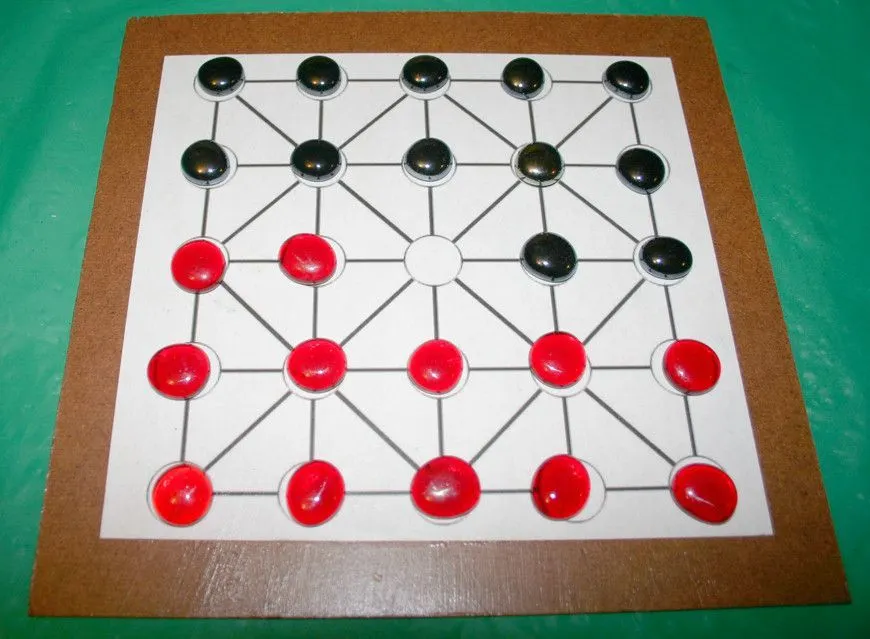
The game of Alquerque is played on a special board of 5 x 5 points with lines between them to indicate allowed moves. To draw a board is easy. First draw a 5 x 5 orthogonal grid. The draw two diagonal lines - from each corner to the opposite corner. Finally draw four diagonal lines in the form of a square that connects the midpoints of each side. Alquerque is played with 12 black pieces and 12 white pieces in a similar way to Draughts (Checkers). The player playing black pieces places them on the 10 points of the nearest 2 rows plus the 2 rightmost points on the middle row as the player looks at it. The other player sets the white pieces up in exactly the same way. This leaves only the middle point without a piece upon it. The objective of the game is to take all of the opponent's pieces or to produce a position such that the opponent is unable to move. Play Players take turns to move one of their pieces. A piece may only move along the lines inscribed upon the board. For each turn a piece makes either a capturing move or an ordinary move. Whenever a piece has an opponent's piece adjacent to it and the point immediately beyond the opponent's piece is vacant, the opponent's piece can be captured. A piece is taken by simply hopping over it into the vacant point beyond and removing it from the board. Unlike an ordinary move, a capturing move can consist of several such hops - if a piece takes an opponent's piece and the new position allows it to take another piece, then it can do so straight away. The move finishes when the position of the capturing piece no longer allows it to taken any more pieces or the player could make another capture but decides not to. An ordinary move is made by simply moving a piece along a line to an adjacent point. Finishing The game is won by the player who first manages to take all his opponent's pieces or by the player who has more pieces when it becomes apparent that no more pieces will be taken. Alternatively, a player can win by rendering the other player unable to move. A draw occurs by agreement at any point during the game. If it becomes apparent that no more pieces will be taken and both players have the same number of pieces left, a draw is agreed. Draws are very common. Arie van der Stoep's reconstruction: In his book Draughts in relation to chess and alquerque (2005) Arie van der Stoep contends that Alquerque de doze was in medieval times played by the following rules. Counters can move and capture, by the short leap, forwards and sideways. Capture is not compulsory. Counters are promoted to Sultans at the last rank. The Sultan (King) moves and captures in all directions. Counters are obliged to follow the pattern on the board. Goal is to capture all the opponent's counters. There existed two variants of Medieval Alquerque. In one version the Sultan can only move one square (short Sultan), and captures by the short leap. This was foremostly played in countries within the Roman sphere of influence. In the other variant the Sultan moves any number of squares, and captures like the King in international draughts, landing anywhere behind the captured piece. This was foremostly played in countries within the Arabic sphere of influence. In Sultan endgames, a majority of at least two Sultans is necessary for a win.
По данным каталога, «Alquerque» рассчитана на 2 игроков. Это число игроков, указанное издателем, то есть игра задумана ровно для такого количества участников. Варианты для другого состава, если они есть, описаны в правилах вашего издания; проверьте их, прежде чем готовить другую конфигурацию.
В каталоге для «Alquerque» указано время партии 10–20 минут — это оценка издателя для полной партии. Фактическая длительность зависит от состава, числа игроков и знакомства с правилами: первые партии обычно идут дольше, опытные компании заканчивают быстрее. Подготовка и объяснение правил в эту оценку не входят.
В каталоге для «Alquerque» указан возраст от 8 лет. Это рекомендация издателя: она учитывает необходимость чтения, сложность правил и мелкие компоненты, а не только тему. Младшие игроки часто могут участвовать с помощью взрослого; проверьте возрастную рекомендацию на своём издании и учтите опыт вашей компании в настольных играх.
Сложность «Alquerque» — 1,9 из 5 по оценкам игроков BoardGameGeek, это лёгкая игра. Оценка отражает, сколько знания правил, планирования и решений требует типичная партия. Сложные игры дольше объяснять в первый раз, поэтому перед игровым вечером пригодится руководство по подготовке.
Категории игры «Alquerque»: Abstract Strategy. Основные механики: Grid Movement. Категории описывают тему и сеттинг игры, а механики — то, что игроки на самом деле делают в свой ход. Каждая механика ведёт в раздел каталога с похожими играми, и так проще найти что-то подобное для следующей партии.
В каталоге авторами «Alquerque» указаны: Alfonso X de Castille и Jorge Yañez. Эти данные взяты из опубликованной информации об игре и называют людей, ответственных за её дизайн, а не иллюстраторов или издателей. Страницы авторов на MeepleRules собирают другие игры тех же авторов — это удобно, когда игра понравилась и хочется найти похожие.
В каталоге «Alquerque» отмечена как самостоятельная игра. В неё можно играть отдельно, используя компоненты из коробки, и никакая другая игра для этого не нужна. Дополнения, если они существуют, добавляют новый контент или правила и указаны в каталоге отдельно со ссылкой на эту базовую игру.