
- Место в рейтинге BGG
- BGG #6 622
- Оценка BGG
- 8,1
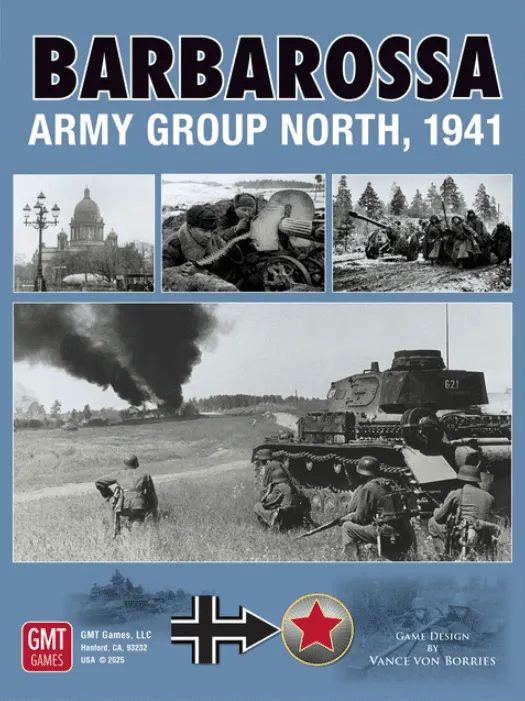
Barbarossa: Army Group North, 1941
- 1–4 игрока
- 300 мин
- Сложность 4,2/5
- 2000
1998
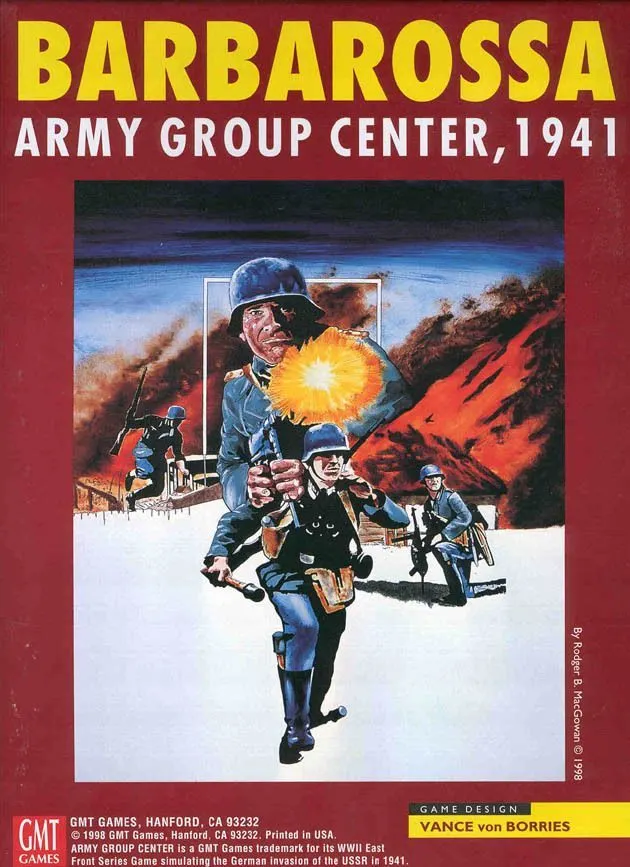
Помощник по правилам Barbarossa: Army Group Center, 1941
Понятные объяснения ходов, эффектов карт и спорных ситуаций со ссылками на официальные источники и сохранённой историей вопросов.
Для 1 игрока
Что хотите уточнить?
Отвечаю по официальным правилам и показываю страницу для проверки.
«Barbarossa: Army Group Center, 1941» — настольная игра 1998 года: для 1–4 игроков, 120 минут на партию и возраст от 12 лет. Авторы игры — Vance von Borries и Tony Curtis; основные механики — Hexagon Grid.
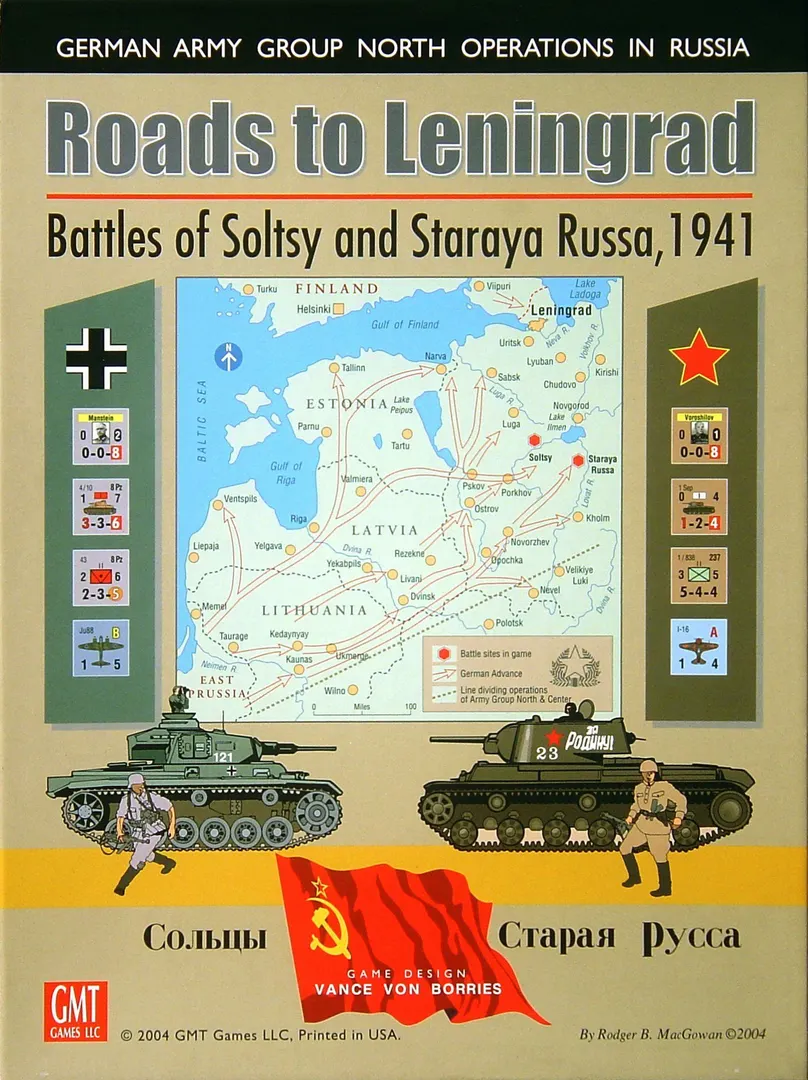



На английском
Historical Setting June 1941 -- Army Group Center hurls itself through the Soviet border defenses, and its two Panzer groups race headlong toward Minsk. Behind them lie the remnants of the Soviet Western Front -- almost a million men in four armies. The Soviets are stunned by the German Blitzkrieg. Their responses are slow, confused, and governed by pre-war contingency plans made obsolete by the speed of the German advance. In little more than a week, the German panzer spearheads meet east of Minsk. Though isolated units continue to fight, the entire Soviet Western Front has ceased to exist! The Germans' next target is Smolensk, but the Soviets resist more effectively. Entire armies are dispatched from other parts of the Soviet Union as the true scope of the Minsk pocket disaster and the magnitude of the German threat become known. Soviet counterattacks, especially around Lepel, are thrown back with horrific losses. Once again the Panzer Groups charge eastward, creating yet another huge Soviet pocket west of Smolensk. The Soviets resist savagely. Smolensk falls on July 13th, but the pocket does not close. Many Soviet units escape to fight another day. Hitler now makes a fateful decision and overrides his generals. Over half of Army Group Center's armored and air formations are diverted south to take Kiev or north to isolate Leningrad. No longer under heavy pressure, the Soviets gain time to form solid fronts around Vyazma and Bryansk. Did Hitler's decision cost the Germans the war? Play Barbarossa: Army Group Center and find out for yourself Game Features Eight scenarios allow players to vary their level of involvement, complexity, and starting point, from introductory to full campaign An asymmetrical sequence of play that highlights Axis armored breakthroughs and Soviet difficulties in combined arms warfare. This includes a “non-op” Soviet HQ system to simulate the rigid, yet fragile, Soviet Command structure Detailed air rules which integrate with land combat and weather rules Incredibly detailed Order of Battle, including special coverage of artillery, rocket artillery, engineers, bridge units, armored trains, and much more Modifications to the proven “EFS” include many revised rules and procedures, as well as new Order of Battle information Extensive bibliography and design/historical notes COMPONENTS • Four 22" × 34" inch maps (Maps C, D, H, and I) • One 25½" × 11½" inch map (Map WA) • 1400 die-cut ½" counters in five full counter sheets • One Rule Book • One Playbook • One 11" × 17" Map Card (with Scenario 3 and 6 Maps either side) • Three double-sided Soviet Set Up Cards (with backside of one card containing a Game Card displaying all Scenario 3 and 6 units) • Two double-sided Axis Set Up Cards (with CRT on one) • One single-sided 8½" × 11" combined Axis and Soviet Step Reduction Organization Card • Two double-sided 11" × 17" inch folded Chart Cards with Combat Results Table, Terrain Effects Chart, Overrun, AA, Air Combat, CAB, etc. charts • One double-sided 11" × 17" inch folded Chart Card with Units and their Symbols, Movement Phase, Effects on Movement Chart, Artillery, etc. charts • One double-sided 8½" × 11" chart card front side Axis/Soviet Set Up Card for Scenario 1 and backside with Super-Heavy Artillery Effects Table • Two single-sided 8½" × 11" Air Unit Status/Unit Rebuilding Cards (one Soviet and one Axis) • One double-sided 11" × 17" inch folded Chart Card containing Scenario Victory Conditions, Replacement Table, Fuel, ASPs, RR Conversion • One single-sided 8½" × 11" Chart Card with Turn Record Track, Weather Table, and various scenario information summaries • Two 11" × 17" Expanded Sequences of Play Cards • One ten-sided die TIME SCALE 2 days per turn MAP SCALE 5 miles per hex GROUND UNIT SCALE Division/Regiment AIR UNIT SCALE 40-80 aircraft per counter NUMBER OF PLAYERS One to four (2nd edition description, from GMT website and components from Playbook) This is one of a very popular series of games from GMT covering the first months of the invasion of the USSR; units are battalions through divisions, hexes are about 5 miles, and turns are two days. The system encompasses (as of 6/2001) Barbarossa: Army Group North (2000), Barbarossa: Army Group Center (1998), and Barbarossa: Army Group South (1996). Typhoon! (1995) is the progenitor of these games, and its system is quite similar, but it is unfortunately subtly incompatible with the later games. While not simple, these games are also not overly complex and present an excellent simulation of the early war. Most of the details of the campaigns are covered in a playable manner. Perhaps the most obviously interesting detail is the sequence of play, which is asymmetrical to account for the difficulties the Soviets labored under. Make no mistake, the Soviets are going to take a lot of abuse, but this is no walkover for the Germans and both sides are interesting to play. (BGG user description) 1st edition errata counters contained in Barbarossa: Crimea, 1941-42.
По данным каталога, «Barbarossa: Army Group Center, 1941» рассчитана на 1–4 игроков. Этот диапазон соответствует числу игроков, указанному издателем, поэтому игру можно подготовить для любого состава в его пределах. Подготовка, отдельные правила и подсчёт очков всё же могут зависеть от числа игроков; точную конфигурацию проверьте в правилах своего издания.
В каталоге для «Barbarossa: Army Group Center, 1941» указано время партии 120 минут — это оценка издателя для полной партии. Фактическая длительность зависит от состава, числа игроков и знакомства с правилами: первые партии обычно идут дольше, опытные компании заканчивают быстрее. Подготовка и объяснение правил в эту оценку не входят.
В каталоге для «Barbarossa: Army Group Center, 1941» указан возраст от 12 лет. Это рекомендация издателя: она учитывает необходимость чтения, сложность правил и мелкие компоненты, а не только тему. Младшие игроки часто могут участвовать с помощью взрослого; проверьте возрастную рекомендацию на своём издании и учтите опыт вашей компании в настольных играх.
Сложность «Barbarossa: Army Group Center, 1941» — 4,0 из 5 по оценкам игроков BoardGameGeek, это сложная игра. Оценка отражает, сколько знания правил, планирования и решений требует типичная партия. Сложные игры дольше объяснять в первый раз, поэтому перед игровым вечером пригодится руководство по подготовке.
Категории игры «Barbarossa: Army Group Center, 1941»: Wargame и World War II. Основные механики: Hexagon Grid. Категории описывают тему и сеттинг игры, а механики — то, что игроки на самом деле делают в свой ход. Каждая механика ведёт в раздел каталога с похожими играми, и так проще найти что-то подобное для следующей партии.
В каталоге авторами «Barbarossa: Army Group Center, 1941» указаны: Vance von Borries и Tony Curtis. Эти данные взяты из опубликованной информации об игре и называют людей, ответственных за её дизайн, а не иллюстраторов или издателей. Страницы авторов на MeepleRules собирают другие игры тех же авторов — это удобно, когда игра понравилась и хочется найти похожие.
В каталоге «Barbarossa: Army Group Center, 1941» отмечена как самостоятельная игра. В неё можно играть отдельно, используя компоненты из коробки, и никакая другая игра для этого не нужна. Дополнения, если они существуют, добавляют новый контент или правила и указаны в каталоге отдельно со ссылкой на эту базовую игру.