

- Место в рейтинге BGG
- BGG #5 035
- Оценка BGG
- 6,2
504
- 2–4 игрока
- 30–120 мин
- Сложность 3,5/5
- 2015
2021
Помощник по правилам P'achakuna
Понятные объяснения ходов, эффектов карт и спорных ситуаций со ссылками на официальные источники и сохранённой историей вопросов.
Для 2 игроков
Что хотите уточнить?
Отвечаю по официальным правилам и показываю страницу для проверки.
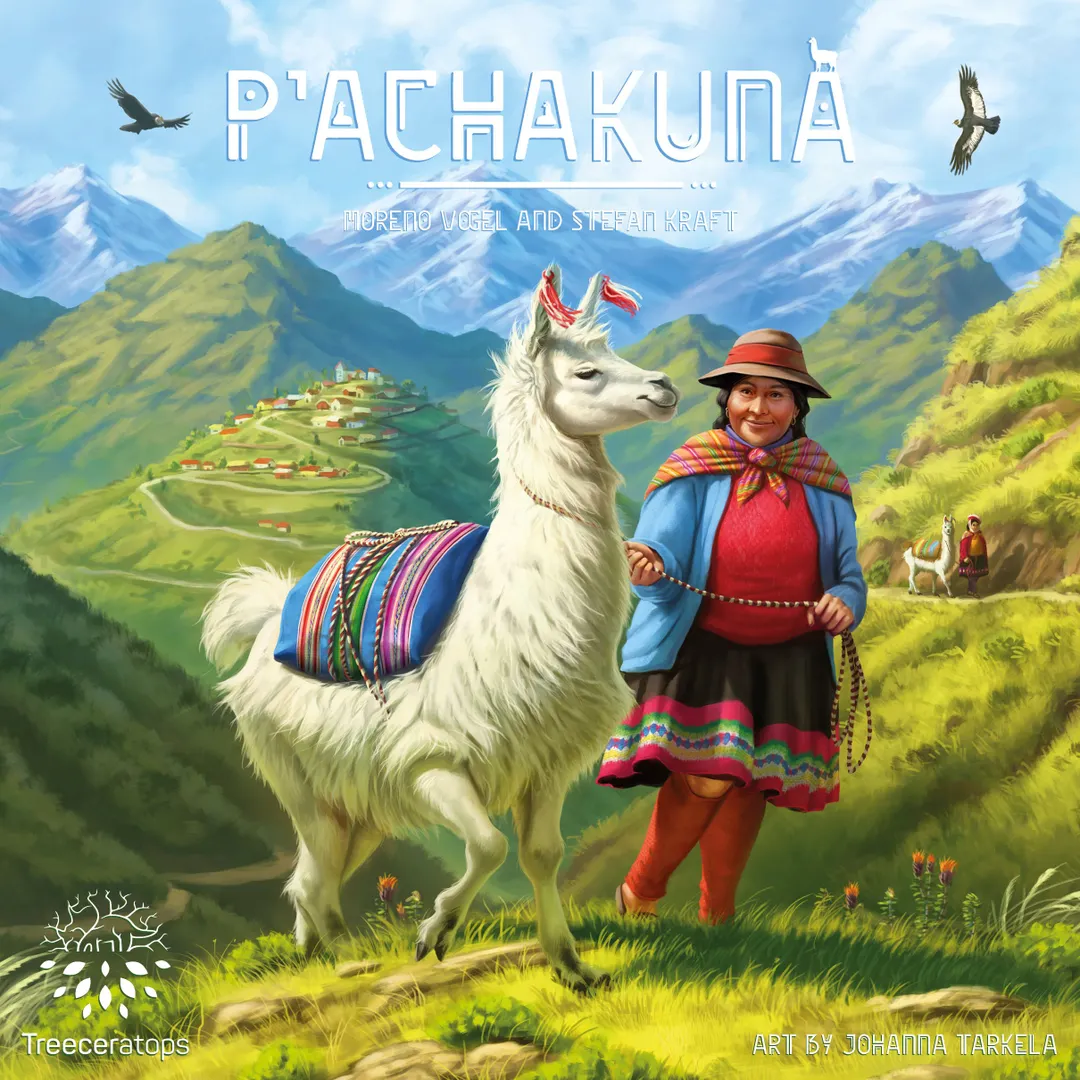
«P'achakuna» — настольная игра 2021 года: для 2 игроков, 30–60 минут на партию и возраст от 8 лет. Авторы игры — Moreno Vogel и Stefan Kraft; основные механики — Point to Point Movement, Tile Placement и Modular Board.


На английском
P'achakuna takes you on a journey in the heart of the Andes together with your most loyal friend — your llama. The game includes both black and white llamas, with you controlling one color and your opponent the other. White llamas move only through the green valleys, while black llamas scale the barren mountains. Whatever the color, however, you want to visit mountain villages to deliver the dye that they desire, ideally collecting dye for yourself along the way. In P'achakuna, each player starts with one llama of their color in the center of the board in the white village, with a white dye loaded on its back. The board is composed of hexagonal tiles that are either half valley/half mountain, two-thirds valley/one-third mountain, or vice versa. The tiles are extremely thick so that you can grab the mountain section of the tile and pluck it from the board. Six villages sit on the perimeter of the game board, each corresponding to one of the primary or secondary colors. Each village has a random demand tile in it that shows two colors, one in high demand and one in low demand; neither of these colors can match the color of the village. On a turn, you may first rotate one unoccupied tile; by paying two dye resources from your personal supply, you can rotate a second tile. You then must move each of your llamas at least one space, but you can move them further if you desire and if the terrain allows them to do this. You rotate tiles to create long paths of valley or mountain so that ideally your llamas can travel far with each move. If you move a llama into a village, you trade the dye on that llama. If the dye you carry isn't in demand in that village, you simply trade that dye for the dye from the village, say, green for yellow. If the dye is in demand, then you add 1-2 dye of that delivered color to your personal supply (depending on whether the demand is low or high), then you place a dye matching the color of that village on your llama. If you collect a color in your personal supply and don't have it in your scoring track, you can place it in your scoring track. No matter what, you replace the demand tile in that village, making sure the color of that village isn't on the demand tile. During a turn in a village, you can hand in four dye from your personal supply to acquire a new llama that is then placed in that village with a dye from that village on its back. Each llama moves on your turn, and you can have at most three llamas. As soon as you have one dye of each of the seven colors on your scoring track, you win. To hold the demand tiles, the game includes a handmade fabric bag from Bolivia and Peru, which supports the local community.
По данным каталога, «P'achakuna» рассчитана на 2 игроков. Это число игроков, указанное издателем, то есть игра задумана ровно для такого количества участников. Варианты для другого состава, если они есть, описаны в правилах вашего издания; проверьте их, прежде чем готовить другую конфигурацию.
В каталоге для «P'achakuna» указано время партии 30–60 минут — это оценка издателя для полной партии. Фактическая длительность зависит от состава, числа игроков и знакомства с правилами: первые партии обычно идут дольше, опытные компании заканчивают быстрее. Подготовка и объяснение правил в эту оценку не входят.
В каталоге для «P'achakuna» указан возраст от 8 лет. Это рекомендация издателя: она учитывает необходимость чтения, сложность правил и мелкие компоненты, а не только тему. Младшие игроки часто могут участвовать с помощью взрослого; проверьте возрастную рекомендацию на своём издании и учтите опыт вашей компании в настольных играх.
Сложность «P'achakuna» — 1,8 из 5 по оценкам игроков BoardGameGeek, это лёгкая игра. Оценка отражает, сколько знания правил, планирования и решений требует типичная партия. Сложные игры дольше объяснять в первый раз, поэтому перед игровым вечером пригодится руководство по подготовке.
Категории игры «P'achakuna»: Animals, Puzzle и Maze. Основные механики: Point to Point Movement, Tile Placement и Modular Board. Категории описывают тему и сеттинг игры, а механики — то, что игроки на самом деле делают в свой ход. Каждая механика ведёт в раздел каталога с похожими играми, и так проще найти что-то подобное для следующей партии.
В каталоге авторами «P'achakuna» указаны: Moreno Vogel и Stefan Kraft. Эти данные взяты из опубликованной информации об игре и называют людей, ответственных за её дизайн, а не иллюстраторов или издателей. Страницы авторов на MeepleRules собирают другие игры тех же авторов — это удобно, когда игра понравилась и хочется найти похожие.
В каталоге «P'achakuna» отмечена как самостоятельная игра. В неё можно играть отдельно, используя компоненты из коробки, и никакая другая игра для этого не нужна. Дополнения, если они существуют, добавляют новый контент или правила и указаны в каталоге отдельно со ссылкой на эту базовую игру.