
- BGG-Bewertung
- 7,4
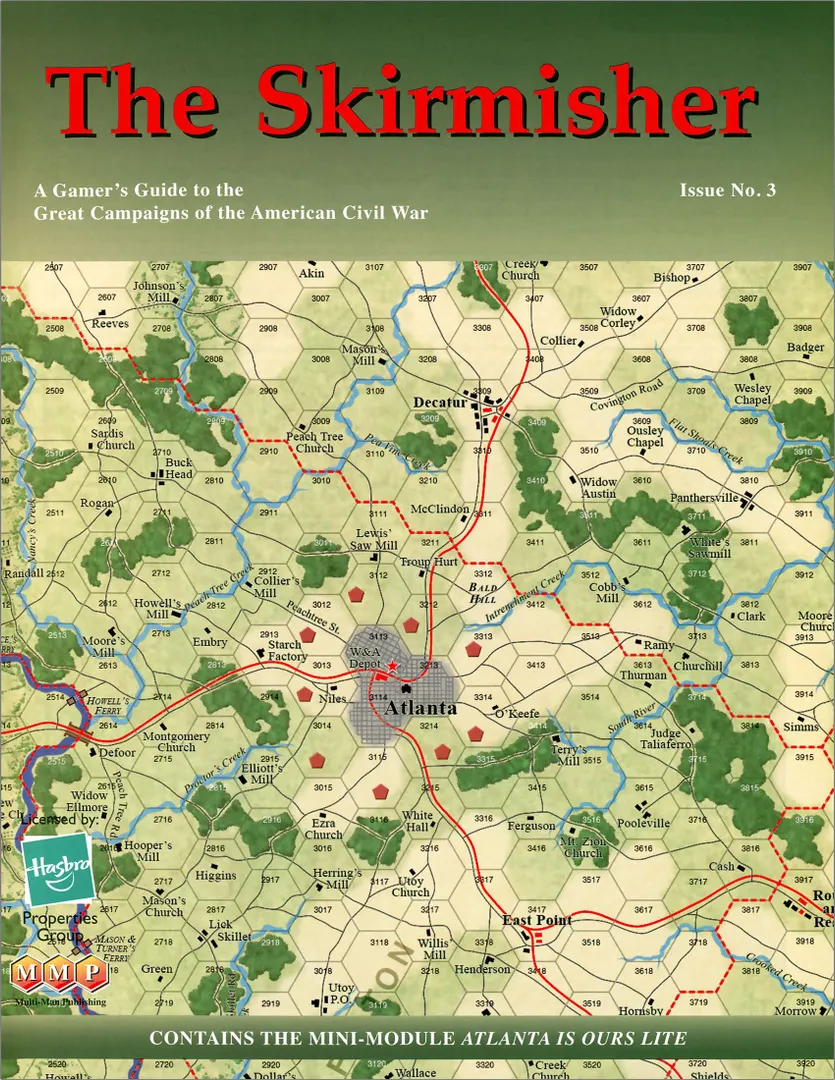
The Skirmisher #3
- 1–2 Spieler
- 180–600 Min.
- Komplexität 3,0/5
- 2022
2018
Regelhilfe für Atlanta Is Ours
Verständliche Erklärungen zu Spielzügen, Karteneffekten und strittigen Situationen mit Verweisen auf offizielle Quellen und gespeichertem Fragenverlauf.
Für 1 Person
Was möchtest du wissen?
Antworten stammen aus dem offiziellen Regelheft, mit Seitenangabe zum Nachprüfen.
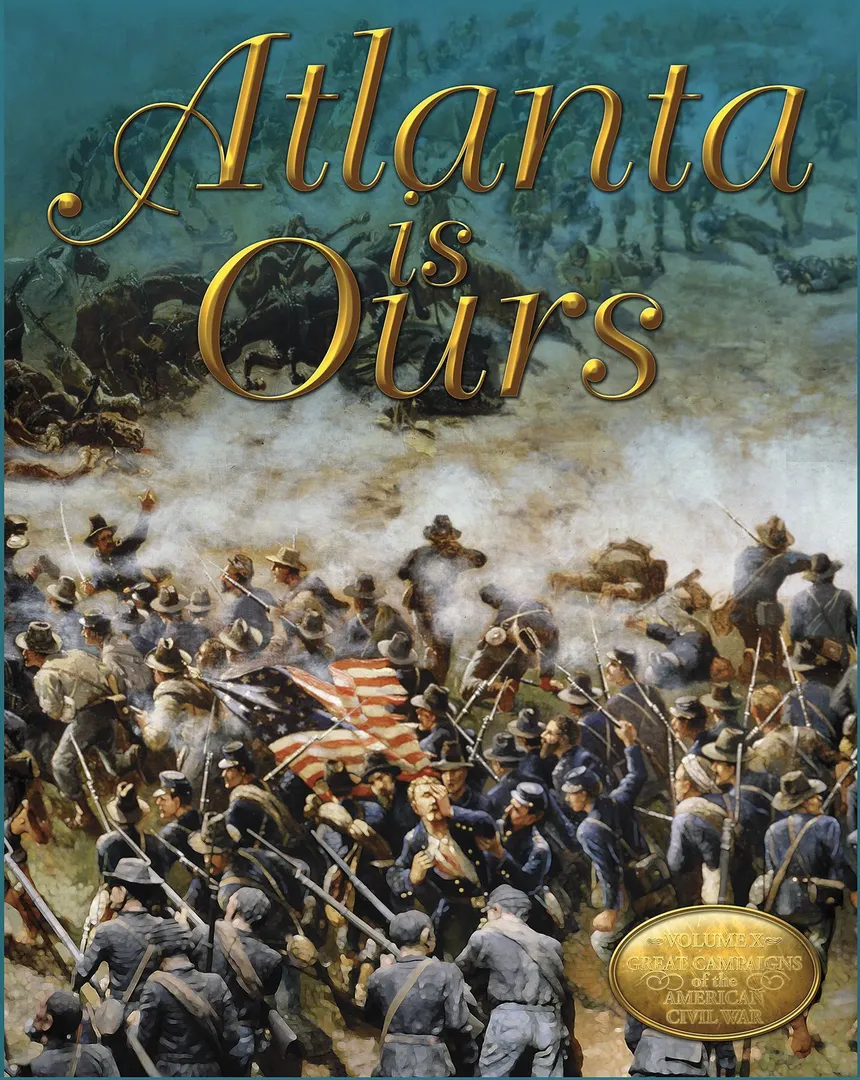
Atlanta Is Ours ist ein Brettspiel aus dem Jahr 2018 für 1–2 Personen und mit 60–7920 Minuten pro Partie. Entwickelt wurde es von Ed Beach, Mike Belles und Chris Withers; die wichtigsten Mechaniken sind Dice Rolling, Grid Movement und Hexagon Grid.



Auf Englisch
Atlanta Is Ours is a game in the award-winning Series: Great Campaigns of the American Civil War (Avalon Hill/MMP) (GCACW) series. The two maps included are painted by original map artist Charlie Kibler. The military unit counters have been redesigned by Charlie Kibler to harken back to the counters in the original games in the series but with a more modern graphical treatment. Atlanta Is Ours contains an updated version of the GCACW Standard Basic Game Rules that all the other games in the series use. The Advanced Game rules are also standardized so players will be able to move quickly from one campaign to the other. Atlanta Is Ours includes fourteen Basic Game scenarios and five Advanced Game campaigns, all extensively playtested: Basic Game Scenarios The Opportunity of a Lifetime (Snake Creek Gap/Resaca (5/9/1864, 1 turn, small forces): Beginner’s scenario, great for learning how to play. The Gap Is Blocked (5/8-5/10/1864, 3 turns): Hypothetical scenario, what could have happened if Sherman had not sent McPherson to Snake Creek Gap and instead attacked or tried to outflank other points in the Confederate defenses. Battle of Resaca (5/14/1864; 1 turn): Sherman's entire army reinforces McPherson's corps outside Resaca, and attacks Johnston's army in Resaca, which has just arrived from its positions around Dalton. From the Oostanaula to the Etowah (5/17-5/23/1864, 7 turns): Sweeping maneuver from one river to the other, with the aborted battle of Cassville near the end of the scenario. Includes special random events and optional limited intelligence. Advance and Retreat (5/19-5/22/1864; 4 turns): Johnston's army attempts to attack a portion of Sherman's army while Sherman is advancing on a wide front. Hood aborts the attack as it is developing and falls back into a defensive line near Cassville. The Hell Hole (5/25-5/28/1864; 4 turns): Sherman moves off the rail line to the west in an attempt to flank Johnston, but is stopped after several days of battle. This scenario encompasses the battles of Dallas, New Hope Church, and Pickett's Mill. Kennesaw Mountain (6-22-6/27; 6 turns): This scenario covers the battles of Kolb’s Farm and Kennesaw Mountain. Crossing the Chattahoochee (7/3-7/8/1864; 6 turns): Johnston retreats from Kennesaw Mountain and then Sherman breaches Johnston's line covering the bridges and fords of the Chattahoochee River. Battle of Atlanta (7/20-7/22/1864; 3 turns): Hood (now in command of the CSA army) attacks portions of Sherman's army twice, at Peachtree Creek and Bald Hill, but is beaten back with heavy losses both times. Ezra Church (7/28/1864; 1 turn; half armies): Hood sends two corps to block Howard (now commanding the Army of the Tennessee), who is attempting to move around Atlanta from the west; they stop Howard, but incur heavy casualties in their attacks. Wheeler's Raid (8/10-8/15; 6 turns; solitaire cavalry scenario): Wheeler moves north to disrupt the Union supply line around Dalton; -Wheeler does minimal damage before being forced to retreat. Kilpatrick's Raid (8/18-8/22/1864; 5 turns, cavalry scenario): Kilpatrick takes the Union cavalry south around Atlanta to Lovejoy's Station, but he does minimal damage and returns to Union lines. Marching On Tara (8/28 - 9/1/1864; 5 turns): Sherman moves around the west flank of the Confederates and marches to the RR stations supplying Atlanta from the west and the south. The goal is to force the Confederates to fight outside the forts or abandon Atlanta. Tara is the fictional plantation in the movie Gone With The Wind, and is "located" a few miles from Jonesboro where the armies have their final battle. Last Stand At Tara (8/31 - 9/2/1864; 3 turns): This scenario encompasses both the Confederate attack on the Union at Jonesboro and then the Confederate retreat and consolidation of their army at Lovejoy’s Station to the south on the RR line. Advanced Game Scenarios To The Chattahoochee (Advanced scenario, May-July 1864): This scenario covers Johnston's retreat and the Union advance from the initial lines at Dalton to near Atlanta. The Real Game For Atlanta (Advanced scenario, July-Sept. 1864): This scenario encompasses Hood's attacks near the Atlanta forts and Sherman's maneuvering resulting in the Union capture of Atlanta. The Atlanta Campaign (Advanced scenario, May-Sept 1864): A "grand campaign" linking the two above advanced scenarios. The Hardest Knocks (Advanced scenario, May-July or Sept 1864): Alternative setups to the May campaign startup. Without Home Or Habitation (Advanced scenario, Sept – Oct 1864): After the fall of Atlanta, Hood heads north to cut Sherman’s rail line. Union forces pursue. Contents GCACW Series Rules Booklet (24 pgs in color) AIO Specific Rules Booklet (96 pgs in color including scenarios, the game as history, map gazetteer, etc) Two 22"x 32" full-color map sheets (preview). Three 280-piece counter sheets One Terrain Effects Chart Two full-color Force Displays One Off-Map Display One Turn Track Two 4-page color Charts and Tables Two 6-sided Dice Design & Development: Ed Beach, Mike Belles, and Chris Withers Original series design by Joseph M. Balkoski Map Artwork by Charlie Kibler Counter Graphics by Charlie Kibler and Nicolás Eskubi
Laut Katalog unterstützt Atlanta Is Ours 1–2 Personen. Diese Spanne entspricht der vom Verlag angegebenen Spielerzahl, das Spiel lässt sich also für jede Gruppengröße innerhalb dieser Spanne aufbauen. Aufbau, einzelne Regeln und Wertungsdetails können je nach Personenzahl trotzdem abweichen; prüfe daher die genaue Konfiguration in der Anleitung deiner Ausgabe.
Die angegebene Spieldauer für Atlanta Is Ours beträgt 60–7920 Minuten. Das ist die Schätzung des Verlags für eine vollständige Partie. Die tatsächliche Dauer hängt von der Gruppe, der Personenzahl und der Regelkenntnis ab: Erste Partien dauern meist länger, erfahrene Gruppen sind oft schneller fertig. Aufbau und Regelerklärung sind in dieser Schätzung nicht enthalten.
Atlanta Is Ours hat bei BoardGameGeek eine Komplexitätswertung von 3,7 von 5 und gilt damit als mittelschweres Spiel. Die Wertung zeigt, wie viel Regelwissen, Planung und Entscheidungen eine typische Partie verlangt. Schwerere Spiele brauchen bei der ersten Erklärung mehr Zeit, daher hilft vor dem Spieleabend eine Vorbereitungsanleitung.
Atlanta Is Ours gehört zu diesen Kategorien: Wargame und American Civil War. Die wichtigsten Mechaniken sind Dice Rolling, Grid Movement und Hexagon Grid. Kategorien beschreiben Thema und Setting eines Spiels, Mechaniken dagegen, was die Spielenden in ihrem Zug tatsächlich tun. Jede Mechanik führt zu einer Katalogseite mit ähnlichen Spielen, falls du etwas Vergleichbares suchst.
Als Autoren von Atlanta Is Ours sind angegeben: Ed Beach, Mike Belles und Chris Withers. Diese Angaben stammen aus den veröffentlichten Spieldaten und nennen die für das Spieldesign verantwortlichen Personen, nicht die Illustratoren oder Verlage. Die Autorenseiten auf MeepleRules sammeln weitere Titel derselben Autoren – praktisch, wenn dir ein Spiel gefällt und du ähnliche Spiele suchst.
Im Katalog ist Atlanta Is Ours als Grundspiel aufgeführt. Es lässt sich eigenständig mit dem Material aus der Schachtel spielen und benötigt keinen weiteren Titel. Erweiterungen, sofern es welche gibt, ergänzen neues Material oder neue Regeln und sind im Katalog separat mit einem Verweis auf dieses Grundspiel aufgeführt.