
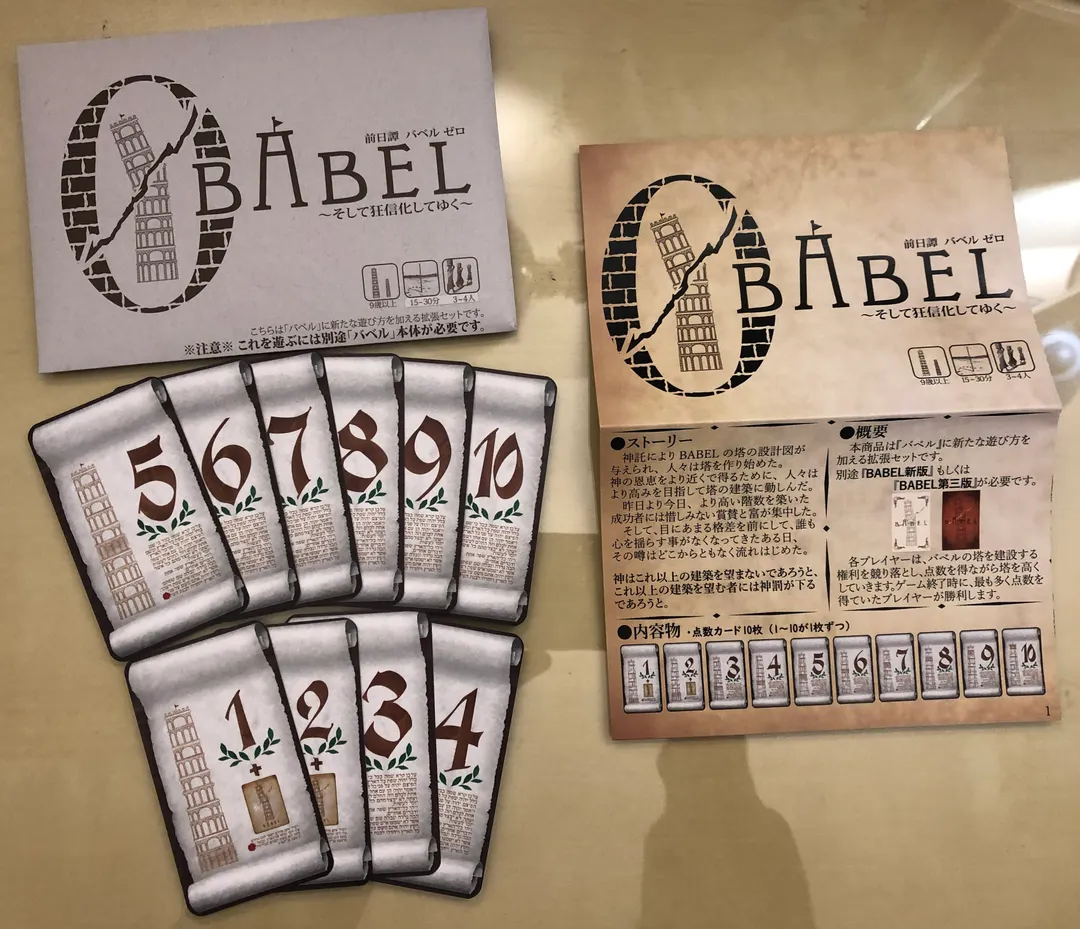
BABEL: 0
- 3–4 Spieler
- 15–30 Min.
- 2021
2016
Regelhilfe für BABEL
Verständliche Erklärungen zu Spielzügen, Karteneffekten und strittigen Situationen mit Verweisen auf offizielle Quellen und gespeichertem Fragenverlauf.
Für 1 Person
Was möchtest du wissen?
Antworten stammen aus dem offiziellen Regelheft, mit Seitenangabe zum Nachprüfen.
BABEL ist ein Brettspiel aus dem Jahr 2016 für 1–5 Personen, mit 15–30 Minuten pro Partie und ab 10 Jahren. Entwickelt wurde es von Masakazu Takizawa (たきざわ まさかず); die wichtigsten Mechaniken sind Hand Management und Cooperative Game.







Auf Englisch
BABEL is a balancing game in which players make a tower of paper by building walls of different heights. This game has three modes of play: hidden identity mode (saboteurs may exist), limited communication co-operative mode (players use strange languages - frog, robot, dog, cat, no words), and random co-operative mode (players may not choose walls). In hidden identity mode, players are secretly assigned a role: Builder or Saboteur (Fanatic is the 2nd Edition). A Builder's goal is to build an eight-tier tower, and a Saboteur's goal is to make one of the builders collapse the tower. The 2nd edition, published in 2017, kept the gameplay the same, but made significant changes to the components of the 1st edition (2016). The original edition had the player's Height cards also acting as the actual floors of the tower. The Height card had a sort of Pac-man shape. By combining two pieces, you made the hexagonal floor you would build. The player building the level was meant to arrange the floor parts to match the wall parts. That is, if the heights combined are a 3 and a 5, the 3-wall goes over the 3-floor, and the 5-wall goes over the 5-floor. The 2017 edition did away with this physical mechanism; instead, players had normal playing cards numbered 1 to 5, and wholly separate floor tiles to actually build with. This edition also introduced a new card 'Break Down The Wall', which means that only one wall piece is used in the level being built. Also, in the new edition, the tower starts with a floor, and on your turn you place two walls and then the floor. The new edition also has a sturdier box and is slightly larger. Gameplay Each player has three cards in their hand. In your turn, you place a floor card, which is numbered 1-5, face-up, and other players place a floor card face-down, saying a hint (saboteurs might be misleading you). Then you choose and reveal one of these face-down cards (the unused go unseen to a discard pile), take a floor tile (in the 2016 edition - combine the chosen card with yours to make a hexagonal floor), and take two walls that correspond to the floor numbers. You must place the floor and the walls on top of tower without making it collapse. Height of walls gradually vary over floor numbers, so you should pick the same number if you want to build an upright tower. If you are a saboteur, it's up to you whether you secretly or explicitly betray the builders. You may try to mislead builders to take unbalanced walls, or boldly build up a skewed tower in your turn. But beware. Your side loses the game if you make the tower collapse yourself. You may also reveal your identity during your turn, in which case builders need to complete one more floor to win the game. In the co-operative mode, players may loosely discuss which card ought to be selected (you cannot say obvious info, such as 'my card is a 3!'). But discussions are done in foreign languages - dog, cat, frog, robot, and no words. You are dealt a card and can only use your given language to communicate. The game can be played as a solitaire but only in random mode. You randomly take two floor cards and use the corresponding walls to build one tier. Repeat the process until you build 12-tier tower without it falling. There is an instructional manga by 七色洋品店 (Nanairo Youhinten) in the first edition. The second edition has a manga by Ayame Gonta (あやめ ゴン太). These are online on the Game Market webpage for the game (see links below). Publisher's summary BABEL is a dexterity game where you build a tower using walls of unoriented heights. You may play the game in 3 variations: Hidden identity mode - the traitor secretly tries to collapse the tower Co-op mode - as postfin of the myth, build with limited communications Solitaire mode - build the tower as high as you can with random draw of walls Difference between the first edition and the 2017 new version: The following improvements were made from the version sold at TGM2016. 1: Introduced the "Height Card". No need to combine the floor cards anymore. 2: Introduced the "Break down the wall" card. When played, the active player must build the tower with only 1 wall card this turn. 3: Construction order for each turn altered, from floor=>wall to wall=>floor. 4: More sturdier box. BABELは不ぞろいのカードを積み上げて、塔を完成させるバランスゲームです。 裏切り者が暗躍する正体隠匿モード、神話の後日談が楽しめる完全協力モード、ランダムにカードを積む神の戯れモード1パッケージで3つのモードが楽しめます。 初版と2017年新版との違い: 2016年にゲームイベント『ゲームマーケット』にて頒布した初版から、下記の点が改良されています。 1.高さ番号カードが導入され、半分ずつの床を組み合わせる必要がなくなりました。 2.壁柱1枚で支えなければならない〈破壊カード〉が追加されました。 3.手番での建設行程が、床→壁から壁→床に変わりました。 4.箱が頑丈になりました。 BABELは不揃いの高さの壁カードを積み上げ塔を完成させるバランスゲームです。裏切り者が暗躍する正体隠匿モード、神話の後日談を楽しむ母語が使えなくなる完全協力モード、ランダムに壁カードを積む髪の戯れモード、1パッケージで3つのモードが楽しめます。 ●正体隠匿モード● 人数+1枚の人格カードを配り、建設者(建てたい人)狂信者(壊したい人)を決定します。床カード5種を各3枚配り、手番プレイヤーはその中から1枚を表にして出します。他のプレイヤーは一言そえて裏向きにカードを出します。手番プレイヤーはその中から1枚選び床カードを組み合わせ1枚にし、対応する、高さの違う壁カード(5種類あります)をそれぞれの床の上にのせます。8段積めたら建設者の勝ち、塔を崩したらその陣営の負けになります。また、狂信者は自分の手番に正体を明かすことで、完成段数を1段上げることができます。
Laut Katalog unterstützt BABEL 1–5 Personen. Diese Spanne entspricht der vom Verlag angegebenen Spielerzahl, das Spiel lässt sich also für jede Gruppengröße innerhalb dieser Spanne aufbauen. Aufbau, einzelne Regeln und Wertungsdetails können je nach Personenzahl trotzdem abweichen; prüfe daher die genaue Konfiguration in der Anleitung deiner Ausgabe.
Die angegebene Spieldauer für BABEL beträgt 15–30 Minuten. Das ist die Schätzung des Verlags für eine vollständige Partie. Die tatsächliche Dauer hängt von der Gruppe, der Personenzahl und der Regelkenntnis ab: Erste Partien dauern meist länger, erfahrene Gruppen sind oft schneller fertig. Aufbau und Regelerklärung sind in dieser Schätzung nicht enthalten.
Im Katalog wird BABEL ab 10 Jahren empfohlen. Das ist die Empfehlung des Verlags und berücksichtigt Leseanforderungen, Regelkomplexität und Kleinteile, nicht nur das Thema. Jüngere Kinder können oft mit Hilfe eines Erwachsenen mitspielen; beachte die Altersangabe deiner Ausgabe und die Brettspielerfahrung deiner Gruppe.
BABEL gehört zu diesen Kategorien: Card Game, Party Game und Bluffing. Die wichtigsten Mechaniken sind Hand Management und Cooperative Game. Kategorien beschreiben Thema und Setting eines Spiels, Mechaniken dagegen, was die Spielenden in ihrem Zug tatsächlich tun. Jede Mechanik führt zu einer Katalogseite mit ähnlichen Spielen, falls du etwas Vergleichbares suchst.
Als Autoren von BABEL sind angegeben: Masakazu Takizawa (たきざわ まさかず). Diese Angaben stammen aus den veröffentlichten Spieldaten und nennen die für das Spieldesign verantwortlichen Personen, nicht die Illustratoren oder Verlage. Die Autorenseiten auf MeepleRules sammeln weitere Titel derselben Autoren – praktisch, wenn dir ein Spiel gefällt und du ähnliche Spiele suchst.
Im Katalog ist BABEL als Grundspiel aufgeführt. Es lässt sich eigenständig mit dem Material aus der Schachtel spielen und benötigt keinen weiteren Titel. Erweiterungen, sofern es welche gibt, ergänzen neues Material oder neue Regeln und sind im Katalog separat mit einem Verweis auf dieses Grundspiel aufgeführt.