
- BGG-Rang
- BGG #6.622
- BGG-Bewertung
- 8,1
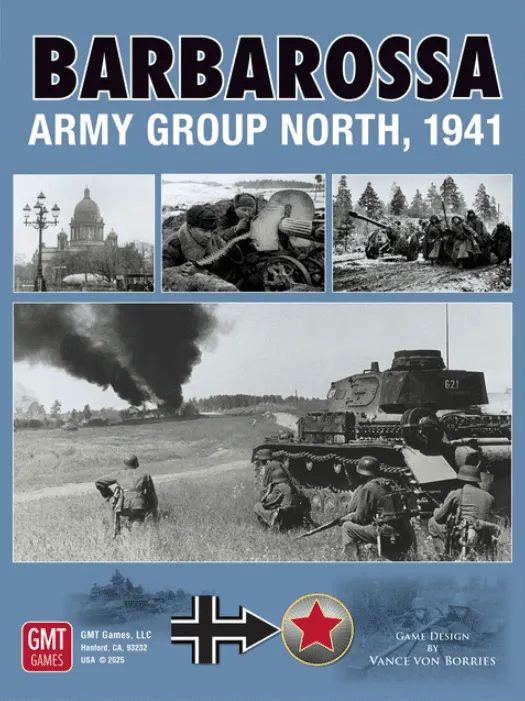
Barbarossa: Army Group North, 1941
- 1–4 Spieler
- 300 Min.
- Komplexität 4,2/5
- 2000
1998
Regelhilfe für Barbarossa: Army Group Center, 1941
Verständliche Erklärungen zu Spielzügen, Karteneffekten und strittigen Situationen mit Verweisen auf offizielle Quellen und gespeichertem Fragenverlauf.
Für 1 Person
Was möchtest du wissen?
Antworten stammen aus dem offiziellen Regelheft, mit Seitenangabe zum Nachprüfen.
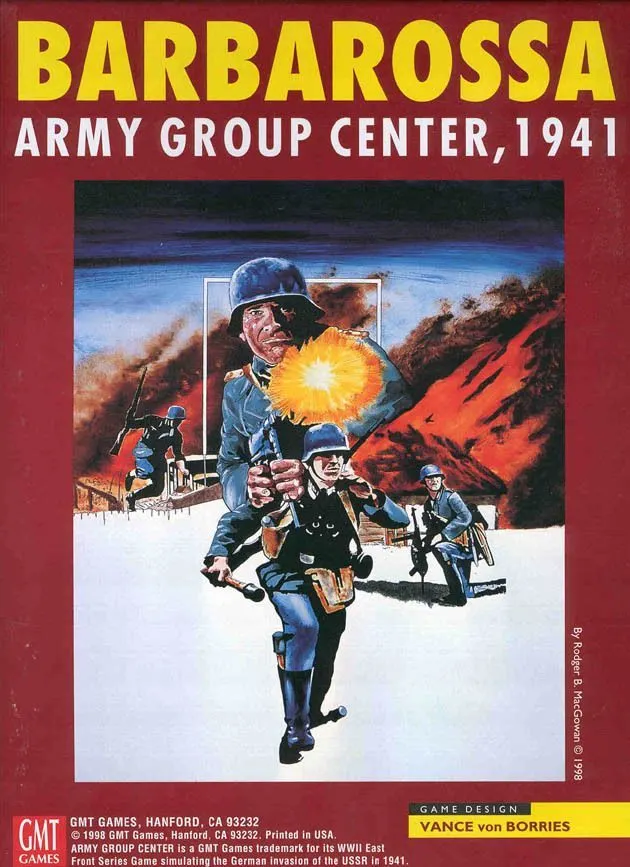
Barbarossa: Army Group Center, 1941 ist ein Brettspiel aus dem Jahr 1998 für 1–4 Personen, mit 120 Minuten pro Partie und ab 12 Jahren. Entwickelt wurde es von Vance von Borries und Tony Curtis; die wichtigsten Mechaniken sind Hexagon Grid.



Auf Englisch
Historical Setting June 1941 -- Army Group Center hurls itself through the Soviet border defenses, and its two Panzer groups race headlong toward Minsk. Behind them lie the remnants of the Soviet Western Front -- almost a million men in four armies. The Soviets are stunned by the German Blitzkrieg. Their responses are slow, confused, and governed by pre-war contingency plans made obsolete by the speed of the German advance. In little more than a week, the German panzer spearheads meet east of Minsk. Though isolated units continue to fight, the entire Soviet Western Front has ceased to exist! The Germans' next target is Smolensk, but the Soviets resist more effectively. Entire armies are dispatched from other parts of the Soviet Union as the true scope of the Minsk pocket disaster and the magnitude of the German threat become known. Soviet counterattacks, especially around Lepel, are thrown back with horrific losses. Once again the Panzer Groups charge eastward, creating yet another huge Soviet pocket west of Smolensk. The Soviets resist savagely. Smolensk falls on July 13th, but the pocket does not close. Many Soviet units escape to fight another day. Hitler now makes a fateful decision and overrides his generals. Over half of Army Group Center's armored and air formations are diverted south to take Kiev or north to isolate Leningrad. No longer under heavy pressure, the Soviets gain time to form solid fronts around Vyazma and Bryansk. Did Hitler's decision cost the Germans the war? Play Barbarossa: Army Group Center and find out for yourself Game Features Eight scenarios allow players to vary their level of involvement, complexity, and starting point, from introductory to full campaign An asymmetrical sequence of play that highlights Axis armored breakthroughs and Soviet difficulties in combined arms warfare. This includes a “non-op” Soviet HQ system to simulate the rigid, yet fragile, Soviet Command structure Detailed air rules which integrate with land combat and weather rules Incredibly detailed Order of Battle, including special coverage of artillery, rocket artillery, engineers, bridge units, armored trains, and much more Modifications to the proven “EFS” include many revised rules and procedures, as well as new Order of Battle information Extensive bibliography and design/historical notes COMPONENTS • Four 22" × 34" inch maps (Maps C, D, H, and I) • One 25½" × 11½" inch map (Map WA) • 1400 die-cut ½" counters in five full counter sheets • One Rule Book • One Playbook • One 11" × 17" Map Card (with Scenario 3 and 6 Maps either side) • Three double-sided Soviet Set Up Cards (with backside of one card containing a Game Card displaying all Scenario 3 and 6 units) • Two double-sided Axis Set Up Cards (with CRT on one) • One single-sided 8½" × 11" combined Axis and Soviet Step Reduction Organization Card • Two double-sided 11" × 17" inch folded Chart Cards with Combat Results Table, Terrain Effects Chart, Overrun, AA, Air Combat, CAB, etc. charts • One double-sided 11" × 17" inch folded Chart Card with Units and their Symbols, Movement Phase, Effects on Movement Chart, Artillery, etc. charts • One double-sided 8½" × 11" chart card front side Axis/Soviet Set Up Card for Scenario 1 and backside with Super-Heavy Artillery Effects Table • Two single-sided 8½" × 11" Air Unit Status/Unit Rebuilding Cards (one Soviet and one Axis) • One double-sided 11" × 17" inch folded Chart Card containing Scenario Victory Conditions, Replacement Table, Fuel, ASPs, RR Conversion • One single-sided 8½" × 11" Chart Card with Turn Record Track, Weather Table, and various scenario information summaries • Two 11" × 17" Expanded Sequences of Play Cards • One ten-sided die TIME SCALE 2 days per turn MAP SCALE 5 miles per hex GROUND UNIT SCALE Division/Regiment AIR UNIT SCALE 40-80 aircraft per counter NUMBER OF PLAYERS One to four (2nd edition description, from GMT website and components from Playbook) This is one of a very popular series of games from GMT covering the first months of the invasion of the USSR; units are battalions through divisions, hexes are about 5 miles, and turns are two days. The system encompasses (as of 6/2001) Barbarossa: Army Group North (2000), Barbarossa: Army Group Center (1998), and Barbarossa: Army Group South (1996). Typhoon! (1995) is the progenitor of these games, and its system is quite similar, but it is unfortunately subtly incompatible with the later games. While not simple, these games are also not overly complex and present an excellent simulation of the early war. Most of the details of the campaigns are covered in a playable manner. Perhaps the most obviously interesting detail is the sequence of play, which is asymmetrical to account for the difficulties the Soviets labored under. Make no mistake, the Soviets are going to take a lot of abuse, but this is no walkover for the Germans and both sides are interesting to play. (BGG user description) 1st edition errata counters contained in Barbarossa: Crimea, 1941-42.
Laut Katalog unterstützt Barbarossa: Army Group Center, 1941 1–4 Personen. Diese Spanne entspricht der vom Verlag angegebenen Spielerzahl, das Spiel lässt sich also für jede Gruppengröße innerhalb dieser Spanne aufbauen. Aufbau, einzelne Regeln und Wertungsdetails können je nach Personenzahl trotzdem abweichen; prüfe daher die genaue Konfiguration in der Anleitung deiner Ausgabe.
Die angegebene Spieldauer für Barbarossa: Army Group Center, 1941 beträgt 120 Minuten. Das ist die Schätzung des Verlags für eine vollständige Partie. Die tatsächliche Dauer hängt von der Gruppe, der Personenzahl und der Regelkenntnis ab: Erste Partien dauern meist länger, erfahrene Gruppen sind oft schneller fertig. Aufbau und Regelerklärung sind in dieser Schätzung nicht enthalten.
Im Katalog wird Barbarossa: Army Group Center, 1941 ab 12 Jahren empfohlen. Das ist die Empfehlung des Verlags und berücksichtigt Leseanforderungen, Regelkomplexität und Kleinteile, nicht nur das Thema. Jüngere Kinder können oft mit Hilfe eines Erwachsenen mitspielen; beachte die Altersangabe deiner Ausgabe und die Brettspielerfahrung deiner Gruppe.
Barbarossa: Army Group Center, 1941 hat bei BoardGameGeek eine Komplexitätswertung von 4,0 von 5 und gilt damit als schweres Spiel. Die Wertung zeigt, wie viel Regelwissen, Planung und Entscheidungen eine typische Partie verlangt. Schwerere Spiele brauchen bei der ersten Erklärung mehr Zeit, daher hilft vor dem Spieleabend eine Vorbereitungsanleitung.
Barbarossa: Army Group Center, 1941 gehört zu diesen Kategorien: Wargame und World War II. Die wichtigsten Mechaniken sind Hexagon Grid. Kategorien beschreiben Thema und Setting eines Spiels, Mechaniken dagegen, was die Spielenden in ihrem Zug tatsächlich tun. Jede Mechanik führt zu einer Katalogseite mit ähnlichen Spielen, falls du etwas Vergleichbares suchst.
Als Autoren von Barbarossa: Army Group Center, 1941 sind angegeben: Vance von Borries und Tony Curtis. Diese Angaben stammen aus den veröffentlichten Spieldaten und nennen die für das Spieldesign verantwortlichen Personen, nicht die Illustratoren oder Verlage. Die Autorenseiten auf MeepleRules sammeln weitere Titel derselben Autoren – praktisch, wenn dir ein Spiel gefällt und du ähnliche Spiele suchst.
Im Katalog ist Barbarossa: Army Group Center, 1941 als Grundspiel aufgeführt. Es lässt sich eigenständig mit dem Material aus der Schachtel spielen und benötigt keinen weiteren Titel. Erweiterungen, sofern es welche gibt, ergänzen neues Material oder neue Regeln und sind im Katalog separat mit einem Verweis auf dieses Grundspiel aufgeführt.