
- BGG-Bewertung
- 7,7
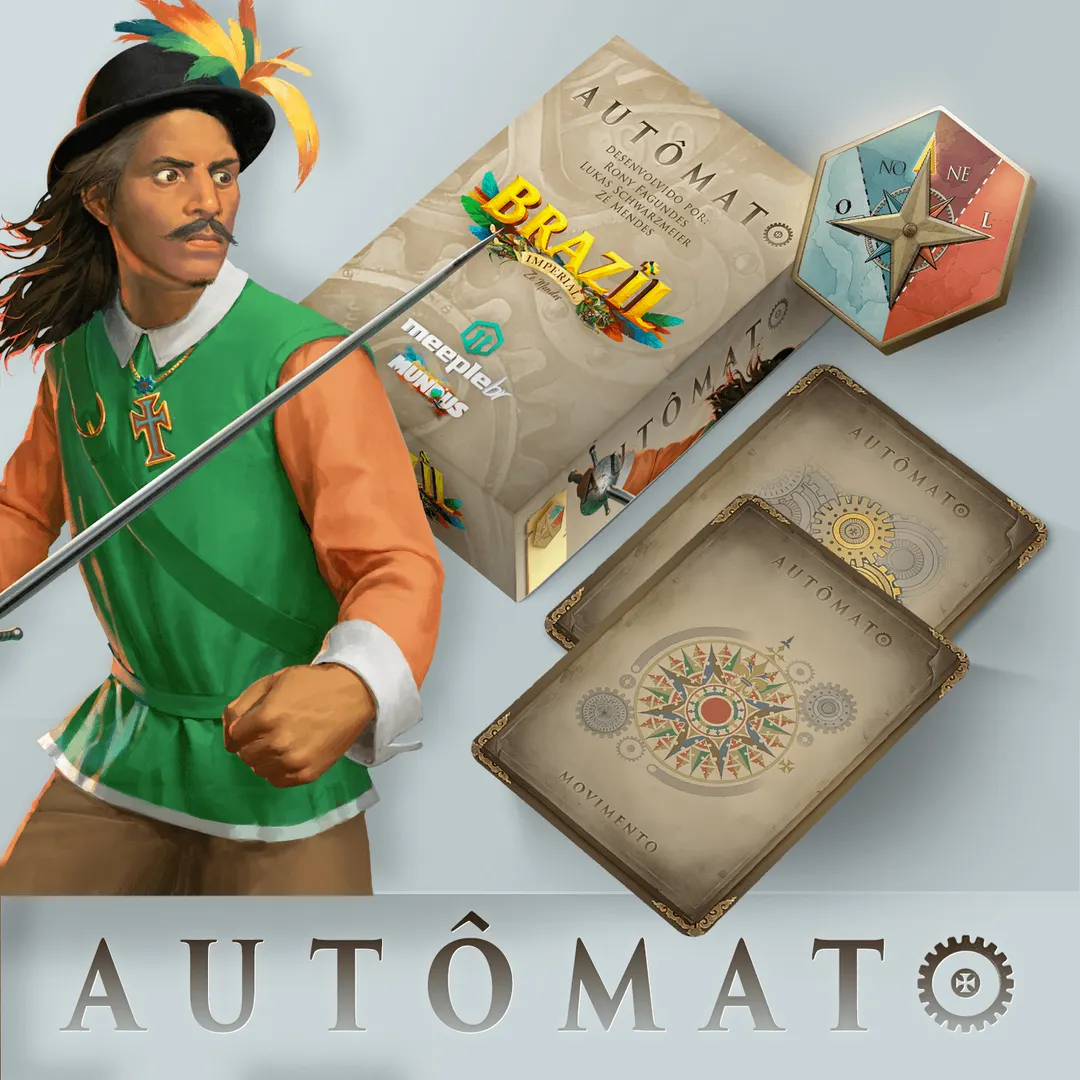
Brazil: Imperial – Autômato
- 1–4 Spieler
- 100 Min.
- Komplexität 2,8/5
- 2022

2021
Regelhilfe für Brazil: Imperial
Verständliche Erklärungen zu Spielzügen, Karteneffekten und strittigen Situationen mit Verweisen auf offizielle Quellen und gespeichertem Fragenverlauf.
Für 1 Person
Was möchtest du wissen?
Antworten stammen aus dem offiziellen Regelheft, mit Seitenangabe zum Nachprüfen.
Brazil: Imperial ist ein Brettspiel aus dem Jahr 2021 für 1–4 Personen, mit 100 Minuten pro Partie und ab 14 Jahren. Entwickelt wurde es von Zé Mendes; die wichtigsten Mechaniken sind Variable Player Powers, Tile Placement und Grid Movement.





Auf Englisch
Take on the role of one of the great monarchs of the past, and show your valor! You will arrive in a vast and rich territory, but the road to the prosperity is filled with challenges. In Brazil: Imperial, you need to construct buildings, manage resources, explore the land, create trade, acquire the support of the greatest personalities of the country, and recruit a powerful army to protect your interest against the rival states. If you make the right choices, you can complete missions to progress to a more advanced era, receiving new interesting options of development and victory points. In the end, the best monarch receives the title of Brazilian Emperor and constructs a new era of prosperity, freedom and peace! In more detail, while playing in a modular map board that recreate real regions, you use a combination of worker placement, area majority, and individual powers to construct an empire in Brazil between the 16th and 19th centuries. You start by choosing one of the available monarchs and its personal game board and components; some monarchs are strong in combat, while others prioritize science or exploration. You receive tasks that advance you to a new era when you complete them, giving you access to more power constructions as you move into the second and third eras of the game, then you choose a starting point on the shared map. On each turn, you can participate in an action phase and a movement phase. You manage actions on your individual game board, and you have these seven choices: Deploy: Summon one military unit to explore and defend your territory. Frame: Buy cards that represent famous historic figures to receive special powers and victory points. Build: Construct farms, mines, cities, and other structures to generate resources and do other things. Renovate: Overhaul an old building to produce new resources. Manufacture: Produce basic resources — wood, sugar cane, cotton, or coffee — to receive victory points, improve your "action arches", and have raw material for more valuable products. Harbor: Go to the port to receive a small amount of basic resources. Trade: Sell your basic resources to receive gold and special cards to improve your empire. During the movement phase, you can explore hidden places or attack other players. For combat, you check the power of the troops involved in the conflict to determine the winner, with cards being able to modify these values. Once a player completes their goals in the third era, the game ends and players tally their scores. Brazil: Imperial was developed with the concept of it being "Euro X", a new style of game that combines Eurogames (in which you collect and manage resources) and 4x games (in which you explore, expand, exploit and exterminate). A new concept of maps was also introduced in this game. All maps are different and created with modular boards that recreate real regions of Brazil and the world. Each game you can focus on resource management, combat, or a combination of both, depending on your choice of monarch and the interaction with other players.
Laut Katalog unterstützt Brazil: Imperial 1–4 Personen. Diese Spanne entspricht der vom Verlag angegebenen Spielerzahl, das Spiel lässt sich also für jede Gruppengröße innerhalb dieser Spanne aufbauen. Aufbau, einzelne Regeln und Wertungsdetails können je nach Personenzahl trotzdem abweichen; prüfe daher die genaue Konfiguration in der Anleitung deiner Ausgabe.
Die angegebene Spieldauer für Brazil: Imperial beträgt 100 Minuten. Das ist die Schätzung des Verlags für eine vollständige Partie. Die tatsächliche Dauer hängt von der Gruppe, der Personenzahl und der Regelkenntnis ab: Erste Partien dauern meist länger, erfahrene Gruppen sind oft schneller fertig. Aufbau und Regelerklärung sind in dieser Schätzung nicht enthalten.
Im Katalog wird Brazil: Imperial ab 14 Jahren empfohlen. Das ist die Empfehlung des Verlags und berücksichtigt Leseanforderungen, Regelkomplexität und Kleinteile, nicht nur das Thema. Jüngere Kinder können oft mit Hilfe eines Erwachsenen mitspielen; beachte die Altersangabe deiner Ausgabe und die Brettspielerfahrung deiner Gruppe.
Brazil: Imperial hat bei BoardGameGeek eine Komplexitätswertung von 3,0 von 5 und gilt damit als mittelschweres Spiel. Die Wertung zeigt, wie viel Regelwissen, Planung und Entscheidungen eine typische Partie verlangt. Schwerere Spiele brauchen bei der ersten Erklärung mehr Zeit, daher hilft vor dem Spieleabend eine Vorbereitungsanleitung.
Brazil: Imperial gehört zu diesen Kategorien: Territory Building, Exploration und City Building. Die wichtigsten Mechaniken sind Variable Player Powers, Tile Placement und Grid Movement. Kategorien beschreiben Thema und Setting eines Spiels, Mechaniken dagegen, was die Spielenden in ihrem Zug tatsächlich tun. Jede Mechanik führt zu einer Katalogseite mit ähnlichen Spielen, falls du etwas Vergleichbares suchst.
Als Autoren von Brazil: Imperial sind angegeben: Zé Mendes. Diese Angaben stammen aus den veröffentlichten Spieldaten und nennen die für das Spieldesign verantwortlichen Personen, nicht die Illustratoren oder Verlage. Die Autorenseiten auf MeepleRules sammeln weitere Titel derselben Autoren – praktisch, wenn dir ein Spiel gefällt und du ähnliche Spiele suchst.
Im Katalog ist Brazil: Imperial als Grundspiel aufgeführt. Es lässt sich eigenständig mit dem Material aus der Schachtel spielen und benötigt keinen weiteren Titel. Erweiterungen, sofern es welche gibt, ergänzen neues Material oder neue Regeln und sind im Katalog separat mit einem Verweis auf dieses Grundspiel aufgeführt.