
- BGG-Rang
- BGG #17.301
- BGG-Bewertung
- 7,8
Gunshi: The Art of Strategy
- 2 Spieler
- 30–60 Min.
- Komplexität 2,0/5
- 2021
2016
Regelhilfe für Captain Dice (キャプテンダイス)
Verständliche Erklärungen zu Spielzügen, Karteneffekten und strittigen Situationen mit Verweisen auf offizielle Quellen und gespeichertem Fragenverlauf.
Was möchtest du wissen?
Antworten stammen aus dem offiziellen Regelheft, mit Seitenangabe zum Nachprüfen.
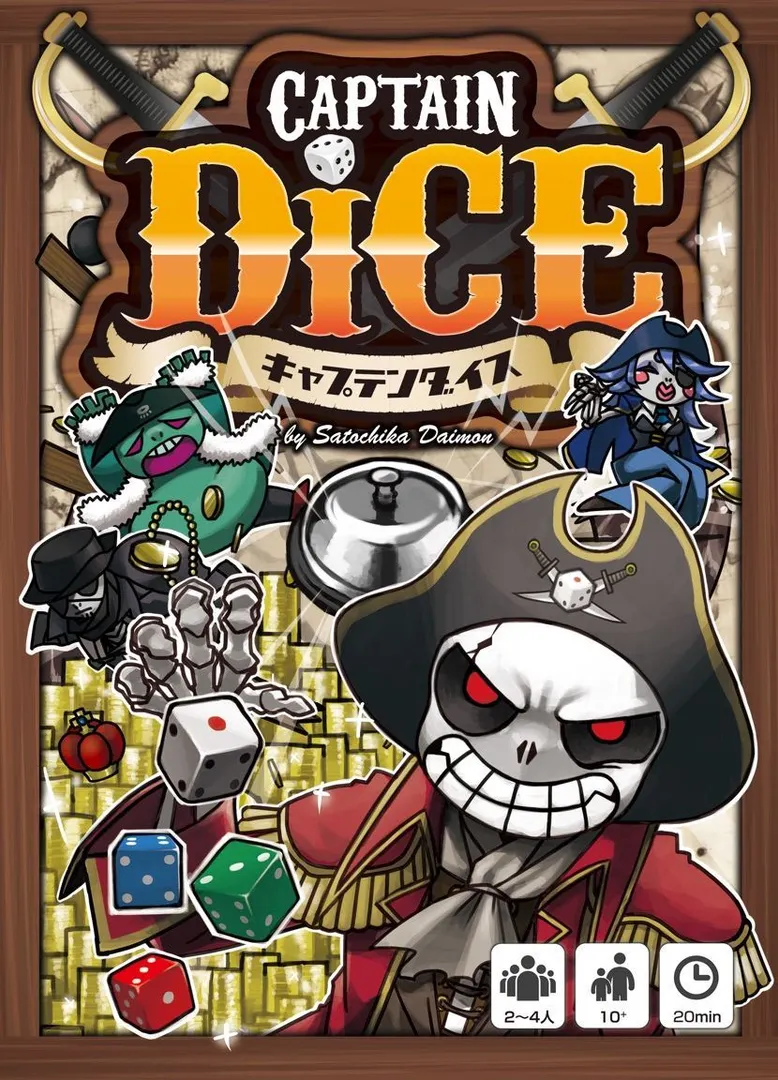
Captain Dice (キャプテンダイス) ist ein Brettspiel aus dem Jahr 2016 für 2–4 Personen, mit 20–30 Minuten pro Partie und ab 10 Jahren. Entwickelt wurde es von Satochika Daimon; die wichtigsten Mechaniken sind Hand Management, Dice Rolling und Area Majority / Influence.







Auf Englisch
User summary Captain Dice (キャプテンダイス) is a dice and action card game, combining speed and cunning. Swiftly place dice to secure treasure cards. Then replace your dice with action cards to attack the other players. Then collect treasure if your cards survive the attacks. The playing area is a grid of treasure cards and a bell in the centre. The bell is rung, and each player rolls and rerolls their own six dice entirely at will, trying to make combos to place on treasure cards. As soon as there are any three pairs in any line, any player may ring the bell to force a stop (and becomes the start player). It helps to secure treasure cards in sections; if you succeed, you collect all treasures you have linked up. Each player has nine cards, numbered 0 to 5 (four 5 cards each). Each card attacks neighbouring locations in different directions, except the 0 card which is a shield, and the 5 cards on which you are becalmed. Depending on which locations you grabbed, you take turns placing cards face down, taking back your dice. The actions are revealed and resolved, going from 0 to 5 (tied numbers are won closest to the start player). Here the tactical element appears. The cards 1 to 4 attack each other in set patterns, and in rank order from low to high. Since you cannot pick up cards spent in previous rounds until you clear your hand, you must choose carefully which cards you place where. If you think a spot is safe from any attack, you can safely spend a 5 card and help clear your hand. If you think a spot is certain to be attacked, place your 0 and it survives. If you have claimed places on straight lines, you'll collect all the empty treasure cards lying between them, so often you want to be secure. If you know what cards the others have spent, you might get your attack in first with a low numbered attack. After a couple of rounds, the tactical choices become very clear and frustrating. Using the wrong action cards is a costly waste. Failing to get dice down means you get fewer chances to collect treasure and it takes longer to clear your hand and pick up your discard. Once the action cards have been resolved, any left standing take the treasure cards below them or linked in straight lines, and the action cards go to a personal discard face-down. Empty treasure spots are refilled, and the bell is rung! The game ends when there is not enough treasure on the table. At the finish, most treasure cards wins. The game is fast and the theme fits the game play. The game is language free. The second edition simply revised the artwork on the box and cards to a more cartoon/manga style and added a strategic variant. Otherwise, components and gameplay are identical between the first and second editions. Publisher's summary Roll the dice to your heart’s content! Ring up a storm with the bells! Speed and strategies are both important for this analog game, which offers real-time domination + mind games, appealing to all 5 senses. Secure territories pre-emptively by placing a pair of dice on the treasure cards as fast as possible, then take time to think about how to protect the territories with attack cards, so that other players cannot foil your plans. If you are successful in holding your territory on the treasure cards, then SUCCESS! The treasure cards are rewarded to you and the process is repeated again. In the end, the player with the most treasure cards wins. サイコロ振りまくり!ベル鳴らしまくり! スピードも心理戦も両方大事な、リアルタイム陣取り×心理戦を五感で楽しめるアナログゲームです。 ひとことで言うとどんなゲーム? 場にある財宝カードをダイスの早置き勝負で自分の陣地として仮確保し、その後はじっくり考えながら攻撃カードを使って他プレイヤーに邪魔されないように陣地を守ります。 守りきった陣地の財宝カードをGET!という流れを繰り返します。 最終的に、財宝カードを一番多く獲得したプレイヤーの勝利というゲームです。
Laut Katalog unterstützt Captain Dice (キャプテンダイス) 2–4 Personen. Diese Spanne entspricht der vom Verlag angegebenen Spielerzahl, das Spiel lässt sich also für jede Gruppengröße innerhalb dieser Spanne aufbauen. Aufbau, einzelne Regeln und Wertungsdetails können je nach Personenzahl trotzdem abweichen; prüfe daher die genaue Konfiguration in der Anleitung deiner Ausgabe.
Die angegebene Spieldauer für Captain Dice (キャプテンダイス) beträgt 20–30 Minuten. Das ist die Schätzung des Verlags für eine vollständige Partie. Die tatsächliche Dauer hängt von der Gruppe, der Personenzahl und der Regelkenntnis ab: Erste Partien dauern meist länger, erfahrene Gruppen sind oft schneller fertig. Aufbau und Regelerklärung sind in dieser Schätzung nicht enthalten.
Im Katalog wird Captain Dice (キャプテンダイス) ab 10 Jahren empfohlen. Das ist die Empfehlung des Verlags und berücksichtigt Leseanforderungen, Regelkomplexität und Kleinteile, nicht nur das Thema. Jüngere Kinder können oft mit Hilfe eines Erwachsenen mitspielen; beachte die Altersangabe deiner Ausgabe und die Brettspielerfahrung deiner Gruppe.
Captain Dice (キャプテンダイス) hat bei BoardGameGeek eine Komplexitätswertung von 1,3 von 5 und gilt damit als leichtes Spiel. Die Wertung zeigt, wie viel Regelwissen, Planung und Entscheidungen eine typische Partie verlangt. Schwerere Spiele brauchen bei der ersten Erklärung mehr Zeit, daher hilft vor dem Spieleabend eine Vorbereitungsanleitung.
Captain Dice (キャプテンダイス) gehört zu diesen Kategorien: Dice, Action / Dexterity und Real-time. Die wichtigsten Mechaniken sind Hand Management, Dice Rolling und Area Majority / Influence. Kategorien beschreiben Thema und Setting eines Spiels, Mechaniken dagegen, was die Spielenden in ihrem Zug tatsächlich tun. Jede Mechanik führt zu einer Katalogseite mit ähnlichen Spielen, falls du etwas Vergleichbares suchst.
Als Autoren von Captain Dice (キャプテンダイス) sind angegeben: Satochika Daimon. Diese Angaben stammen aus den veröffentlichten Spieldaten und nennen die für das Spieldesign verantwortlichen Personen, nicht die Illustratoren oder Verlage. Die Autorenseiten auf MeepleRules sammeln weitere Titel derselben Autoren – praktisch, wenn dir ein Spiel gefällt und du ähnliche Spiele suchst.
Im Katalog ist Captain Dice (キャプテンダイス) als Grundspiel aufgeführt. Es lässt sich eigenständig mit dem Material aus der Schachtel spielen und benötigt keinen weiteren Titel. Erweiterungen, sofern es welche gibt, ergänzen neues Material oder neue Regeln und sind im Katalog separat mit einem Verweis auf dieses Grundspiel aufgeführt.