
- BGG-Bewertung
- 7,3
Casinopolis: Place Your Bets
- 1–4 Spieler
- 15 Min.
- 2025
2025
Regelhilfe für Casinopolis
Verständliche Erklärungen zu Spielzügen, Karteneffekten und strittigen Situationen mit Verweisen auf offizielle Quellen und gespeichertem Fragenverlauf.
Für 1 Person
Was möchtest du wissen?
Antworten stammen aus dem offiziellen Regelheft, mit Seitenangabe zum Nachprüfen.
Casinopolis ist ein Brettspiel aus dem Jahr 2025 für 1–4 Personen, mit 15 Minuten pro Partie und ab 8 Jahren. Entwickelt wurde es von Danny Devine, Steven Aramini und Paul Kluka; die wichtigsten Mechaniken sind Hand Management, Tile Placement und Layering.



Auf Englisch
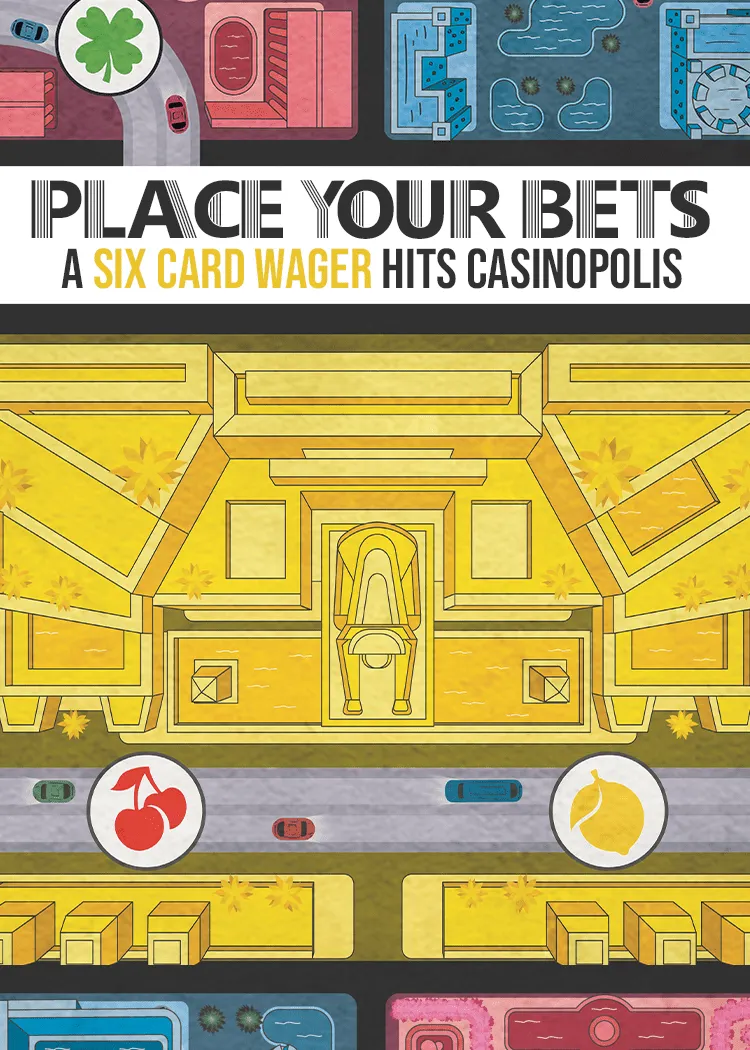
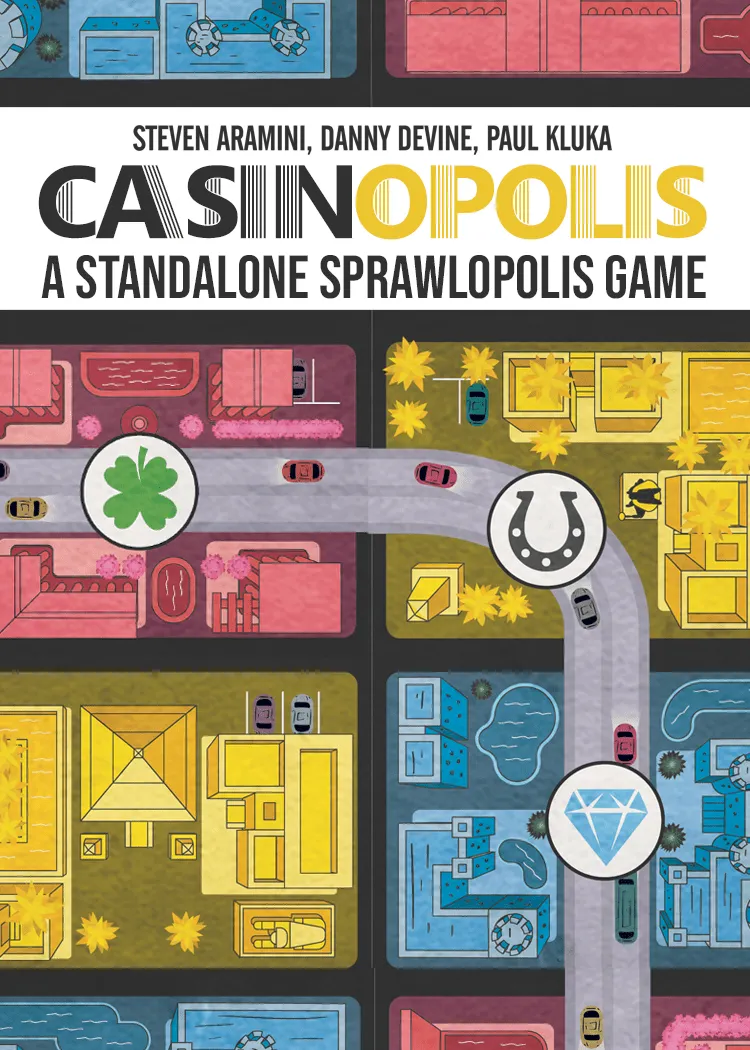
Ka-ching! Ka-ching! The sounds of slot machines paying out their lucky winners are everywhere. Build up the central strip with popular themed casinos to turn this town into a proper gambler's haven. Casinopolis is a standalone entry in the Sprawlopolis line of games, and plays similarly to the original with a few new twists. Place cards in an expanding map to create large groups of casinos, line up jackpot icons along roads, and balance scoring from three unique goals. You’ll need a little luck and a whole lot of skill to maximize your winnings! Casinopolis has 18 double-sided cards. One side shows the blocks that players use to expand their map, while the other side shows unique scoring conditions. 3 of these are randomly dealt at the start of the game to establish the 1-, 2-, and 3-chip bets for the game. The higher the bet, the more points that goal is worth at the end of the game. Players take turns adding a single card to the map. Cards must be added in a horizontal alignment. They can be placed next to or overlapping a previously-placed card. Each card features 4 blocks split among the 3 different casino colors. Adjacent blocks that share a color form larger casinos. Blocks can include up to 2 roads on them. Each road costs points at the end of the game, though their impact can be lessened by connecting segments across multiple blocks to form a single road. The longest road at the end of play is the Strip, where the most important casinos can be found. Roads may also include 1 or more of the 6 lucky symbols, which can pay off substantially at the end if lined up properly. Once all 15 cards have been played, the game ends and points are scored. Players gain 1 point per block from the largest casino of each type that is adjacent to the Strip, then lose 1 point for each road. Each scoring goal is evaluated in order, with each instance of the condition adding 1, 2, or 3 points to the total based on the goal’s placement at setup. Next, jackpots are scored: for each run of 3 or more matching lucky symbols that are adjacent on a shared road, score 1 point per icon. Finally, the total is compared to the target number: the sum of the 3 numbers listed on each goal card. Score higher than the target number to win the game!
Laut Katalog unterstützt Casinopolis 1–4 Personen. Diese Spanne entspricht der vom Verlag angegebenen Spielerzahl, das Spiel lässt sich also für jede Gruppengröße innerhalb dieser Spanne aufbauen. Aufbau, einzelne Regeln und Wertungsdetails können je nach Personenzahl trotzdem abweichen; prüfe daher die genaue Konfiguration in der Anleitung deiner Ausgabe.
Die angegebene Spieldauer für Casinopolis beträgt 15 Minuten. Das ist die Schätzung des Verlags für eine vollständige Partie. Die tatsächliche Dauer hängt von der Gruppe, der Personenzahl und der Regelkenntnis ab: Erste Partien dauern meist länger, erfahrene Gruppen sind oft schneller fertig. Aufbau und Regelerklärung sind in dieser Schätzung nicht enthalten.
Im Katalog wird Casinopolis ab 8 Jahren empfohlen. Das ist die Empfehlung des Verlags und berücksichtigt Leseanforderungen, Regelkomplexität und Kleinteile, nicht nur das Thema. Jüngere Kinder können oft mit Hilfe eines Erwachsenen mitspielen; beachte die Altersangabe deiner Ausgabe und die Brettspielerfahrung deiner Gruppe.
Casinopolis hat bei BoardGameGeek eine Komplexitätswertung von 1,7 von 5 und gilt damit als leichtes Spiel. Die Wertung zeigt, wie viel Regelwissen, Planung und Entscheidungen eine typische Partie verlangt. Schwerere Spiele brauchen bei der ersten Erklärung mehr Zeit, daher hilft vor dem Spieleabend eine Vorbereitungsanleitung.
Casinopolis gehört zu diesen Kategorien: Card Game, Territory Building und Print & Play. Die wichtigsten Mechaniken sind Hand Management, Tile Placement und Layering. Kategorien beschreiben Thema und Setting eines Spiels, Mechaniken dagegen, was die Spielenden in ihrem Zug tatsächlich tun. Jede Mechanik führt zu einer Katalogseite mit ähnlichen Spielen, falls du etwas Vergleichbares suchst.
Als Autoren von Casinopolis sind angegeben: Danny Devine, Steven Aramini und Paul Kluka. Diese Angaben stammen aus den veröffentlichten Spieldaten und nennen die für das Spieldesign verantwortlichen Personen, nicht die Illustratoren oder Verlage. Die Autorenseiten auf MeepleRules sammeln weitere Titel derselben Autoren – praktisch, wenn dir ein Spiel gefällt und du ähnliche Spiele suchst.
Im Katalog ist Casinopolis als Grundspiel aufgeführt. Es lässt sich eigenständig mit dem Material aus der Schachtel spielen und benötigt keinen weiteren Titel. Erweiterungen, sofern es welche gibt, ergänzen neues Material oder neue Regeln und sind im Katalog separat mit einem Verweis auf dieses Grundspiel aufgeführt.