

- BGG-Rang
- BGG #1.299
- BGG-Bewertung
- 7,2
Bonsai
- 1–4 Spieler
- 40 Min.
- Komplexität 1,8/5
- 2023
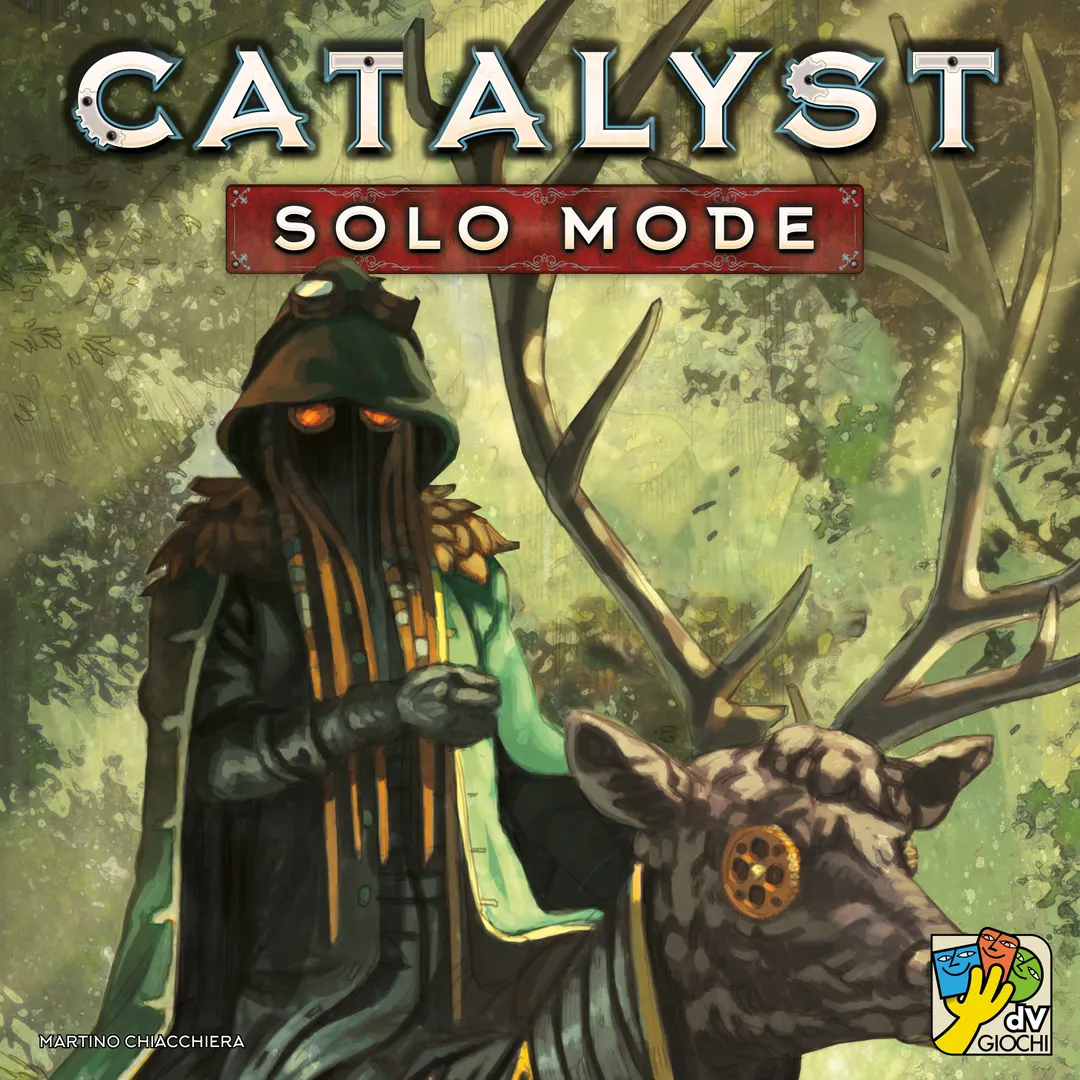
Regelhilfe für Catalyst: Solo mode
Verständliche Erklärungen zu Spielzügen, Karteneffekten und strittigen Situationen mit Verweisen auf offizielle Quellen und gespeichertem Fragenverlauf.
Was möchtest du wissen?
Antworten stammen aus dem offiziellen Regelheft, mit Seitenangabe zum Nachprüfen.
Catalyst: Solo mode ist eine Erweiterung für Catalyst aus dem Jahr 2019 für 1 Person, mit 20–30 Minuten pro Partie und ab 8 Jahren. Entwickelt wurde es von Martino Chiacchiera; die wichtigsten Mechaniken sind Set Collection und Open Drafting.


Auf Englisch
The official solo mode of Catalyst - originally released as a promotional set of rules in IoGioco game magazine. GOAL OF THE GAME Confront your skills against a fearsome Artificial Intelligence (AI). PREPARATION Choose the difficulty level: easy (+10 PV), standard (+20 PV), advanced (+30 PV). Follow the instructions for preparing a 2-player game. You are the first player. Return all building cards to the box with the exception of a building costing 1, one that costs 2, one that costs 3 and one that costs 4. They must all be of a different color and randomly selected (e.g.: play with the blue “1” building, the “2” red building, the “3” yellow building and the “4” green building). PLAYING THE GAME Play multiple turns in a row until the game ends. During each of your turns you must perform one of the three actions of the game, with the following additions to the normal rules: Collect Contributions: you get coins as usual, and the AI gets a military power token. Recruit a Catalyst: You recruit a Catalyst as usual, then take the first card to the left of the one you recruited and place it, without looking at it, in the deck of AI's scoring pile. If you recruit the first Catalyst to the right of the deck (the one on the space marked with “+1”), then place the top card of the draw pile, without looking at it, in the scoring pile of the AI. Activate a Catalyst: activate a Catalyst as usual, then place the card on top of the drawing deck, without looking at it, in the AI’s scoring pile. Note: When you get coins or actions to recruit a Catalyst through a Catalyst or a building’s effects, and when you spend Chain activation tokens to activate Catalysts, the additions to the normal rules (see above) do not apply: This means that while you perform the effect of an activated Catalyst or building, the AI does not get any military power tokens nor you must put cards in its scoring pile. THE END OF YOUR TURN As in the standard rules, after you have chosen and performed one action (and possibly the AI has gained a card in its scoring pile or a military power token), your turn is over. If one or more spaces of the board are empty, slide the other cards to the right until there are no gaps, then draw new cards from the deck to fill the board back up to 5 cards. THE END OF THE GAME When the last card of the reserve deck is discarded or put on the board, the game ends immediately. Count your VPs as usual, including the goal card’s points. The AI instead obtains the VPs written on the cards in its scoring pile, the VPs provided by each pair of its military power tokens (and for the majority), and additional VPs depending on the difficulty level chosen (see Preparation). If you scored at least 1 VP more than the AI, you won – otherwise, try harder! —description from the publisher
Laut Katalog unterstützt Catalyst: Solo mode 1 Person. Das ist die vom Verlag angegebene Spielerzahl, das Spiel ist also genau für diese Anzahl von Mitspielenden ausgelegt. Varianten für andere Gruppengrößen sind, sofern vorhanden, in der Anleitung deiner Ausgabe beschrieben; prüfe sie, bevor du eine andere Konfiguration aufbaust.
Die angegebene Spieldauer für Catalyst: Solo mode beträgt 20–30 Minuten. Das ist die Schätzung des Verlags für eine vollständige Partie. Die tatsächliche Dauer hängt von der Gruppe, der Personenzahl und der Regelkenntnis ab: Erste Partien dauern meist länger, erfahrene Gruppen sind oft schneller fertig. Aufbau und Regelerklärung sind in dieser Schätzung nicht enthalten.
Im Katalog wird Catalyst: Solo mode ab 8 Jahren empfohlen. Das ist die Empfehlung des Verlags und berücksichtigt Leseanforderungen, Regelkomplexität und Kleinteile, nicht nur das Thema. Jüngere Kinder können oft mit Hilfe eines Erwachsenen mitspielen; beachte die Altersangabe deiner Ausgabe und die Brettspielerfahrung deiner Gruppe.
Catalyst: Solo mode gehört zu diesen Kategorien: Card Game und Expansion for Base-game. Die wichtigsten Mechaniken sind Set Collection und Open Drafting. Kategorien beschreiben Thema und Setting eines Spiels, Mechaniken dagegen, was die Spielenden in ihrem Zug tatsächlich tun. Jede Mechanik führt zu einer Katalogseite mit ähnlichen Spielen, falls du etwas Vergleichbares suchst.
Als Autoren von Catalyst: Solo mode sind angegeben: Martino Chiacchiera. Diese Angaben stammen aus den veröffentlichten Spieldaten und nennen die für das Spieldesign verantwortlichen Personen, nicht die Illustratoren oder Verlage. Die Autorenseiten auf MeepleRules sammeln weitere Titel derselben Autoren – praktisch, wenn dir ein Spiel gefällt und du ähnliche Spiele suchst.
Im Katalog ist Catalyst: Solo mode als Erweiterung zu Catalyst aufgeführt. Erweiterungen ergänzen das Grundspiel um neues Material, neue Regeln oder Szenarien und sind meist nicht eigenständig spielbar; du brauchst also Catalyst, um sie zu nutzen. Prüfe, ob deine Ausgabe von Catalyst kompatibel ist, da manche Erweiterungen zwischen den Auflagen überarbeitet wurden.