- BGG-Bewertung
- 8,4
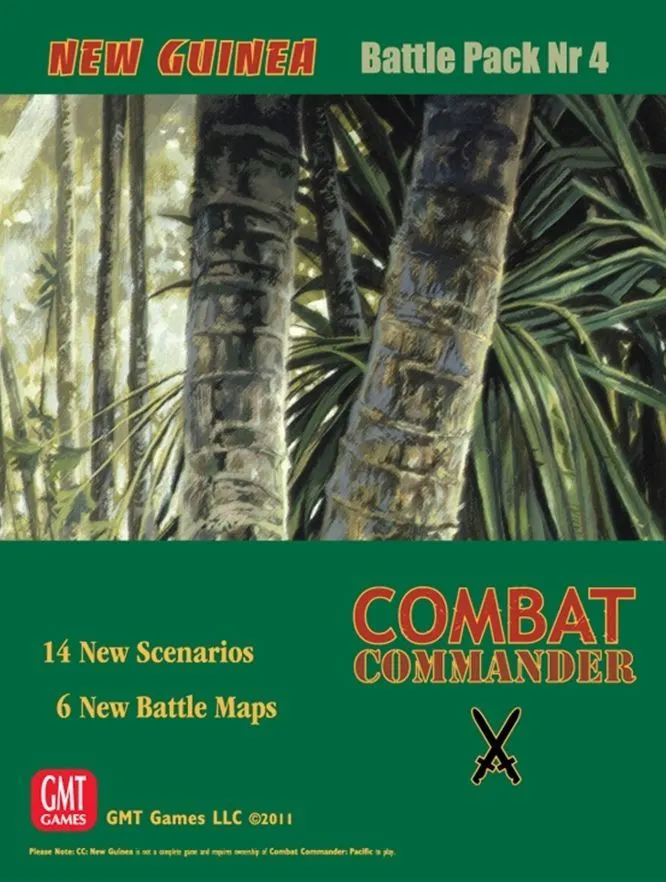
Combat Commander: Battle Pack #4 – New Guinea
- 2 Spieler
- 180 Min.
- Komplexität 3,0/5
- 2011
2008
Regelhilfe für Combat Commander: Pacific
Verständliche Erklärungen zu Spielzügen, Karteneffekten und strittigen Situationen mit Verweisen auf offizielle Quellen und gespeichertem Fragenverlauf.
Für 2 Personen
Was möchtest du wissen?
Antworten stammen aus dem offiziellen Regelheft, mit Seitenangabe zum Nachprüfen.
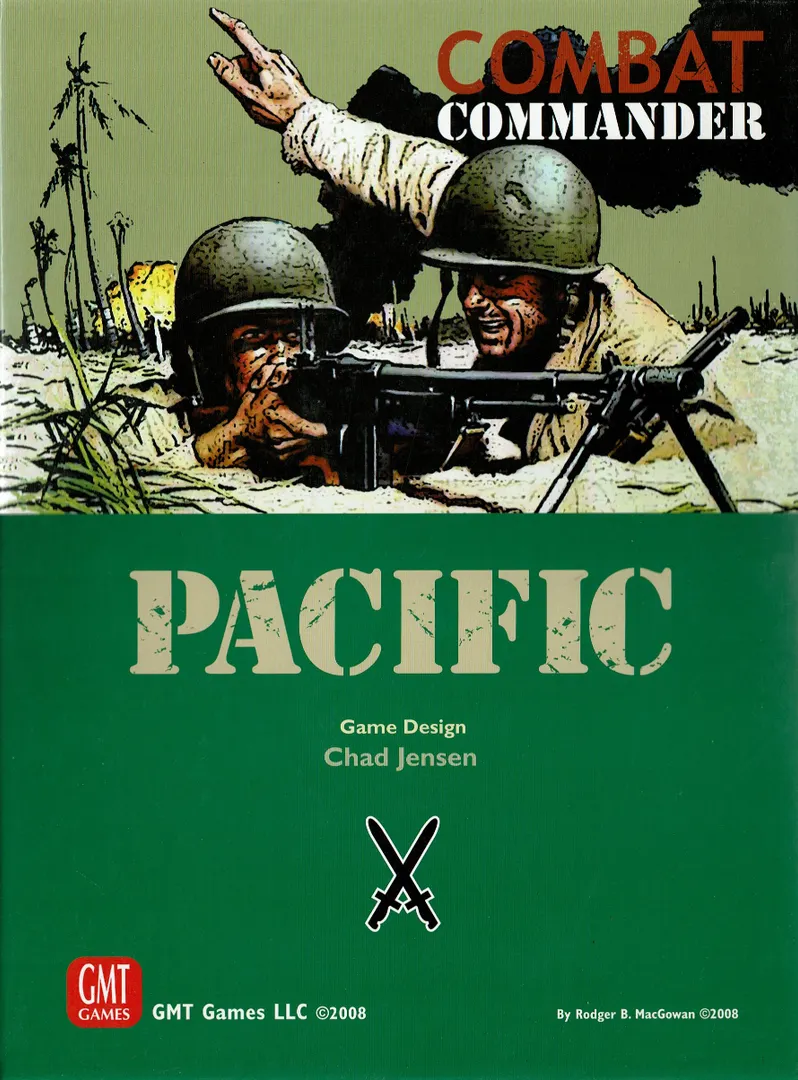
Combat Commander: Pacific ist ein Brettspiel aus dem Jahr 2008 für 2 Personen, mit 180 Minuten pro Partie und ab 12 Jahren. Entwickelt wurde es von Chad Jensen, John Foley und Kai Jensen; die wichtigsten Mechaniken sind Hexagon Grid, Simulation und Line of Sight.









Auf Englisch
Combat Commander:Pacific is a card-driven board game covering tactical infantry combat in the Pacific Theater of World War II. CC:P's main theme is the addition of three new factions to the Combat Commander family: Imperial Japan the Pacific US - with a strong emphasis on the US Marine Corps the Pacific Commonwealth - focusing on Indian and ANZAC forces CC:P is a stand alone game in the card-driven Combat Commander game series. While utilizing Combat Commander: Europe's basic rules, CC:P includes numerous rule tweaks and additions in order to more accurately portray tactical warfare as experienced by the participants in and around the Pacific and Indian Oceans. This slightly ramps up the complexity of the Combat Commander series while at the same time imparting a bit more depth and realism. Just a few of the additions include: Banzai attacks; BARs and Thompson SMGs; Beach landings & river crossings; Hidden movement; Caves; Scouts; Aircraft; Bayonets; Mortar spotting; Treetop snipers; Reconnoitering. SCALE: Each hex of a Combat Commander map is roughly 100 feet across (about 30 meters). Each complete Player Turn abstractly represents several seconds of real time. Each complete Game Turn abstractly represents several minutes of real time. UNITS: Due in part to the unique composition of late-war USMC squads and the imbedding of specialized weapon teams within IJA squads, the units in the game are represented by 4-6 man Teams and 8-13 man Squads. Radios — and individual weapons larger than a rifle — are represented by their own counters. Individual Aircraft are also represented with their own counters. VICTORY: Players attempt to achieve victory by moving their combat units across the game map to attack their opponent’s combat units and occupy as many objectives as possible. The degree to which a player succeeds or fails is measured by a scenario’s specific Objective chits, the destruction of enemy units, and the exiting of friendly units off the opponent’s board edge. GAME FLOW: A game of Combat Commander is divided into several Time segments. There is no sequence of play to follow, however: each Time segment is divided into a variable number of Player Turns, each of which may consist of one or more Fate Card "Orders" conducted by the active player. Fate Card "Actions" may generally be conducted by either player at any time. "Events" and die roll "Triggers" — both good and bad — will occur at random intervals to add a bit of chaos and uncertainty to each player’s perfect plan. CC:P includes twelve maps featuring terrain specific to the PTO. CC:P's playbook includes: twelve scenarios. Pacific version of the Random Scenario Generator utilizing the new maps and nationalities. This random scenario system provides an almost unending variety of map configurations, force structures, and combat situations. section detailing the differences between CC:P and Combat Commander's first two volumes in order that players familiar with those earlier games can jump right into their first scenario with minimal rules reading. examples of play. Design & Development notes as well as numerous play hints. Components: 352x large counters (5/8") 280x small counters (1/2") 220x 2.5 x 3.5 cards 6x 2-sided 17 x 22 maps (twelve maps in total) 3x 2-sided 8.5 x 11 nation-specific player aid sheets 2x 1-sided 8.5 x 11 generic player aid sheets 1x 32-page Rulebook 1x 32-page Playbook 1x Track Display NOTE: Combat Commander:Pacific is a stand-alone game. You do NOT need to own any other Combat Commander game in order to play it, though familiarity with the system would be a plus.
Laut Katalog unterstützt Combat Commander: Pacific 2 Personen. Das ist die vom Verlag angegebene Spielerzahl, das Spiel ist also genau für diese Anzahl von Mitspielenden ausgelegt. Varianten für andere Gruppengrößen sind, sofern vorhanden, in der Anleitung deiner Ausgabe beschrieben; prüfe sie, bevor du eine andere Konfiguration aufbaust.
Die angegebene Spieldauer für Combat Commander: Pacific beträgt 180 Minuten. Das ist die Schätzung des Verlags für eine vollständige Partie. Die tatsächliche Dauer hängt von der Gruppe, der Personenzahl und der Regelkenntnis ab: Erste Partien dauern meist länger, erfahrene Gruppen sind oft schneller fertig. Aufbau und Regelerklärung sind in dieser Schätzung nicht enthalten.
Im Katalog wird Combat Commander: Pacific ab 12 Jahren empfohlen. Das ist die Empfehlung des Verlags und berücksichtigt Leseanforderungen, Regelkomplexität und Kleinteile, nicht nur das Thema. Jüngere Kinder können oft mit Hilfe eines Erwachsenen mitspielen; beachte die Altersangabe deiner Ausgabe und die Brettspielerfahrung deiner Gruppe.
Combat Commander: Pacific hat bei BoardGameGeek eine Komplexitätswertung von 3,3 von 5 und gilt damit als mittelschweres Spiel. Die Wertung zeigt, wie viel Regelwissen, Planung und Entscheidungen eine typische Partie verlangt. Schwerere Spiele brauchen bei der ersten Erklärung mehr Zeit, daher hilft vor dem Spieleabend eine Vorbereitungsanleitung.
Combat Commander: Pacific gehört zu diesen Kategorien: Wargame und World War II. Die wichtigsten Mechaniken sind Hexagon Grid, Simulation und Line of Sight. Kategorien beschreiben Thema und Setting eines Spiels, Mechaniken dagegen, was die Spielenden in ihrem Zug tatsächlich tun. Jede Mechanik führt zu einer Katalogseite mit ähnlichen Spielen, falls du etwas Vergleichbares suchst.
Als Autoren von Combat Commander: Pacific sind angegeben: Chad Jensen, John Foley und Kai Jensen. Diese Angaben stammen aus den veröffentlichten Spieldaten und nennen die für das Spieldesign verantwortlichen Personen, nicht die Illustratoren oder Verlage. Die Autorenseiten auf MeepleRules sammeln weitere Titel derselben Autoren – praktisch, wenn dir ein Spiel gefällt und du ähnliche Spiele suchst.
Im Katalog ist Combat Commander: Pacific als Grundspiel aufgeführt. Es lässt sich eigenständig mit dem Material aus der Schachtel spielen und benötigt keinen weiteren Titel. Erweiterungen, sofern es welche gibt, ergänzen neues Material oder neue Regeln und sind im Katalog separat mit einem Verweis auf dieses Grundspiel aufgeführt.