- BGG-Rang
- BGG #11.400
- BGG-Bewertung
- 6,5
Dark Empire: Revolution
2013
Regelhilfe für Dark Empire: Revolution
Verständliche Erklärungen zu Spielzügen, Karteneffekten und strittigen Situationen mit Verweisen auf offizielle Quellen und gespeichertem Fragenverlauf.
- 3–5 Spieler
- 60 Min.
- 12+
- Komplexität 2,6/5

Für 3 Personen
Regelassistent für Dark Empire: Revolution
Was möchtest du wissen?
Antworten stammen aus dem offiziellen Regelheft, mit Seitenangabe zum Nachprüfen.
Dark Empire: Revolution ist ein Brettspiel aus dem Jahr 2013 für 3–5 Personen, mit 60 Minuten pro Partie und ab 12 Jahren. Entwickelt wurde es von Daniel Danzer; die wichtigsten Mechaniken sind Hand Management, Simultaneous Action Selection und Traitor Game.
Über das Spiel
Auf Englisch
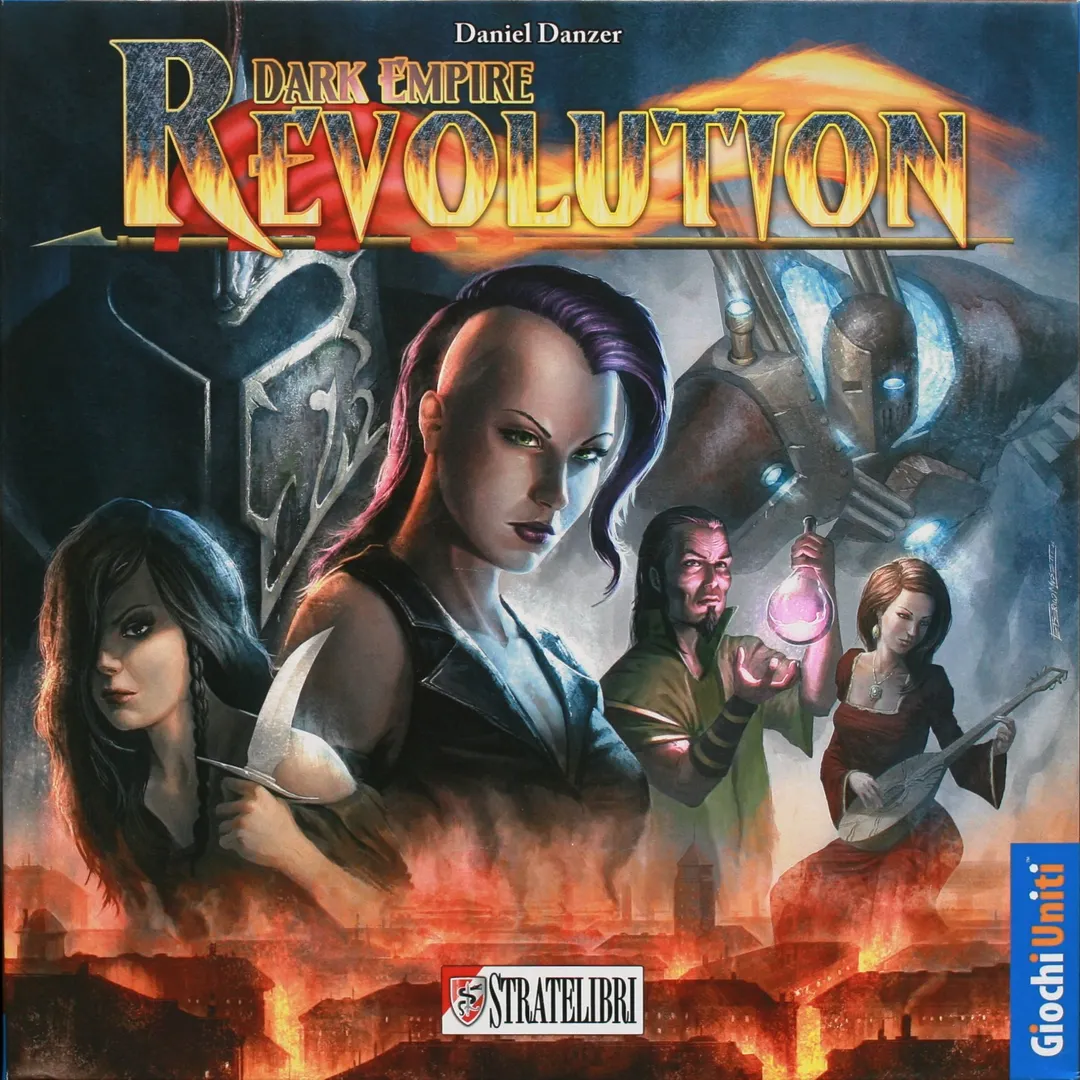
In the state of R’yan, five factions of the population rise against Emperor Flaut III: Students, Beggars, the City Guard, Alchemists, and the Apparats, medieval robots with a living soul, implemented by said Alchemists. These factions must work together to overcome the Emperor, but only one will eventually rule the future country. Otherwise, Flaut III suppresses the revolution and retains control... In Dark Empire: Revolution, each faction consists of a total of 13 cards: three cards with a value of 4-6 and two cards with values 7-8. There are ten additional cards which can be added to the strength of any faction card already in play. The table represents Vindoban, the capital of R`yan, where the emperor deploys his army on one side and the insurgent people gather on the other. The game is played over a series of turns ("weeks"). After four weeks, a month is completed with an intermediate scoring, and after three months a final scoring ends the game. Each player starts with a hand of seven cards, one random “secret goal” faction that the player attempts to guide to victory, and a set of "temporary support" cards. With these cards you secretly “bid” on the faction you believe will win the next month’s scoring by having accumulated the most points. Gameplay: players simultaneously place one card each in the centre of the table, either towards the revolutionary forces, or as a traitor on the emperor's side adding this value to an “Emperor card” already placed in that location. This happens three times, but you are only allowed to place one of your three cards as a traitor. The week is then resolved and the player who provided the most support for the strongest faction puts aside one of his cards for this faction to be scored; in addition, this player is immediately awarded 2 extra points. The player who played the highest single card for this faction (not necessarily the same player!) is awarded 1 point. But beware - when the emperor (his card plus all traitors) gained more points than each single faction, the Emperor card is placed to the scoring! The table is cleared and the next week begins. After four weeks, a month is over and an intermediate scoring takes place. If you are correct with your prediction of this month’s winner you gain another 6 points. After three months the final scoring occurs, determining the winner: the “secret goals” are revealed and the collected points of each player are added to the cards scored for their faction during the course of the game. The faction with the highest score wins the revolution - and the game. But: if the emperor can put down the rebellion - then the faction with the lowest score wins the game. Or, if the winning faction is too far ahead, it is immediately overthrown by all the others and the faction with the second highest score wins the game.
Autoren
Verlage
- Giochi Uniti
- Stratelibri
- spielpunk
Fragen und Antworten
Laut Katalog unterstützt Dark Empire: Revolution 3–5 Personen. Diese Spanne entspricht der vom Verlag angegebenen Spielerzahl, das Spiel lässt sich also für jede Gruppengröße innerhalb dieser Spanne aufbauen. Aufbau, einzelne Regeln und Wertungsdetails können je nach Personenzahl trotzdem abweichen; prüfe daher die genaue Konfiguration in der Anleitung deiner Ausgabe.
Die angegebene Spieldauer für Dark Empire: Revolution beträgt 60 Minuten. Das ist die Schätzung des Verlags für eine vollständige Partie. Die tatsächliche Dauer hängt von der Gruppe, der Personenzahl und der Regelkenntnis ab: Erste Partien dauern meist länger, erfahrene Gruppen sind oft schneller fertig. Aufbau und Regelerklärung sind in dieser Schätzung nicht enthalten.
Im Katalog wird Dark Empire: Revolution ab 12 Jahren empfohlen. Das ist die Empfehlung des Verlags und berücksichtigt Leseanforderungen, Regelkomplexität und Kleinteile, nicht nur das Thema. Jüngere Kinder können oft mit Hilfe eines Erwachsenen mitspielen; beachte die Altersangabe deiner Ausgabe und die Brettspielerfahrung deiner Gruppe.
Dark Empire: Revolution hat bei BoardGameGeek eine Komplexitätswertung von 2,6 von 5 und gilt damit als eher leichtes Spiel. Die Wertung zeigt, wie viel Regelwissen, Planung und Entscheidungen eine typische Partie verlangt. Schwerere Spiele brauchen bei der ersten Erklärung mehr Zeit, daher hilft vor dem Spieleabend eine Vorbereitungsanleitung.
Dark Empire: Revolution gehört zu diesen Kategorien: Card Game, Comic Book / Strip und Bluffing. Die wichtigsten Mechaniken sind Hand Management, Simultaneous Action Selection und Traitor Game. Kategorien beschreiben Thema und Setting eines Spiels, Mechaniken dagegen, was die Spielenden in ihrem Zug tatsächlich tun. Jede Mechanik führt zu einer Katalogseite mit ähnlichen Spielen, falls du etwas Vergleichbares suchst.
Als Autoren von Dark Empire: Revolution sind angegeben: Daniel Danzer. Diese Angaben stammen aus den veröffentlichten Spieldaten und nennen die für das Spieldesign verantwortlichen Personen, nicht die Illustratoren oder Verlage. Die Autorenseiten auf MeepleRules sammeln weitere Titel derselben Autoren – praktisch, wenn dir ein Spiel gefällt und du ähnliche Spiele suchst.
Im Katalog ist Dark Empire: Revolution als Grundspiel aufgeführt. Es lässt sich eigenständig mit dem Material aus der Schachtel spielen und benötigt keinen weiteren Titel. Erweiterungen, sofern es welche gibt, ergänzen neues Material oder neue Regeln und sind im Katalog separat mit einem Verweis auf dieses Grundspiel aufgeführt.