
- BGG-Rang
- BGG #213
- BGG-Bewertung
- 7,8
Endeavor: Age of Sail
- 2–5 Spieler
- 60–90 Min.
- Komplexität 2,9/5
- 2018
2009
Regelhilfe für Endeavor
Verständliche Erklärungen zu Spielzügen, Karteneffekten und strittigen Situationen mit Verweisen auf offizielle Quellen und gespeichertem Fragenverlauf.
Für 3 Personen
Was möchtest du wissen?
Antworten stammen aus dem offiziellen Regelheft, mit Seitenangabe zum Nachprüfen.
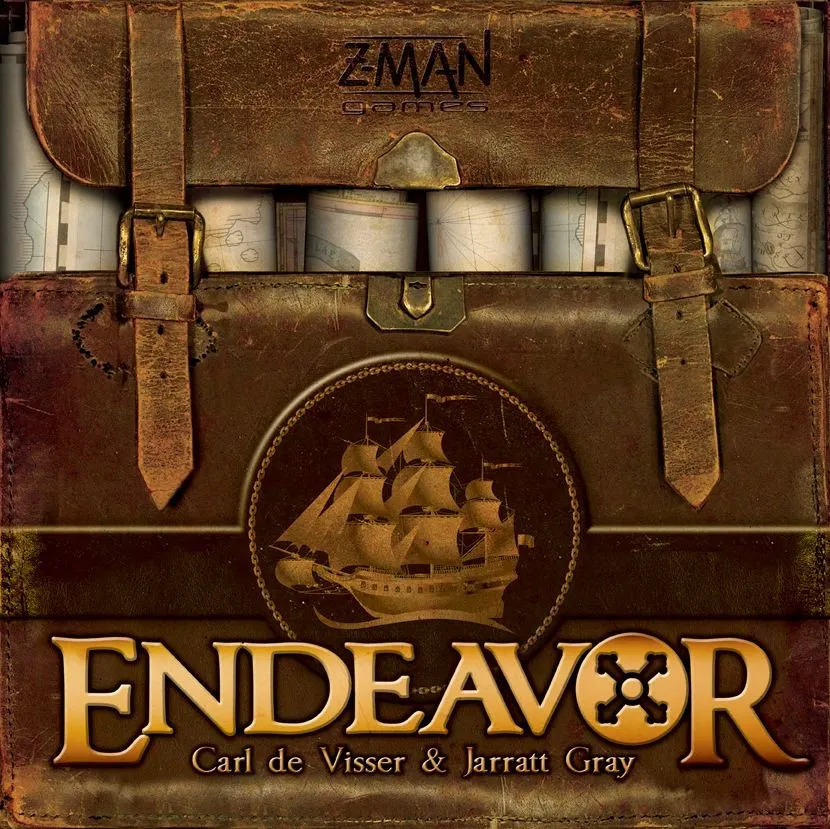
Endeavor ist ein Brettspiel aus dem Jahr 2009 für 3–5 Personen, mit 90 Minuten pro Partie und ab 12 Jahren. Entwickelt wurde es von Carl de Visser und Jarratt Gray; die wichtigsten Mechaniken sind Hand Management, Set Collection und Area Majority / Influence.


Auf Englisch
It is a time when the maps of the world are still being filled in. Seagoing empires expand their frontiers by sending ships to the farthest reaches of the globe in search of new lands, new alliances, and new conquests. The wealth of the newly-discovered worlds abroad is a tempting prize for those with the strength and the cunning to seize it... and to hold it! You represent a growing empire engaged in a glorious endeavor to expand your influence and status at home and across the great oceans of the world. Through exploration and shipping, colonization and war, you will struggle with the other great powers to control the resources and the regions that unfold before you. The goal in Endeavor is to earn the most glory for your empire. Players earn glory by increasing their scores in Industry, Culture, Finance, and Politics, as well as by occupying cities, controlling connections between cities, and by holding certain Asset Cards and Building Tiles. Short-term goals of constructing useful buildings, gathering Trade Tokens, and obtaining Asset Cards must be balanced with the overall goal of attaining glory as you compete for control over the various regions of the world. The game only lasts seven rounds, and when it is over you want to be the one who has earned the most Glory points! Each round every player gets to build a new building, based on their Industry track. They then obtain new population markers based on their Culture track and retrieve used markers from building based on their Finance track. During the action phase, players take turns to either activate a building using a population marker or spend trade tokens to take an action: Ship, Occupy, Attack, Payment or Draw. Some buildings and tokens allow a player to take one or both of two actions. Shipping is used to open new regions for Occupation and Drawing, and gains you Trade Tokens. Once a shipping track is full, the player with the most influence in that region gains the powerful Governor card for that region. Occupation of a city results in glory and Trade Tokens, while Attacking steals a city from an opponent! Either Occupation or Attacking can result in claiming the connection between two cities, if both connected cities are controlled by the same player. Drawing gains a card from a region up to the maximum hand limit based on the player's Politics track. A player's influence in a region determines which cards they can draw. Once all players have passed, a new round begins.
Laut Katalog unterstützt Endeavor 3–5 Personen. Diese Spanne entspricht der vom Verlag angegebenen Spielerzahl, das Spiel lässt sich also für jede Gruppengröße innerhalb dieser Spanne aufbauen. Aufbau, einzelne Regeln und Wertungsdetails können je nach Personenzahl trotzdem abweichen; prüfe daher die genaue Konfiguration in der Anleitung deiner Ausgabe.
Die angegebene Spieldauer für Endeavor beträgt 90 Minuten. Das ist die Schätzung des Verlags für eine vollständige Partie. Die tatsächliche Dauer hängt von der Gruppe, der Personenzahl und der Regelkenntnis ab: Erste Partien dauern meist länger, erfahrene Gruppen sind oft schneller fertig. Aufbau und Regelerklärung sind in dieser Schätzung nicht enthalten.
Im Katalog wird Endeavor ab 12 Jahren empfohlen. Das ist die Empfehlung des Verlags und berücksichtigt Leseanforderungen, Regelkomplexität und Kleinteile, nicht nur das Thema. Jüngere Kinder können oft mit Hilfe eines Erwachsenen mitspielen; beachte die Altersangabe deiner Ausgabe und die Brettspielerfahrung deiner Gruppe.
Endeavor hat bei BoardGameGeek eine Komplexitätswertung von 2,9 von 5 und gilt damit als eher leichtes Spiel. Die Wertung zeigt, wie viel Regelwissen, Planung und Entscheidungen eine typische Partie verlangt. Schwerere Spiele brauchen bei der ersten Erklärung mehr Zeit, daher hilft vor dem Spieleabend eine Vorbereitungsanleitung.
Endeavor gehört zu diesen Kategorien: Exploration, Nautical und Renaissance. Die wichtigsten Mechaniken sind Hand Management, Set Collection und Area Majority / Influence. Kategorien beschreiben Thema und Setting eines Spiels, Mechaniken dagegen, was die Spielenden in ihrem Zug tatsächlich tun. Jede Mechanik führt zu einer Katalogseite mit ähnlichen Spielen, falls du etwas Vergleichbares suchst.
Als Autoren von Endeavor sind angegeben: Carl de Visser und Jarratt Gray. Diese Angaben stammen aus den veröffentlichten Spieldaten und nennen die für das Spieldesign verantwortlichen Personen, nicht die Illustratoren oder Verlage. Die Autorenseiten auf MeepleRules sammeln weitere Titel derselben Autoren – praktisch, wenn dir ein Spiel gefällt und du ähnliche Spiele suchst.
Im Katalog ist Endeavor als Grundspiel aufgeführt. Es lässt sich eigenständig mit dem Material aus der Schachtel spielen und benötigt keinen weiteren Titel. Erweiterungen, sofern es welche gibt, ergänzen neues Material oder neue Regeln und sind im Katalog separat mit einem Verweis auf dieses Grundspiel aufgeführt.