- BGG-Rang
- BGG #3.256
- BGG-Bewertung
- 6,6
Mundus Novus
2011
Regelhilfe für Mundus Novus
Verständliche Erklärungen zu Spielzügen, Karteneffekten und strittigen Situationen mit Verweisen auf offizielle Quellen und gespeichertem Fragenverlauf.
- 2–6 Spieler
- 45–60 Min.
- 14+
- Komplexität 2,2/5

Über das Spiel
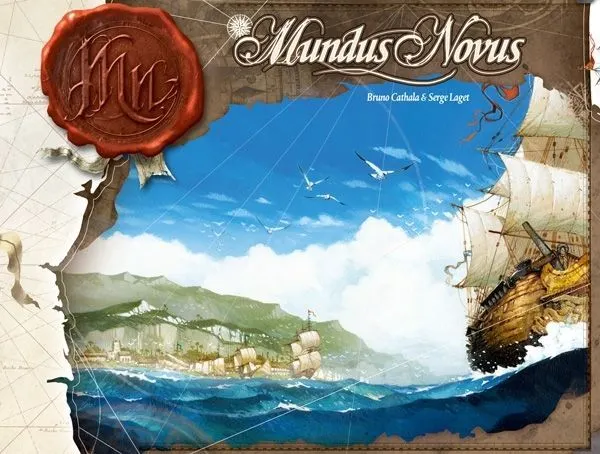
Spain, 16th century. You are a powerful ship owner in search of wealth from the recently discovered Mundus Novus (New World). Your goal: Charter fleets of caravels to collect valuable goods (including the legendary Inca relics) and trade to form the best sets to expand your business empire and make your fortune. The game is played using two decks of cards: a deck of resource cards, which contains cards representing ten different resources, and a deck of development cards, which give special benefits to their owners. The game is played in rounds, with each round consisting of four phases: Each round starts with the Event phase, in which a random event may occur that affects all players. The next phase is the Supply phase. Each player receives five random resource cards, plus one resource card for each caravel (a type of development card) that he owns, chosen from a common pool. Then, during the Trade phase, the players trade some of their cards. One of the players, the Trade Master, determines how many resource cards (2, 3 or 4) each player must offer for trade. The player that offers the resources with the highest value becomes the new Trade Master. He chooses one of the resources offered by one of the other players, and adds it to his hand, or exchanges it with a card from the market (three face-up cards that are available for such exchanges). Then, the player that he has taken a card from gets to take a card, and so on, until all the cards have been taken. Finally, during the Progression phase, the players exchange their resources for doubloons and developments. A player may exchange one set of three or more of the same resource for a development. Bigger combinations and rarer resources will allow more choice of which development can be selected from the five that are on offer. In addition, players can exchange sets of three or more different goods for doubloons, with bigger combinations earning more doubloons. If a player can make a combination of ten different cards (i.e., one of each type of resource), he wins the game. Alternatively, if a player has accumulated 75 doubloons, he wins the game. If no player has achieved victory by the time the development deck runs out, the player who has accumulated the most doubloons wins.
Kategorien
Autoren
Verlage
- asmodee
Fragen und Antworten
Der Regelassistent für Mundus Novus soll Spielzüge, Karteneffekte und strittige Situationen erklären, auf geprüfte offizielle Quellen verweisen und den Fragenverlauf speichern. Er ist noch nicht bereit; geprüfte Quellen für deine Ausgabe werden noch vorbereitet.
Laut Katalog unterstützt Mundus Novus 2–6 Personen.
Die angegebene Spieldauer für Mundus Novus beträgt 45–60 Minuten. Die tatsächliche Dauer hängt von der Gruppe und ihrer Spielerfahrung ab.
Im Katalog wird Mundus Novus ab 14 Jahren empfohlen. Beachte die Altersangabe deiner Ausgabe.
Als Autoren von Mundus Novus sind angegeben: Bruno Cathala und Serge Laget.
Im Katalog ist Mundus Novus als Grundspiel aufgeführt.
Regelassistent für Mundus Novus
Wird geladen…