
- BGG-Rang
- BGG #5.813
- BGG-Bewertung
- 7,8
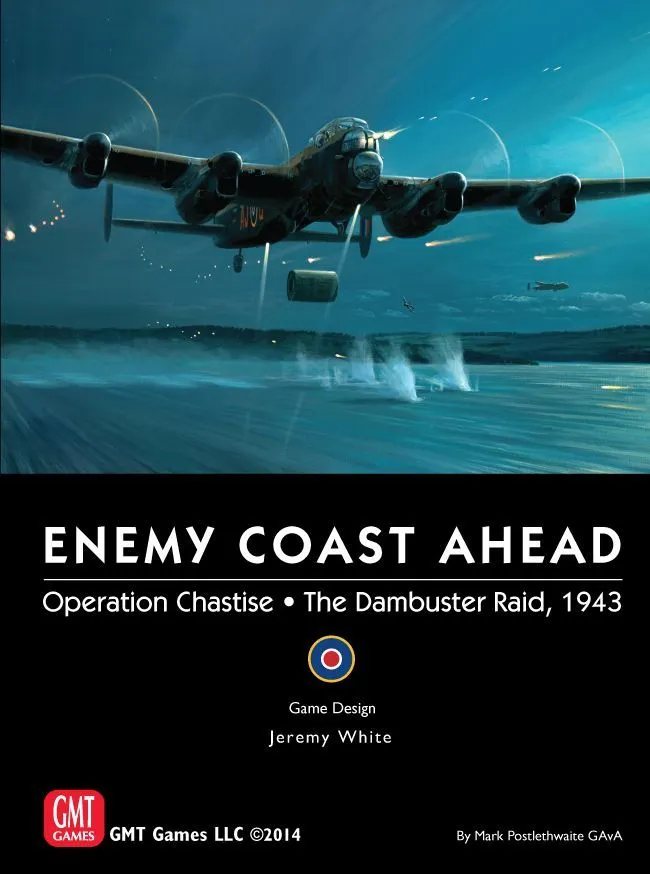
Enemy Coast Ahead: Operation Chastise – The Dambuster Raid
- 1–3 Spieler
- Komplexität 3,2/5
- 2014
2017
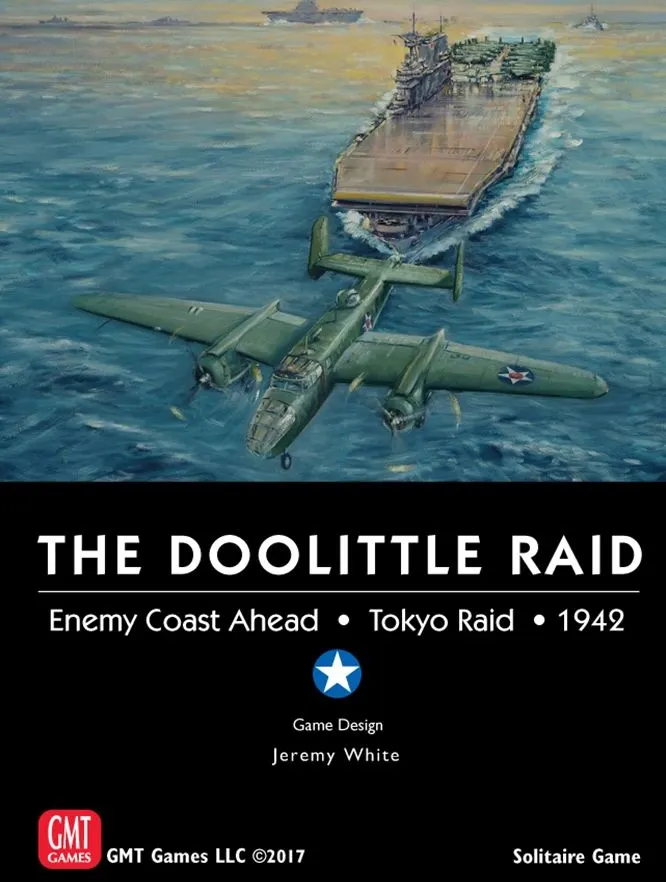
Regelhilfe für Enemy Coast Ahead: The Doolittle Raid
Verständliche Erklärungen zu Spielzügen, Karteneffekten und strittigen Situationen mit Verweisen auf offizielle Quellen und gespeichertem Fragenverlauf.
Für 1 Person
Was möchtest du wissen?
Antworten stammen aus dem offiziellen Regelheft, mit Seitenangabe zum Nachprüfen.
Enemy Coast Ahead: The Doolittle Raid ist ein Brettspiel aus dem Jahr 2017 für 1–3 Personen, mit 20–360 Minuten pro Partie und ab 14 Jahren. Entwickelt wurde es von Jeremy White; die wichtigsten Mechaniken sind Area Movement, Dice Rolling und Cooperative Game.


Auf Englisch
Enemy Coast Ahead: The Doolittle Raid uses the game format to explore the first raid on the Japanese home islands by the United States during World War Two. It is a solitaire game challenging the player to conduct a successful mission where the criteria for success is not purely military. The player must organize, equip, and train a squadron of B-25 “Mitchell” medium bombers to attack a distant and rather dangerous target. The game not only covers the raid from launch to landing, it extends the story on both ends. Threatened from the air and from the sea, the player must do his utmost to strike the Japanese capital, avenging the attack on Pearl Harbor, and then land his aircraft safely. If the raid goes poorly it may boost Japanese morale and deflate the mood in the United States. Getting the B-25s close enough to launch is vital, as is the recovery of aircraft and crewmen, but above all, the player’s main dilemma will be secrecy. The risk is great. Failure could mean the loss of an entire squadron, or worse, the sinking of a precious aircraft carrier. Will the Doolittle Raid add to the dismal news of Pearl Harbor, Guam, Wake Island, and Bataan, or will it signal the turning of the tide? The History Washington – April 21, 1942: After two days of rumor prompted by Japanese radio broadcasts, President Franklin Delano Roosevelt finally agrees to a press conference. Deftly avoiding difficult questions, he claims insufficient information to neither confirm nor deny the biggest news story of the four month old war. To placate tenacious journalists, however, he tells the press that the attack on Kobe, Osaka, Nagoya, and Tokyo by United States aircraft, was launched from a mysterious base he would only call “Shangri-La,” an imaginary island from the recently published novel Lost Horizon. His impish grin, if not his words, tell the press that the top secret operation dubbed Special Aviation Project Number One has indeed been a success. That same day China’s foreign minister hands a telegram to Army Air Corps Chief Hap Arnold. It has taken some time to arrive in Washington, an indication that all may not be well with the mission. Dictated two days ago by the commander of that top secret operation, a distraught Lt. Colonel James Doolittle, it reads: Mission to bomb Tokyo has been accomplished. On entering China we ran into bad weather and it is feared that all planes crashed. Telegram in hand, Arnold immediately admits to the commander of the Joint Chiefs of Staff that the mission has failed. No bombers have been recovered. After sending that telegram, Doolittle himself expects a court martial, confiding to his engineer that they’ll tie him to a desk for the rest of the war, if he’s lucky. Days later he is astonished to learn of his promotion to Brigadier General, and even more so when he is notified that the president recommended the Congressional Medal of Honor. The Doolittle Raid remains an enigmatic and contradictory episode of World War Two, defying easy interpretation even to this day. Was it a victory or a debacle? Was it a minor footnote in the annals of that war or a significant military event? Was it a desperate bid to avenge the attack on Pearl Harbor, or, a harbinger signaling death and horror soon to visit Japanese cities from the sky? Narrative Sequence Much like chapters in a story, the game is organized in six narrative segments, chronologically arranged. Each poses its own set of challenges and prompts decisions that establish the environment and conditions of subsequent chapters. Planning Naval Flight Over Targets Recovery Debriefing Historical Scenarios Besides play of the full narrative, the game offers a number of historical dissections, each a scenario focusing on a fragment of the raid. They are also a handy way to learn the game, since each scenario uses only part of the rules. For example, Scenario One covers Doolittle’s flight over Tokyo, using only the 8.5x11 Target Map and the Attack Segment. An alternative scenario looks at a night raid by that flight, as Doolittle originally planned it. After playing one or two small scenarios using only the Attack segment’s rules, a larger scenario can be played adding the Flight segment. Graduate next to an even larger scenario that starts with the Naval segment. In this way a player can learn the game in program fashion, little by little, studying the history of the raid by playing it as he learns. Player Aid Folders: The game comes with several 11” x 17” bi-fold aids allowing the play of each game segment with minimal study of the rule book. The mapsheet is designed to interlock with other game components, including those play aids, in order to make the player’s experience fluid.
Laut Katalog unterstützt Enemy Coast Ahead: The Doolittle Raid 1–3 Personen. Diese Spanne entspricht der vom Verlag angegebenen Spielerzahl, das Spiel lässt sich also für jede Gruppengröße innerhalb dieser Spanne aufbauen. Aufbau, einzelne Regeln und Wertungsdetails können je nach Personenzahl trotzdem abweichen; prüfe daher die genaue Konfiguration in der Anleitung deiner Ausgabe.
Die angegebene Spieldauer für Enemy Coast Ahead: The Doolittle Raid beträgt 20–360 Minuten. Das ist die Schätzung des Verlags für eine vollständige Partie. Die tatsächliche Dauer hängt von der Gruppe, der Personenzahl und der Regelkenntnis ab: Erste Partien dauern meist länger, erfahrene Gruppen sind oft schneller fertig. Aufbau und Regelerklärung sind in dieser Schätzung nicht enthalten.
Im Katalog wird Enemy Coast Ahead: The Doolittle Raid ab 14 Jahren empfohlen. Das ist die Empfehlung des Verlags und berücksichtigt Leseanforderungen, Regelkomplexität und Kleinteile, nicht nur das Thema. Jüngere Kinder können oft mit Hilfe eines Erwachsenen mitspielen; beachte die Altersangabe deiner Ausgabe und die Brettspielerfahrung deiner Gruppe.
Enemy Coast Ahead: The Doolittle Raid hat bei BoardGameGeek eine Komplexitätswertung von 3,0 von 5 und gilt damit als mittelschweres Spiel. Die Wertung zeigt, wie viel Regelwissen, Planung und Entscheidungen eine typische Partie verlangt. Schwerere Spiele brauchen bei der ersten Erklärung mehr Zeit, daher hilft vor dem Spieleabend eine Vorbereitungsanleitung.
Enemy Coast Ahead: The Doolittle Raid gehört zu diesen Kategorien: Wargame, World War II und Aviation / Flight. Die wichtigsten Mechaniken sind Area Movement, Dice Rolling und Cooperative Game. Kategorien beschreiben Thema und Setting eines Spiels, Mechaniken dagegen, was die Spielenden in ihrem Zug tatsächlich tun. Jede Mechanik führt zu einer Katalogseite mit ähnlichen Spielen, falls du etwas Vergleichbares suchst.
Als Autoren von Enemy Coast Ahead: The Doolittle Raid sind angegeben: Jeremy White. Diese Angaben stammen aus den veröffentlichten Spieldaten und nennen die für das Spieldesign verantwortlichen Personen, nicht die Illustratoren oder Verlage. Die Autorenseiten auf MeepleRules sammeln weitere Titel derselben Autoren – praktisch, wenn dir ein Spiel gefällt und du ähnliche Spiele suchst.
Im Katalog ist Enemy Coast Ahead: The Doolittle Raid als Grundspiel aufgeführt. Es lässt sich eigenständig mit dem Material aus der Schachtel spielen und benötigt keinen weiteren Titel. Erweiterungen, sofern es welche gibt, ergänzen neues Material oder neue Regeln und sind im Katalog separat mit einem Verweis auf dieses Grundspiel aufgeführt.