

- BGG-Rang
- BGG #26.747
- BGG-Bewertung
- 5,7
Fanhunter: Las Montañas de la Locura – Electric Boogaloo
- 1–5 Spieler
- 30 Min.
- Komplexität 1,3/5
- 2013
2010
Regelhilfe für Frenetic Village
Verständliche Erklärungen zu Spielzügen, Karteneffekten und strittigen Situationen mit Verweisen auf offizielle Quellen und gespeichertem Fragenverlauf.
Was möchtest du wissen?
Antworten stammen aus dem offiziellen Regelheft, mit Seitenangabe zum Nachprüfen.
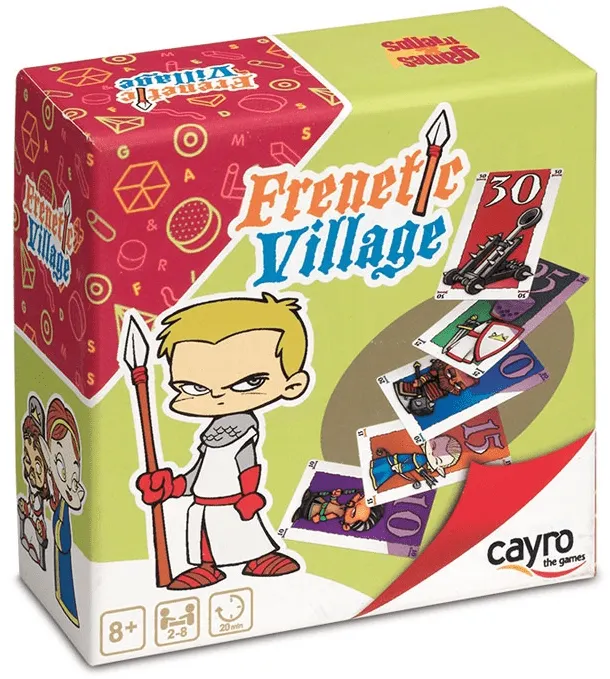
Frenetic Village ist ein Brettspiel aus dem Jahr 2010 für 2–8 Personen, mit 20 Minuten pro Partie und ab 8 Jahren. Entwickelt wurde es von Ignacio Sánchez Usera und Jorge Piñan; die wichtigsten Mechaniken sind Open Drafting.





Auf Englisch
INTRODUCTION: Table Land is populated by humans, dwarfs, elves, orcs and barbarians. It is a world in permanent war for the control of the territory. Play and become a true Lord of Tierra Mesa by beating your rivals. AIM OF THE GAME: The aim of the game is to achieve, before the other players, a combination of 5 cards with the same value, or to form an army with 5 consecutive cards of the same race or where each value accords a different race (Unbeatable Run). You will become Lord of Table Land in several ways: 1. Gathering together an army of 5 consecutive cards (run) of the same race. 2. Gathering together 5 cards of the same value (archers, princesses, catapults…) 3. And finally, the Unbeatable Run; you can get an army alliance gathering 5 consecutive cards of a different race each. The winner is the player who gathers one of these combinations. BEFORE THE GAME: - Shuffle the cards. - Hand out 5 cards to each player. - Allocate the deck of cards facing down, in the middle of Table Land. - The first game starts with the player who owns most hairs in his ears, continuing then, in a clockwise direction. The following games are started by the winner of the previous game. Once all the cards have been distributed to the players the game stars. The player that starts the game draws one card from the central deck, looks at it, and gets rid of the card which is not convenient for him. Each player should always have 5 cards. Each player discards should be placed on Table Land, ALWAYS in front of the player, creating a deck where the last discarded card is shown. This way there should be as many discarded decks as players. When a player gets rid of a card and puts it on its deck facing up, any interested player can take it. How? The interested player should cover it with its hand. The fastest player covering the deck is the one that gets the card. This player should then discard one of his cards. Then, the game continues in a clockwise direction starting from him. This way the game continues until one of the players gathers 5 cards with the same value or 5 consecutive cards of the same race or the Unbeatable Run. The player should let the other players know during his turn by placing the discard card facing down and by showing his 5 wining cards, he gains the victory by beating his rivals. WINING COMBINATIONS: Option 1 – Whoever wins 5 games is the winner of the whole game. Option 2 – After each game all card points must be counted, except those from the winner, being 100 points those from the action cards. The player with fewer points after 5 games is the winner. Option 3 – After each game only the winner’s points must be counted, in this situation the value (each value corresponds to a different race) of the Unbeatable Run is three times the addition of the values. The game finishes when one of the players reaches 1000 points or a previously agreed quantity. These are not the only possibilities, players can agree on other options for victory. ACTION CARDS: This game has a series of action cards which are used for the interaction between players to threaten their rivals: Skull (2 cards): If a player places this card on the other player’s deck it means that all his troops have been killed. He must place all his cards, facing down, beneath the central deck and draw 5 new cards. card swap (1 card): If a player places this card in another player’s deck, both players must swap one card. hand swap (1 card): Placing this card in another player’s discard deck means that you swap your hand of cards with that player. steal 2 cards for the deck (2 cards): Placing this card on to other player’s discard deck means that the player who has placed the card (the attacking card) randomly takes 2 cards from the other player’s hand, and then this player must immediately pick up two new cards from the central deck. The 2 cards that have been taken from the player’s hand must be placed beneath the central deck without looking at them. steal 3 cards for the deck (1 card): Placing this card in another player’s discard deck means that the player who has placed the card (the assailant) randomly takes 3 cards from his rival’s hand. Then, the rival should draw 3 new cards from the central deck. The cards taken from his hand must be placed beneath the central deck without looking at them. steal a card (3 cards): Placing this card in another player’s discard deck means that the player who has placed the card (the assailant) randomly takes 1 card from his rival’s hand, and keeps it. Now the victim has 4 cards, therefore he must pick up a new card to have 5. The assailant has now 6 cards therefore he must discard one of them to have 5 again to continue the battle. Potion (2 cards): the joker substitutes any other card concerning value and race. It can NOT be used as action card. One player can have on its hand up to two jokers. FAQs: - Which discard cards can I pick up? You can only pick up the last card that has been placed at the top of the discard deck from the player that’s on its turn. - After an action card who continues? The player next to the player who has discarded the Action Card, always clockwise. - Do runs or the Unbeatable Run have to start from number 5? Runs do not have to start from 5, as long as they are always consecutive numbers. - What should it be done if the extension of Tierra Mesa cannot be cover and a player does not reach their rivals discard decks? Instead of hunting the card with the hand you should scream Guar!!! The one that screams it first takes the card. - Can I draw one card from any discard deck while other player is drawing a card from the central deck? When a player picks up a card from the central deck the possibility of taking a card from a discard deck is blocked. - If I take a card from a discard deck, can the card that appears underneath be taken later on? NO. Those cards were previously played, therefore, you should pay attention!! - What should it be done when the central deck finishes? All discard decks from all the players must be gathered together to form a new central deck. The cards must be shuffle before placing them on the middle of Tierra Mesa. - If two players place their hands on a discard deck, who takes the card? Either the one that has more fingers placed on it, or the most aggressive one.
Laut Katalog unterstützt Frenetic Village 2–8 Personen. Diese Spanne entspricht der vom Verlag angegebenen Spielerzahl, das Spiel lässt sich also für jede Gruppengröße innerhalb dieser Spanne aufbauen. Aufbau, einzelne Regeln und Wertungsdetails können je nach Personenzahl trotzdem abweichen; prüfe daher die genaue Konfiguration in der Anleitung deiner Ausgabe.
Die angegebene Spieldauer für Frenetic Village beträgt 20 Minuten. Das ist die Schätzung des Verlags für eine vollständige Partie. Die tatsächliche Dauer hängt von der Gruppe, der Personenzahl und der Regelkenntnis ab: Erste Partien dauern meist länger, erfahrene Gruppen sind oft schneller fertig. Aufbau und Regelerklärung sind in dieser Schätzung nicht enthalten.
Im Katalog wird Frenetic Village ab 8 Jahren empfohlen. Das ist die Empfehlung des Verlags und berücksichtigt Leseanforderungen, Regelkomplexität und Kleinteile, nicht nur das Thema. Jüngere Kinder können oft mit Hilfe eines Erwachsenen mitspielen; beachte die Altersangabe deiner Ausgabe und die Brettspielerfahrung deiner Gruppe.
Frenetic Village hat bei BoardGameGeek eine Komplexitätswertung von 1,3 von 5 und gilt damit als leichtes Spiel. Die Wertung zeigt, wie viel Regelwissen, Planung und Entscheidungen eine typische Partie verlangt. Schwerere Spiele brauchen bei der ersten Erklärung mehr Zeit, daher hilft vor dem Spieleabend eine Vorbereitungsanleitung.
Frenetic Village gehört zu diesen Kategorien: Card Game, Fantasy und Party Game. Die wichtigsten Mechaniken sind Open Drafting. Kategorien beschreiben Thema und Setting eines Spiels, Mechaniken dagegen, was die Spielenden in ihrem Zug tatsächlich tun. Jede Mechanik führt zu einer Katalogseite mit ähnlichen Spielen, falls du etwas Vergleichbares suchst.
Als Autoren von Frenetic Village sind angegeben: Ignacio Sánchez Usera und Jorge Piñan. Diese Angaben stammen aus den veröffentlichten Spieldaten und nennen die für das Spieldesign verantwortlichen Personen, nicht die Illustratoren oder Verlage. Die Autorenseiten auf MeepleRules sammeln weitere Titel derselben Autoren – praktisch, wenn dir ein Spiel gefällt und du ähnliche Spiele suchst.
Im Katalog ist Frenetic Village als Grundspiel aufgeführt. Es lässt sich eigenständig mit dem Material aus der Schachtel spielen und benötigt keinen weiteren Titel. Erweiterungen, sofern es welche gibt, ergänzen neues Material oder neue Regeln und sind im Katalog separat mit einem Verweis auf dieses Grundspiel aufgeführt.