

- BGG-Rang
- BGG #11.283
- BGG-Bewertung
- 7,5
Final Act
- 2 Spieler
- 50–70 Min.
- Komplexität 2,1/5
- 2016
2019
Regelhilfe für GladiGala
Verständliche Erklärungen zu Spielzügen, Karteneffekten und strittigen Situationen mit Verweisen auf offizielle Quellen und gespeichertem Fragenverlauf.
Für 2 Personen
Was möchtest du wissen?
Antworten stammen aus dem offiziellen Regelheft, mit Seitenangabe zum Nachprüfen.
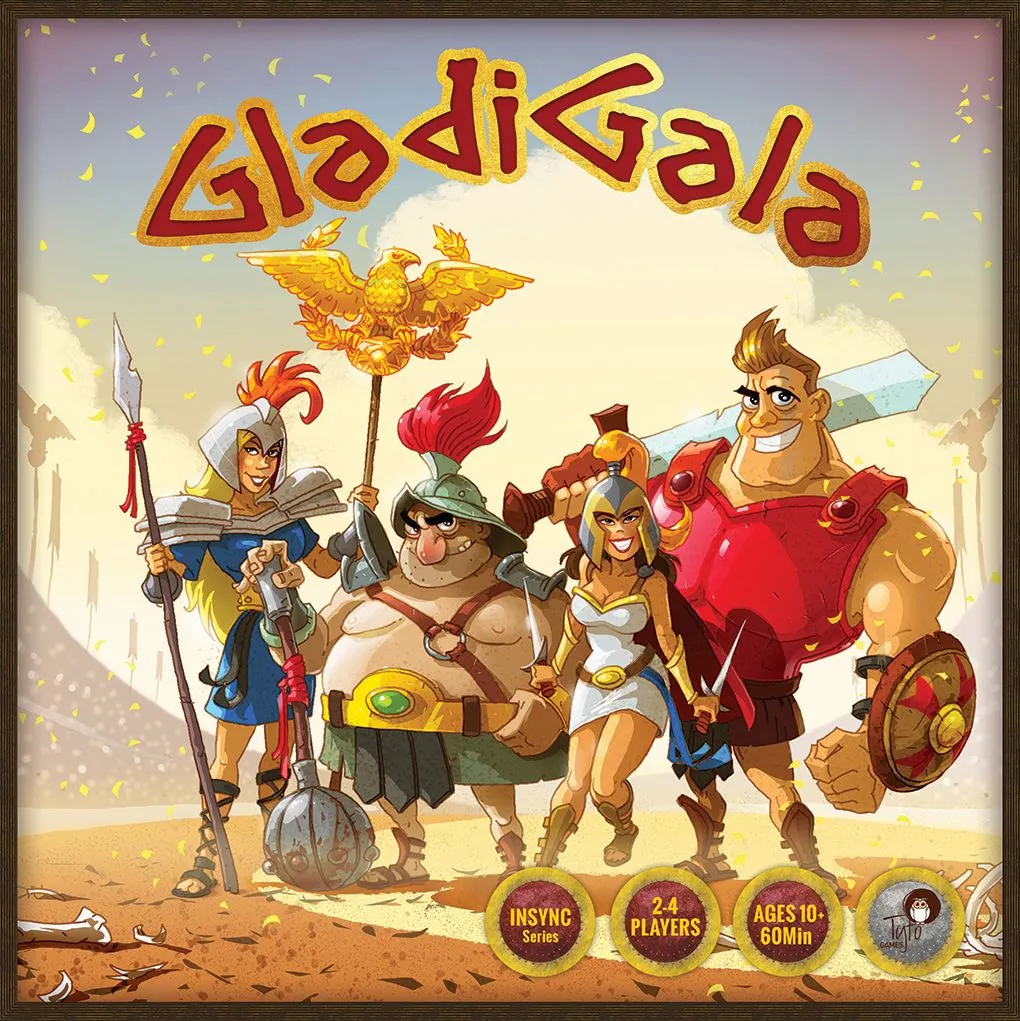
GladiGala ist ein Brettspiel aus dem Jahr 2019 für 2–4 Personen, mit 45–60 Minuten pro Partie und ab 10 Jahren. Entwickelt wurde es von Sharon Katz; die wichtigsten Mechaniken sind Simultaneous Action Selection und Action Queue.


Auf Englisch
GladiGala is a 2-4 player skirmish style family game of fast paced tactics and simultaneous play – a tactical rush for fame & fortune. In GladiGala players take the role of gladiator school leaders who meet in the arena for a day of a tactical show off. Your objective is to finish the day (after playing 2 matches, morning and afternoon) as the most decorated gladiator school of Rome, and winner of the day! Players can achieve this in 2 ways: either capture an opponent's Eagle (and receive Medal of Eagle), or by having the most denarii (GladiGala's coins) in your Treasury as a match ends (receive Medal of Coin). In GladiGala all the results of what happens in the arena are translated into coins, by which players can also manage their gladiator team during the match (upgrade a hurt gladiator, create advanced maneuvers, or enter the arena's "Safe Zone"). As a Gladiator School Leader it is up to you to gain coins and fill your Treasury for marvelous tactical performances and for making accurate strategic choices. Outwit your opponents, make the most of your gladiators' formation, manage your Treasury wisely, and get the crowds on your side chanting GladiGala's mantra: "Always aim for an eagle – always stand guard!" GladiGala is a simultaneous game played in multiple rounds. First, players use magnetic panels/cards to give movements, maneuvering, and action orders to all gladiators. Each game players enter the arena with a different gladiator formation, made from GladiGala's 4 gladiator types: Sword, Spear, Dagger, and Club, each has a different set of abilities. After giving movements orders, players place their attacks trying to anticipate their opponent's moves. Finally, cards are revealed and all gladiators perform accordingly. A gladiator moving to an attacked area is marked as "Hit". A gladiator hit twice is out of the arena! Welcome to Rome, 101 A.D. The city's center stage is set up and ready for GladiGala, the year's greatest show of skill in the arena. Rome's 4 finest Gladiator Schools; ACADEMIA – LEO – SOLIS & SPIRITUS – appear in the arena for a glorious day of tactical contest in the pursuit of title and Medal of Champion! Morning rises and the crowds make their way to the arena. The teams all gear up, final preparations are made, last instructions are given. Your gladiator formation for the morning match is set and ready to head out the gate. Your gladiators are holding to their eagle, your house symbol of honor and respect. You hope they will be holding it to the end… Trumpets are blown, the crowds are ecstatic: "open the gates!" you hear them shouting, frantic. GladiGala begins: Shlak Shlak Shlak – all gates are raised announcing it's time to storm Rome's most celebrated central stage! —description from the designer
Laut Katalog unterstützt GladiGala 2–4 Personen. Diese Spanne entspricht der vom Verlag angegebenen Spielerzahl, das Spiel lässt sich also für jede Gruppengröße innerhalb dieser Spanne aufbauen. Aufbau, einzelne Regeln und Wertungsdetails können je nach Personenzahl trotzdem abweichen; prüfe daher die genaue Konfiguration in der Anleitung deiner Ausgabe.
Die angegebene Spieldauer für GladiGala beträgt 45–60 Minuten. Das ist die Schätzung des Verlags für eine vollständige Partie. Die tatsächliche Dauer hängt von der Gruppe, der Personenzahl und der Regelkenntnis ab: Erste Partien dauern meist länger, erfahrene Gruppen sind oft schneller fertig. Aufbau und Regelerklärung sind in dieser Schätzung nicht enthalten.
Im Katalog wird GladiGala ab 10 Jahren empfohlen. Das ist die Empfehlung des Verlags und berücksichtigt Leseanforderungen, Regelkomplexität und Kleinteile, nicht nur das Thema. Jüngere Kinder können oft mit Hilfe eines Erwachsenen mitspielen; beachte die Altersangabe deiner Ausgabe und die Brettspielerfahrung deiner Gruppe.
GladiGala hat bei BoardGameGeek eine Komplexitätswertung von 1,0 von 5 und gilt damit als leichtes Spiel. Die Wertung zeigt, wie viel Regelwissen, Planung und Entscheidungen eine typische Partie verlangt. Schwerere Spiele brauchen bei der ersten Erklärung mehr Zeit, daher hilft vor dem Spieleabend eine Vorbereitungsanleitung.
GladiGala gehört zu diesen Kategorien: Ancient. Die wichtigsten Mechaniken sind Simultaneous Action Selection und Action Queue. Kategorien beschreiben Thema und Setting eines Spiels, Mechaniken dagegen, was die Spielenden in ihrem Zug tatsächlich tun. Jede Mechanik führt zu einer Katalogseite mit ähnlichen Spielen, falls du etwas Vergleichbares suchst.
Als Autoren von GladiGala sind angegeben: Sharon Katz. Diese Angaben stammen aus den veröffentlichten Spieldaten und nennen die für das Spieldesign verantwortlichen Personen, nicht die Illustratoren oder Verlage. Die Autorenseiten auf MeepleRules sammeln weitere Titel derselben Autoren – praktisch, wenn dir ein Spiel gefällt und du ähnliche Spiele suchst.
Im Katalog ist GladiGala als Grundspiel aufgeführt. Es lässt sich eigenständig mit dem Material aus der Schachtel spielen und benötigt keinen weiteren Titel. Erweiterungen, sofern es welche gibt, ergänzen neues Material oder neue Regeln und sind im Katalog separat mit einem Verweis auf dieses Grundspiel aufgeführt.