

- BGG-Rang
- BGG #8.655
- BGG-Bewertung
- 7,3
Second World War at Sea: Bomb Alley
- 2 Spieler
- 360 Min.
- Komplexität 3,1/5
- 2002
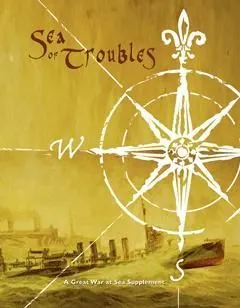
Regelhilfe für Great War at Sea: Sea of Troubles
Verständliche Erklärungen zu Spielzügen, Karteneffekten und strittigen Situationen mit Verweisen auf offizielle Quellen und gespeichertem Fragenverlauf.
Was möchtest du wissen?
Antworten stammen aus dem offiziellen Regelheft, mit Seitenangabe zum Nachprüfen.
Great War at Sea: Sea of Troubles ist eine Erweiterung für Great War at Sea: Jutland aus dem Jahr 2007 für 2 Personen und mit 120 Minuten pro Partie. Entwickelt wurde es von Michael Bennighof; die wichtigsten Mechaniken sind Hexagon Grid und Simulation.








Auf Englisch
From the Avalanche Website During the course of the First World War, the United States continued to build huge new battleships despite a pressing need for destroyers and merchant ships. In Britain, Royal Navy planners wondered just what their American allies were up to, because such a fleet could only have one potential adversary. Britain also made plans to construct new ships. Sea of Troubles is a 64-page book supplement for the Great War at Sea series based on the war plans of both sides. Most of the scenarios take place in the Caribbean Sea, using the map from U.S. Navy Plan Gold, but some actions are also placed in European waters on the maps for Jutland or Mediterranean. There are 210 die-cut and mounted playing pieces, the same pieces that originally appeared in our now out-of-print U.S. Navy Plan Red. The Americans get the huge 1919 program battleship mounting eight 18-inch guns as well as four examples of the South Dakota class with their dozen 16-inch guns apiece. There are also the Lexington class battle cruisers in their original configuration with 14-inch guns, and the 1914 design for a fast commerce-raiding armored cruiser armed with 10-inch guns. The Royal Navy adds the remainder of its R-class battleships not seen in Jutland, plus the huge battleships of the N3 design with nine 18-inch guns each, and the ungainly but powerful battle cruisers of the G3 design. Plus the Royal Canadian Navy makes an appearance with three dreadnought battleships and a flotilla of destroyers. There are over three dozen new scenarios featuring brawls between huge fleets of battleships, plus of course background articles on the ships, the fleets and the war plans of all potential participants. This is not a stand-alone game; ownership of Mediterranean, Jutland and U.S. Navy Plan Gold is required to enjoy all of the scenarios. NOTE: This product acts as a successor to the now out-of-print Great War at Sea: U.S. Navy Plan Red. As a result, both countersheets that ship with this product are still labeled 'US Navy Plan Red', although the scenarios for that product, set along the United States Eastern seaboard, are now deprecated in favor of scenarios set in the Mediterranean and North Sea. Additionally, while 'US Navy Plan Red' was a boxed-set and limited to a few scenarios that could work with the components included, as a module book 'Sea of Troubles' is not so constrained. There are more than 2 dozen scenarios in this product that cover more than just 'Plan Red', along with articles on the ships and historical flavor for this period. Plan Red was released in a second edition in 2013. It has a completely revised scenario book with 14 battle and 20 operational scenarios, and updated special rules. Sea of Troubles is out of print.
Laut Katalog unterstützt Great War at Sea: Sea of Troubles 2 Personen. Das ist die vom Verlag angegebene Spielerzahl, das Spiel ist also genau für diese Anzahl von Mitspielenden ausgelegt. Varianten für andere Gruppengrößen sind, sofern vorhanden, in der Anleitung deiner Ausgabe beschrieben; prüfe sie, bevor du eine andere Konfiguration aufbaust.
Die angegebene Spieldauer für Great War at Sea: Sea of Troubles beträgt 120 Minuten. Das ist die Schätzung des Verlags für eine vollständige Partie. Die tatsächliche Dauer hängt von der Gruppe, der Personenzahl und der Regelkenntnis ab: Erste Partien dauern meist länger, erfahrene Gruppen sind oft schneller fertig. Aufbau und Regelerklärung sind in dieser Schätzung nicht enthalten.
Great War at Sea: Sea of Troubles hat bei BoardGameGeek eine Komplexitätswertung von 2,9 von 5 und gilt damit als eher leichtes Spiel. Die Wertung zeigt, wie viel Regelwissen, Planung und Entscheidungen eine typische Partie verlangt. Schwerere Spiele brauchen bei der ersten Erklärung mehr Zeit, daher hilft vor dem Spieleabend eine Vorbereitungsanleitung.
Great War at Sea: Sea of Troubles gehört zu diesen Kategorien: Wargame, Nautical und Expansion for Base-game. Die wichtigsten Mechaniken sind Hexagon Grid und Simulation. Kategorien beschreiben Thema und Setting eines Spiels, Mechaniken dagegen, was die Spielenden in ihrem Zug tatsächlich tun. Jede Mechanik führt zu einer Katalogseite mit ähnlichen Spielen, falls du etwas Vergleichbares suchst.
Als Autoren von Great War at Sea: Sea of Troubles sind angegeben: Michael Bennighof. Diese Angaben stammen aus den veröffentlichten Spieldaten und nennen die für das Spieldesign verantwortlichen Personen, nicht die Illustratoren oder Verlage. Die Autorenseiten auf MeepleRules sammeln weitere Titel derselben Autoren – praktisch, wenn dir ein Spiel gefällt und du ähnliche Spiele suchst.
Im Katalog ist Great War at Sea: Sea of Troubles als Erweiterung zu Great War at Sea: Jutland aufgeführt. Erweiterungen ergänzen das Grundspiel um neues Material, neue Regeln oder Szenarien und sind meist nicht eigenständig spielbar; du brauchst also Great War at Sea: Jutland, um sie zu nutzen. Prüfe, ob deine Ausgabe von Great War at Sea: Jutland kompatibel ist, da manche Erweiterungen zwischen den Auflagen überarbeitet wurden.