
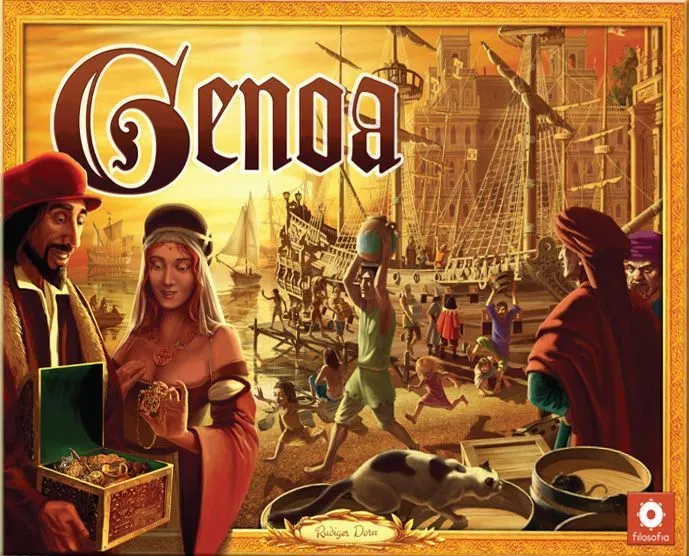
- BGG-Rang
- BGG #1.151
- BGG-Bewertung
- 7,0
Genoa
- 2–5 Spieler
- 60–120 Min.
- Komplexität 3,1/5
- 2001
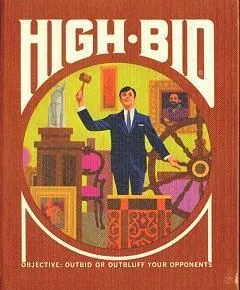
1963
Regelhilfe für High-Bid
Verständliche Erklärungen zu Spielzügen, Karteneffekten und strittigen Situationen mit Verweisen auf offizielle Quellen und gespeichertem Fragenverlauf.
Für 2 Personen
Was möchtest du wissen?
Antworten stammen aus dem offiziellen Regelheft, mit Seitenangabe zum Nachprüfen.
High-Bid ist ein Brettspiel aus dem Jahr 1963 für 2–4 Personen, mit 25 Minuten pro Partie und ab 12 Jahren. Entwickelt wurde es von Larry Winters und P. Winters; die wichtigsten Mechaniken sind Set Collection und Auction / Bidding.
Auf Englisch
Players represent collectors attempting to gather sets of valuable properties and artifacts ... coins, antiques, miniatures, etc. These sets are worth handsome sums at game's end. Individual pieces of a set are worthless at game's end, but are able to be sold during the course of the game in order to provide a cash-flow. These 'properties' are represented on cards. There are 12 different types of properties, varying from 3 - 6 pieces per set. Naturally, the sets containing six pieces are much more valuable than the sets containing only three pieces as it is much more difficult to complete these larger sets. Each player is dealt six cards and given a starting 'fund' of $2,000. The top 'property' card is revealed and a bidding ensues. The winner pays the bank and takes the card into his hand. The player then has the option of selling 1 - 3 properties to the bank. The idea here is to rid yourself of properties that you do not wish to collect and provide a source of income. There is danger, however. The sales price is determined randomly via the roll of two dice. The price can vary from 25% - 100% of the listed worth of the item. Further, if a '0' is rolled on one of the dice, then the item is NOT sold outright, but rather an auction takes place amongst the players. This can result in a substantially reduced price to the seller, or a higher price, depending upon the demand for the item. Further, it is quite possible that no one desires the item, so the seller must take the item back into his hand. There is also the possibility that the player will earn a $200 bonus if the proper digit is rolled on one of the dice. When a property is sold, it is placed on the appropriate section of the 'board' - 25%, 50%, 75%, or 100% (there really isn't a board, just a card holder that indicates these sections). After a player sells properties, he may surrender one of the special 'buyer' cards and purchase from 1 - 3 cards from one of these markets. The player must pay the indicated price (based on the particular percentage market where the property is located) and take the property into his hand. Again, there is a decision to be made here. Buyer cards are very valuable, as they can be used in a number of fashions: 1) Purchase properties, as described above; 2) Used as a 'wild' card to complete a set; or 3) Valued as $500.00 at the end of the game. So, a player has to weigh the advantages of each of these options and play accordingly. Buyer cards are purchases at auction in conjunction with a property card. When a Buyer card is revealed, another card is then revealed, and both cards are then auctioned together. The auction is a 'sealed' auction, however, so the stakes are often high as these cards carry tremendous advantages. The game continues in this fashion until the property deck expires or a player calls an end to the game. One can only do this, however, if he has a total value (property sets plus cash) in excess of $5,000. Even then, a player should only do this when he feels he has more assets than any of his opponents. As High Bid, this game was published for the 3M Bookshelf Series and 3M Gamette Series.
Laut Katalog unterstützt High-Bid 2–4 Personen. Diese Spanne entspricht der vom Verlag angegebenen Spielerzahl, das Spiel lässt sich also für jede Gruppengröße innerhalb dieser Spanne aufbauen. Aufbau, einzelne Regeln und Wertungsdetails können je nach Personenzahl trotzdem abweichen; prüfe daher die genaue Konfiguration in der Anleitung deiner Ausgabe.
Die angegebene Spieldauer für High-Bid beträgt 25 Minuten. Das ist die Schätzung des Verlags für eine vollständige Partie. Die tatsächliche Dauer hängt von der Gruppe, der Personenzahl und der Regelkenntnis ab: Erste Partien dauern meist länger, erfahrene Gruppen sind oft schneller fertig. Aufbau und Regelerklärung sind in dieser Schätzung nicht enthalten.
Im Katalog wird High-Bid ab 12 Jahren empfohlen. Das ist die Empfehlung des Verlags und berücksichtigt Leseanforderungen, Regelkomplexität und Kleinteile, nicht nur das Thema. Jüngere Kinder können oft mit Hilfe eines Erwachsenen mitspielen; beachte die Altersangabe deiner Ausgabe und die Brettspielerfahrung deiner Gruppe.
High-Bid hat bei BoardGameGeek eine Komplexitätswertung von 1,8 von 5 und gilt damit als leichtes Spiel. Die Wertung zeigt, wie viel Regelwissen, Planung und Entscheidungen eine typische Partie verlangt. Schwerere Spiele brauchen bei der ersten Erklärung mehr Zeit, daher hilft vor dem Spieleabend eine Vorbereitungsanleitung.
High-Bid gehört zu diesen Kategorien: Negotiation. Die wichtigsten Mechaniken sind Set Collection und Auction / Bidding. Kategorien beschreiben Thema und Setting eines Spiels, Mechaniken dagegen, was die Spielenden in ihrem Zug tatsächlich tun. Jede Mechanik führt zu einer Katalogseite mit ähnlichen Spielen, falls du etwas Vergleichbares suchst.
Als Autoren von High-Bid sind angegeben: Larry Winters und P. Winters. Diese Angaben stammen aus den veröffentlichten Spieldaten und nennen die für das Spieldesign verantwortlichen Personen, nicht die Illustratoren oder Verlage. Die Autorenseiten auf MeepleRules sammeln weitere Titel derselben Autoren – praktisch, wenn dir ein Spiel gefällt und du ähnliche Spiele suchst.
Im Katalog ist High-Bid als Grundspiel aufgeführt. Es lässt sich eigenständig mit dem Material aus der Schachtel spielen und benötigt keinen weiteren Titel. Erweiterungen, sofern es welche gibt, ergänzen neues Material oder neue Regeln und sind im Katalog separat mit einem Verweis auf dieses Grundspiel aufgeführt.