

- BGG-Rang
- BGG #24.139
- BGG-Bewertung
- 6,1
Yarmuk
- 2 Spieler
- Komplexität 2,6/5
- 1997
2010
Regelhilfe für Invasion Pearl Harbor
Verständliche Erklärungen zu Spielzügen, Karteneffekten und strittigen Situationen mit Verweisen auf offizielle Quellen und gespeichertem Fragenverlauf.
Was möchtest du wissen?
Antworten stammen aus dem offiziellen Regelheft, mit Seitenangabe zum Nachprüfen.
Invasion Pearl Harbor ist ein Brettspiel aus dem Jahr 2010 für 1–2 Personen, mit 120 Minuten pro Partie und ab 12 Jahren. Entwickelt wurde es von Adrian McGrath und Chris Smith; die wichtigsten Mechaniken sind Dice Rolling, Hexagon Grid und Simulation.




Auf Englisch
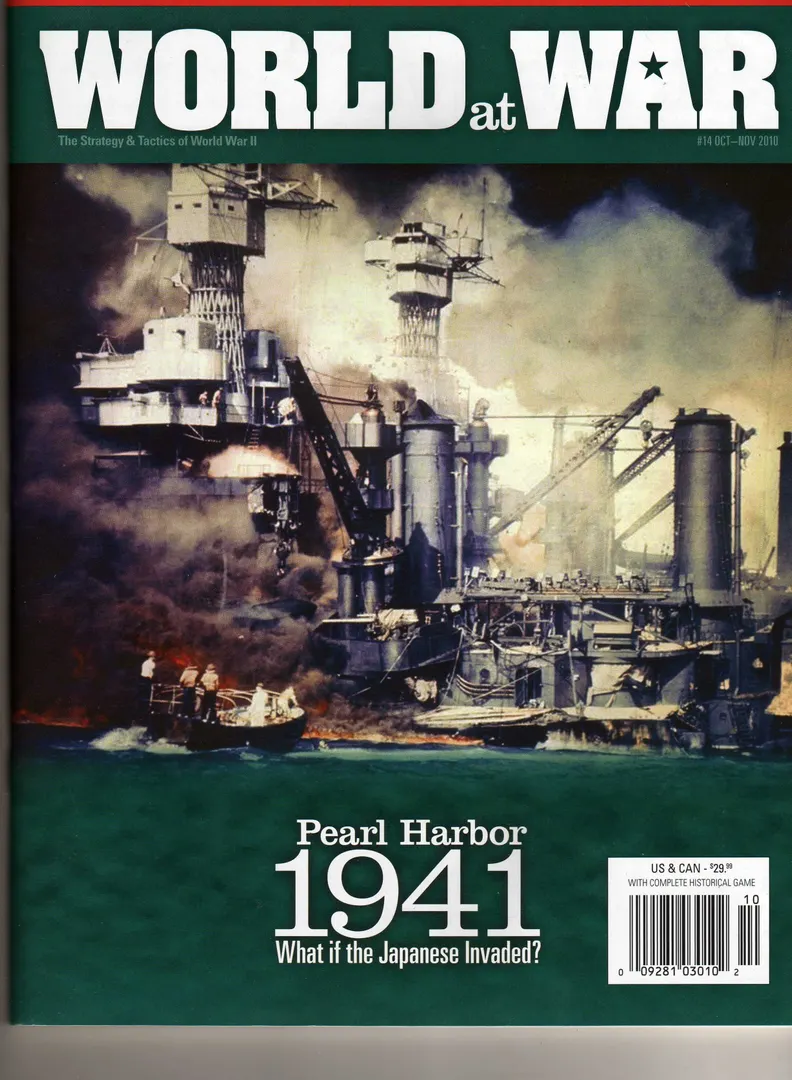
What If the Japanese Invaded? (IPH). It’s a low-to-intermediate complexity, strategic/operational-level, alternative history wargame of the campaign that could've resulted had the Japanese decided to launch an amphibious invasion of Oahu at the same time as their historic air raid. The game is intended for two players, one commanding the Japanese and the other commanding the US forces. The game system is focused so as to present the ground-commanders’ views of the campaign. Aero-naval operations – though certainly important in play – are presented more abstractly than would be the case in a design centered on those aspects of the campaign. Each hex on the 34x22 large-hex map equals one mile (1.62 km) from side to opposite side. Each game turn represents about four hours of daylight or an entire night. Playing pieces (176 iconic counters) represent ground units of approximately company size, or individual aircraft carriers or battleships, or enough aircraft sorties (about two to three dozen) needed to affect battlefield events at this scale. The rules contain a little less than 11,000 words. Two experienced players can finish a match in less than four hours. The single counterfactual assumption underlying the game is Adm. Yamamoto decided to back the plan he scrapped historically in September 1941. That plan had called for an amphibious invasion, conducted by about two regiments, to land on Oahu at the same time as the air attacks were begun. The further supposition then is, the Japanese, once ashore, would’ve had no more than about three days in which to achieve their now more ambitious goal: either secure the whole island or at least fight their way across enough of it – while thoroughly wrecking facilities as they came to them – to ensure the American recovery would be delayed as long as possible. The three-day limit is due to the fact that, by the end of that period, the Japanese carrier strike group would had to have withdrawn and the ground force’s initial load of combat supply would be used up. Rules cover such things as: variable landing sites, rough surf, carrier interventions, combat ground support, interdiction, a Nisei uprising, Ford Island and Battleship Row, night combat, banzai attacks and much more. The turn sequence is as follows. I. Carrier Warfare Phase (only Game Turns 5 & 9) A. Ship Disposition Segment B. Carrier Combat Segment II. US Submarine Attack Phase (only Game Turns 5 through 11) III. Japanese Landing Phase IV. US Sub-Command Chit-Pull Phase* V. US Sub-Command Chit-Pull Phase* VI. US Sub-Command Chit-Pull Phase* VII. US Sub-Command Chit-Pull Phase* May be preceded or followed by the Japanese Movement or Combat Phase, to the limit of one of such Japanese phase being executed per game turn upon that player’s declarations of them. Magazine: World at War #14
Laut Katalog unterstützt Invasion Pearl Harbor 1–2 Personen. Diese Spanne entspricht der vom Verlag angegebenen Spielerzahl, das Spiel lässt sich also für jede Gruppengröße innerhalb dieser Spanne aufbauen. Aufbau, einzelne Regeln und Wertungsdetails können je nach Personenzahl trotzdem abweichen; prüfe daher die genaue Konfiguration in der Anleitung deiner Ausgabe.
Die angegebene Spieldauer für Invasion Pearl Harbor beträgt 120 Minuten. Das ist die Schätzung des Verlags für eine vollständige Partie. Die tatsächliche Dauer hängt von der Gruppe, der Personenzahl und der Regelkenntnis ab: Erste Partien dauern meist länger, erfahrene Gruppen sind oft schneller fertig. Aufbau und Regelerklärung sind in dieser Schätzung nicht enthalten.
Im Katalog wird Invasion Pearl Harbor ab 12 Jahren empfohlen. Das ist die Empfehlung des Verlags und berücksichtigt Leseanforderungen, Regelkomplexität und Kleinteile, nicht nur das Thema. Jüngere Kinder können oft mit Hilfe eines Erwachsenen mitspielen; beachte die Altersangabe deiner Ausgabe und die Brettspielerfahrung deiner Gruppe.
Invasion Pearl Harbor hat bei BoardGameGeek eine Komplexitätswertung von 2,3 von 5 und gilt damit als eher leichtes Spiel. Die Wertung zeigt, wie viel Regelwissen, Planung und Entscheidungen eine typische Partie verlangt. Schwerere Spiele brauchen bei der ersten Erklärung mehr Zeit, daher hilft vor dem Spieleabend eine Vorbereitungsanleitung.
Invasion Pearl Harbor gehört zu diesen Kategorien: Wargame und World War II. Die wichtigsten Mechaniken sind Dice Rolling, Hexagon Grid und Simulation. Kategorien beschreiben Thema und Setting eines Spiels, Mechaniken dagegen, was die Spielenden in ihrem Zug tatsächlich tun. Jede Mechanik führt zu einer Katalogseite mit ähnlichen Spielen, falls du etwas Vergleichbares suchst.
Als Autoren von Invasion Pearl Harbor sind angegeben: Adrian McGrath und Chris Smith. Diese Angaben stammen aus den veröffentlichten Spieldaten und nennen die für das Spieldesign verantwortlichen Personen, nicht die Illustratoren oder Verlage. Die Autorenseiten auf MeepleRules sammeln weitere Titel derselben Autoren – praktisch, wenn dir ein Spiel gefällt und du ähnliche Spiele suchst.
Im Katalog ist Invasion Pearl Harbor als Grundspiel aufgeführt. Es lässt sich eigenständig mit dem Material aus der Schachtel spielen und benötigt keinen weiteren Titel. Erweiterungen, sofern es welche gibt, ergänzen neues Material oder neue Regeln und sind im Katalog separat mit einem Verweis auf dieses Grundspiel aufgeführt.