
- BGG-Rang
- BGG #2.444
- BGG-Bewertung
- 8,0
Successors (Fourth Edition)
- 2–5 Spieler
- 300 Min.
- Komplexität 4,2/5
- 2021
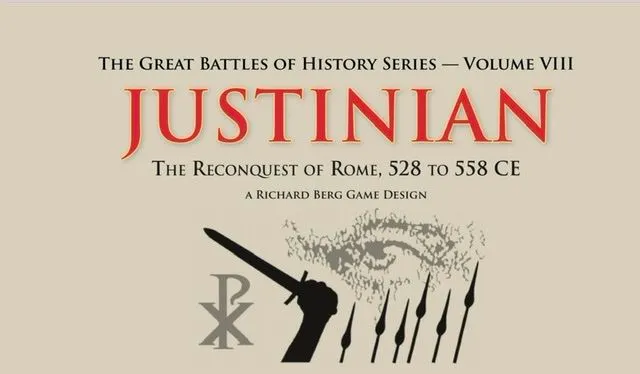
1999
Regelhilfe für Justinian
Verständliche Erklärungen zu Spielzügen, Karteneffekten und strittigen Situationen mit Verweisen auf offizielle Quellen und gespeichertem Fragenverlauf.
Für 2 Personen
Was möchtest du wissen?
Antworten stammen aus dem offiziellen Regelheft, mit Seitenangabe zum Nachprüfen.
Justinian ist ein Brettspiel aus dem Jahr 1999 für 2 Personen, mit 240 Minuten pro Partie und ab 12 Jahren. Entwickelt wurde es von Richard H. Berg; die wichtigsten Mechaniken sind Area Movement, Dice Rolling und Area Majority / Influence.


Auf Englisch
Justinian is a strategic level board-wargame game set in the early 6th century, after the collapse of the Western Roman Empire and the burgeoning of the Byzantine Eastern Roman Empire. The Byzantine Emperor, Justinian I, has started his reconquest of the Western Roman Empire, and the game attempts to simulate his endeavor for players to emulate. One player takes on Justinian's role, the other coordinates the Barbarian faction (basically the non-Byzantines); the designer also said the game can be played solitaire. The two factions' design are asymmetrical. Each turn, the Byzantine has to manage its finances, gaining income by taxing its controlled provinces and spending the money to raise and maintain its armies. Then the Barbarian and Byzantine factions alternate with each other to take actions (one at a time). They can raise more armies, move the troops, or do nothing. Whereas the extent of the Byzantine faction's orders are certainties, most of the Barbarian faction's are random; i.e. dice rolls sometimes determine how many armies join the Barbarians and whether these armies join the Byzantines instead. Both sides conquer territories by moving their armies into the lands. If two armies meet, combat occurs, which is resolved by dice rolls and cross checking the results with tables. The game features mutinies, naval actions, and random events. The latter throws up revolts, removal of generals and plagues. The game ends after 10 turns or after a second plague has erupted. The Byzantine faction has to control a certain majority of the empire by that time to win. The game also ends if the reconquest was accomplished much earlier. If the Byzantine faction is unable to win when the game ends, the Barbarian faction is the winner. JUSTINIAN is a game covering the reconquest of the Roman Empire by Justinian I, Emperor of Eastern Rome (Byzantium). Justinian’s reign represents Byzantium’s high water mark; his conquest of lands is exceeded in Roman history only by that of Augustus and Trajan. Players. The game may be played by two players, or solitaire.[...] —description from the rulebook
Laut Katalog unterstützt Justinian 2 Personen. Das ist die vom Verlag angegebene Spielerzahl, das Spiel ist also genau für diese Anzahl von Mitspielenden ausgelegt. Varianten für andere Gruppengrößen sind, sofern vorhanden, in der Anleitung deiner Ausgabe beschrieben; prüfe sie, bevor du eine andere Konfiguration aufbaust.
Die angegebene Spieldauer für Justinian beträgt 240 Minuten. Das ist die Schätzung des Verlags für eine vollständige Partie. Die tatsächliche Dauer hängt von der Gruppe, der Personenzahl und der Regelkenntnis ab: Erste Partien dauern meist länger, erfahrene Gruppen sind oft schneller fertig. Aufbau und Regelerklärung sind in dieser Schätzung nicht enthalten.
Im Katalog wird Justinian ab 12 Jahren empfohlen. Das ist die Empfehlung des Verlags und berücksichtigt Leseanforderungen, Regelkomplexität und Kleinteile, nicht nur das Thema. Jüngere Kinder können oft mit Hilfe eines Erwachsenen mitspielen; beachte die Altersangabe deiner Ausgabe und die Brettspielerfahrung deiner Gruppe.
Justinian hat bei BoardGameGeek eine Komplexitätswertung von 2,5 von 5 und gilt damit als eher leichtes Spiel. Die Wertung zeigt, wie viel Regelwissen, Planung und Entscheidungen eine typische Partie verlangt. Schwerere Spiele brauchen bei der ersten Erklärung mehr Zeit, daher hilft vor dem Spieleabend eine Vorbereitungsanleitung.
Justinian gehört zu diesen Kategorien: Wargame, Medieval und Ancient. Die wichtigsten Mechaniken sind Area Movement, Dice Rolling und Area Majority / Influence. Kategorien beschreiben Thema und Setting eines Spiels, Mechaniken dagegen, was die Spielenden in ihrem Zug tatsächlich tun. Jede Mechanik führt zu einer Katalogseite mit ähnlichen Spielen, falls du etwas Vergleichbares suchst.
Als Autoren von Justinian sind angegeben: Richard H. Berg. Diese Angaben stammen aus den veröffentlichten Spieldaten und nennen die für das Spieldesign verantwortlichen Personen, nicht die Illustratoren oder Verlage. Die Autorenseiten auf MeepleRules sammeln weitere Titel derselben Autoren – praktisch, wenn dir ein Spiel gefällt und du ähnliche Spiele suchst.
Im Katalog ist Justinian als Grundspiel aufgeführt. Es lässt sich eigenständig mit dem Material aus der Schachtel spielen und benötigt keinen weiteren Titel. Erweiterungen, sofern es welche gibt, ergänzen neues Material oder neue Regeln und sind im Katalog separat mit einem Verweis auf dieses Grundspiel aufgeführt.