- BGG-Bewertung
- 7,5
Karnag: The Congregations
- 2–5 Spieler
- 100 Min.
- Komplexität 3,5/5
- 2012
2012
Regelhilfe für Karnag
Verständliche Erklärungen zu Spielzügen, Karteneffekten und strittigen Situationen mit Verweisen auf offizielle Quellen und gespeichertem Fragenverlauf.
Was möchtest du wissen?
Antworten stammen aus dem offiziellen Regelheft, mit Seitenangabe zum Nachprüfen.
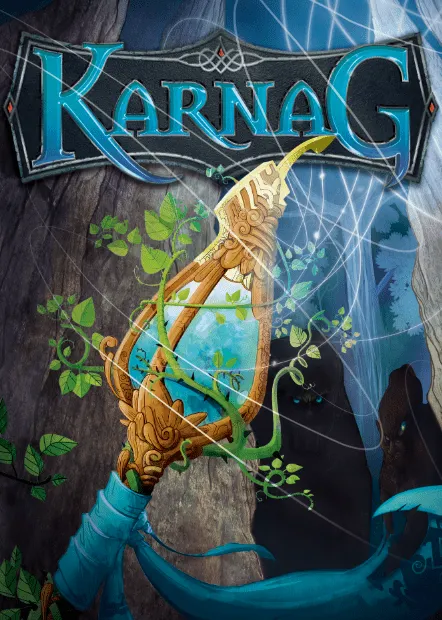
Karnag ist ein Brettspiel aus dem Jahr 2012 für 2–5 Personen, mit 120 Minuten pro Partie und ab 14 Jahren. Entwickelt wurde es von Pascal Cadot; die wichtigsten Mechaniken sind Enclosure, Action Queue und Worker Placement.








Auf Englisch
AIM OF THE GAME Obtain magical points (MP) by preventing evil creatures from invading the human world. These creatures come from the underwater Ker-Ys city. PREPARATION In turn, the players place all elements of the game area (wall ruins, swamps). Four creatures are introduced in the game and will progress from the door (in the centre of a glade) towards either side of the game board (representing the druids’ path surrounding the glade). Creatures’ moves are pre-defined and happen automatically. The players place their team of three druids whose role is to prevent the creatures from invading the human world. Energy markers are set at the start level and the knowledge track markers are set under the tracks. The pile of Power cards is shuffled and placed near the board. THE GAME The game consists of a defined number of rounds (depending on number of players). Every round is composed of the following phases: The creatures progress. The creatures already on the board progress towards the side of the board using a totally automatic way of moving. New creatures (1 to 3, depending on a dice roll) arrive on the board and start to progress too. Preparation of the Action tiles. The six Action tiles are shuffled and placed one by one forming a line, face up. These tiles represent all possible actions, each tile being separated into a major and a minor action. The number of places available on the tiles depends on the number of players. Choice of actions. Each druid team carries out 5 actions a round, represented by Action markers. Players, in the reverse order of their position on the score track, choose their actions one by one by setting their Action markers on the available places on the Action cards. Actions can be: moving the druids (they only move on the path surrounding the glade), setting a magical stone (a magical stone is set at the intersection of the magical beams emitted by two druids looking at the glade, this costs energy; the magical beams do not cross obstacles), capturing creature(s) (a druid may capture a creature in front of him with his magical beam; this costs energy but gives MP and sometimes special properties), progressing in knowledge tracks (to increase the capacity of moving, or to increase the influence at the druid council, for instance), preparing magical beverages (to increase knowledge but also to recover energy), moving a magical stone (it is possible to move a magical stone), acquiring Power cards (they give special powers, such as allowing the magical beam to pass through a wall), and influencing a creature (allows to move a creature). Actions are performed. Actions are performed marker by marker, from left to right, starting with the major actions before doing the minor ones. If the same colour of marker is encountered a second time on the same action, this action is not carried out. The actions on the next Action tile are then carried out and so on, until all major or all minor actions have been performed. Then, the players come back to the stopped action to perform it. Druids must inform the council about all their actions. After they have set a stone, captured a creature, or prepared a magical beverage, druids are placed at the druid council. Any druid can start from the council to enter back the path, but he can also stay at the council to influence it and gain MP at the end of the round. Activation of magical stones. At the end of each round, all stones that are aligned and of the same colour automatically become menhirs. MP are attributed to the corresponding players and depend on the distance between the stones that have been transformed, as well as their position in the glade. Menhirs have a special property that will be activated at the end of the game. Druid council. At the end of each round, the influence of each druid team on the council is evaluated. Players receive as many MP as their number of druids at the council. In addition, the team in majority can increase his knowledge in one of the knowledge tracks. Then, a new round can start. END OF THE GAME The game is finished after 5 or 6 rounds, depending on the number of players. In addition to the MP gained during the game, players receive MP according to the magical stones still on the board and the Power cards still in their hands. Also, the final menhir layout is important and can afford MP according to two different scenarios. If the central door (from which the creatures come) can be completely shut in by drawing a connecting line between menhirs, then MP are attributed to the players for the menhirs they have placed in the glade. If it is not possible to shut in the central door by connecting menhirs, then MP are attributed to the players for the creatures that they have captured. THE WINNER The winner is the player with the highest MP score.
Laut Katalog unterstützt Karnag 2–5 Personen. Diese Spanne entspricht der vom Verlag angegebenen Spielerzahl, das Spiel lässt sich also für jede Gruppengröße innerhalb dieser Spanne aufbauen. Aufbau, einzelne Regeln und Wertungsdetails können je nach Personenzahl trotzdem abweichen; prüfe daher die genaue Konfiguration in der Anleitung deiner Ausgabe.
Die angegebene Spieldauer für Karnag beträgt 120 Minuten. Das ist die Schätzung des Verlags für eine vollständige Partie. Die tatsächliche Dauer hängt von der Gruppe, der Personenzahl und der Regelkenntnis ab: Erste Partien dauern meist länger, erfahrene Gruppen sind oft schneller fertig. Aufbau und Regelerklärung sind in dieser Schätzung nicht enthalten.
Im Katalog wird Karnag ab 14 Jahren empfohlen. Das ist die Empfehlung des Verlags und berücksichtigt Leseanforderungen, Regelkomplexität und Kleinteile, nicht nur das Thema. Jüngere Kinder können oft mit Hilfe eines Erwachsenen mitspielen; beachte die Altersangabe deiner Ausgabe und die Brettspielerfahrung deiner Gruppe.
Karnag hat bei BoardGameGeek eine Komplexitätswertung von 3,4 von 5 und gilt damit als mittelschweres Spiel. Die Wertung zeigt, wie viel Regelwissen, Planung und Entscheidungen eine typische Partie verlangt. Schwerere Spiele brauchen bei der ersten Erklärung mehr Zeit, daher hilft vor dem Spieleabend eine Vorbereitungsanleitung.
Karnag gehört zu diesen Kategorien: Fantasy. Die wichtigsten Mechaniken sind Enclosure, Action Queue und Worker Placement. Kategorien beschreiben Thema und Setting eines Spiels, Mechaniken dagegen, was die Spielenden in ihrem Zug tatsächlich tun. Jede Mechanik führt zu einer Katalogseite mit ähnlichen Spielen, falls du etwas Vergleichbares suchst.
Als Autoren von Karnag sind angegeben: Pascal Cadot. Diese Angaben stammen aus den veröffentlichten Spieldaten und nennen die für das Spieldesign verantwortlichen Personen, nicht die Illustratoren oder Verlage. Die Autorenseiten auf MeepleRules sammeln weitere Titel derselben Autoren – praktisch, wenn dir ein Spiel gefällt und du ähnliche Spiele suchst.
Im Katalog ist Karnag als Grundspiel aufgeführt. Es lässt sich eigenständig mit dem Material aus der Schachtel spielen und benötigt keinen weiteren Titel. Erweiterungen, sofern es welche gibt, ergänzen neues Material oder neue Regeln und sind im Katalog separat mit einem Verweis auf dieses Grundspiel aufgeführt.