

- BGG-Rang
- BGG #17.119
- BGG-Bewertung
- 7,3
BARPIG: After Hours
- 3–7 Spieler
- 30–75 Min.
- 2019
2014
Regelhilfe für Kombat Kittens
Verständliche Erklärungen zu Spielzügen, Karteneffekten und strittigen Situationen mit Verweisen auf offizielle Quellen und gespeichertem Fragenverlauf.
Für 2 Personen
Was möchtest du wissen?
Antworten stammen aus dem offiziellen Regelheft, mit Seitenangabe zum Nachprüfen.
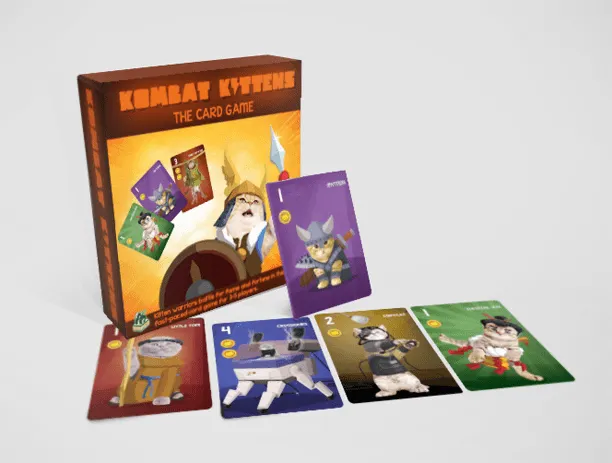
Kombat Kittens ist ein Brettspiel aus dem Jahr 2014 für 2–5 Personen, mit 20 Minuten pro Partie und ab 9 Jahren. Entwickelt wurde es von Wade Tinney, Josh Welber, Mike Domingo, Jon Keefer und Brad MacDonald; die wichtigsten Mechaniken sind Hand Management, Open Drafting und Deck, Bag, and Pool Building.






Auf Englisch
Kombat Kittens Game Rules THE GOAL Collect the most treasure by battling your kitten compadres and taking their treasure. At the end of the game, the player with the most treasure wins! THE DECK 80 Kitten Cards: Ten each of ranks 1-7 and ten of rank 9 (There is no rank 8 in Kombat Kittens.) Each card has treasure value from 1 to 4. Five Dog Cards: Each Dog card has a treasure value of 5. Dogs do not have a rank. SETUP Remove all Dog cards from the deck and deal each player five Kitten cards. For two players: Deal out three Kitten cards face up in the center of the table - these are the Recruit cards. Add three Dog cards to the remaining deck, each ⅓ of the way through the deck, with the last on the bottom. This is the Draw pile. Place it in the center of the table. For three to five Players: Deal out one Kitten card face up in the center of the table - this is the Recruit card. Add two Dog cards to the remaining deck, one at the center, and one on the bottom. This is the Draw pile. Place it in the center of the table. The player with the most realistic “meow” goes first. TAKING TURNS On each turn, the player can either: 1) Draw a card from the Draw pile. (If they have less than seven cards in their hand.) or 2) Take a Recruit card and replace it with a card from their hand. or 3) Battle another player: do this by declaring which player you wish to battle. We recommend passing a turn token (coin, salt shaker, stuffed mouse, etc.) around the table as you play this game. It is always okay to ask how many cards another player has. Battles In a battle, both players attempt to make the best three card set from the cards in their hand. To indicate they are ready to battle, each player holds their first card face down over the table. When both players are ready, they reveal their cards simultaneously. They repeat this process until three cards have been played (unless a player forfeits, as described below.) After the third card, the best hand is determined and the winner chooses their treasure (see below). DETERMINING THE WINNER OF A BATTLE The winner is the player with the best hand based on the hierarchy below, from high to low. If two hands of the same type are played, the one with the highest rank wins. Three of a Kind: Three cards of the same rank. Example: 4,4,4 beats 2,2,2 and all straights, pairs and high card hands. Three Card Straight: Three cards of adjacent rank. Example: 4,5,6 beats 2,3,4 and all pairs and high card hands. Pair: Two cards of matching rank, plus one other card. For matching pairs, the one with the highest 3rd card wins. Example: 6,6,5 beats 6,6,3 or 4,4,7 and any high card hand. High Card Hand: A hand without a straight and no pairs. Example: 7,4,3 beats 6,5,2. TIES If there is a tie, all players involved in the tied battle discard the played cards and take the number of cards they played from the draw pile instead of drawing up to five cards. No treasure is taken in a tied battle. CAPTURING TREASURE At the end of battle, the winning player captures Treasure from the losing player(s) as follows: Three to Five Player Game: The winner may now take either one card from the losing player’s played cards or the lowest value treasure from the losing player’s captured treasure. If there are multiple lowest value cards, the winner chooses whichever of these they want. Two Player Game: The winner takes one of the loser’s played cards - they cannot take captured treasure. AFTER A BATTLE Once battle is resolved, all uncaptured cards that were played are put into a discard pile, which we call the Litter Box. Then, all players who participated who have fewer than five cards left, draw new cards until they have a total of five in their hand. All captured cards are placed face up in front of the player who captured them, so that their treasure value and suit are visible to all. Additionally, if a player forfeited (see below), they draw an extra card now. If a battle ended in a tie, then each of the players in the battle (primary and helper) draw the number of cards they played (three or one). HELPING Once a battle has been announced, but before the first card is played, each player involved in the battle may ask for help. If Player B agrees to help Player A, then Player B will play a single card at the end of the battle, after Player A has played their three cards. In a four or five person game, each side in a battle may ask for and receive help. If both sides have a helper, then each helper reveals their card simultaneously after the two main combatants have shown all three cards. After all cards are played, each side makes their best three card hand out of the four cards available. Taking treasure: In a helper battle, two cards are taken from the loser. The main combatant on the winning side chooses one card from the played cards (all four cards, if the losing side had a helper) and one card from the main losing combatant’s captured treasure. If the main combatant on the losing side has no captured treasure, then the winning side takes two cards from the cards played. Once they’ve taken treasure, the winner can choose to give one of those cards to the player who helped them. Example: Kim announces she will battle Josh. Josh and Kim both ask for help. Mike agrees to help Kim, and Vivian agrees to help Josh. Kim and Josh then simultaneously reveal three cards from their hand in sequence. Mike and Vivian then both reveal a card from their hand. Kim’s side ends up with 5,5,5,7 and Josh’s side ends with 4,5,6,7. Kim’s side wins, because she has three 5’s which beats Josh’s hand of 5,6,7. Kim then takes one card from Josh’s captured treasure, and one of the four cards played (one of the 4,5, 6 or 7). Although she could add both cards to her own treasure, she gives Mike one of the two as a reward for helping her. FORFEITING Either of the main combatants in a battle may forfeit after playing their first or second card. Players who are receiving help can forfeit as well, but even if they do, the helper must play a card. Cards played by the forfeiting player or their helper are subject to being taken by the winner, just as in any other battle. If a player forfeits, they are allowed to take an additional card from the Draw Pile after the battle. If they are left with fewer than five cards at the end of battle, they first draw until they have five cards then take their additional card. Helpers on the forfeiting side may not take an additional card. They only take new cards if they have less than five in their hand at the end of battle. DOGFIGHTS If at any point during play a player draws a Dog card from the deck, they immediately place it face up in the center of the table and a Dogfight commences. (Before the Dogfight, the player who drew the Dog draws a new card and any other players who were in mid-draw should finish drawing.) Players must play at least one card in the Dogfight, but they may forfeit after playing their first or second card. The winner of the Dogfight takes the Dog card and places it face up in front of them in their captured treasure. As in normal battle, all players select a card and hold it face down over the table, then reveal their cards at once. Unlike a normal battle, players may not ask for help. The Dogfight ends when either a) all players but one have forfeited, or b) all players who are still in the Dogfight have played three cards. In the case of Ties, the Dog is discarded, and all players who played three cards take three cards from the draw pile. As with normal battle, any players who forfeit the Dogfight battle draw an extra card at the end of the battle and all players who have fewer than five cards draw until they have five. REACHING THE END OF THE DECK Two Players: At the end of the first deck, there will be a single Dogfight (the bottom card is always a Dog) and then the game is over. Three to Five Players: At the end of the first deck, after the Dogfight, take all the discarded cards from the Litter Box and reshuffle them. Then add the last three Dogs to this deck, each card roughly ⅓ of the way through the deck with the last Dog on the bottom of the deck. When you reach the end of the second deck there will be one final Dogfight and then the game is over. END OF THE GAME Two players: The game ends after the Dogfight at the end of the first deck. Three to Five players: The game ends after the Dogfight at the end of the second deck. Note: If any player has fewer than five cards or needs to draw cards due to a previous battle, then shuffle the discards from the Litter Box and draw cards before the final Dogfight. DETERMINING A WINNER At the end of the game, each player adds up the treasure value of all cards in their captured treasure (the ones face up in front of them) and adds any Suit Bonuses (as described below). The player with the highest total wins! They should be patted on the head and given a treat. SUIT BONUSES A player who has four or more treasure cards of the same suit receives a 10 point bonus at the end of the game. Players receive this bonus once per suit of which they have four or more cards. Example: If a player has four captured Samurai kittens, they get 10 bonus points. If they have eight captured Samurai, they still get just 10 bonus points. However, if they have four captured Samurai and four captured Mechs, they get a 20 point bonus (10 for each suit). If two or more players tie for the the highest treasure score, the tied players play a three-card hand after first drawing to make sure have at least five cards in their hands. The player with the best hand is the winner.
Laut Katalog unterstützt Kombat Kittens 2–5 Personen. Diese Spanne entspricht der vom Verlag angegebenen Spielerzahl, das Spiel lässt sich also für jede Gruppengröße innerhalb dieser Spanne aufbauen. Aufbau, einzelne Regeln und Wertungsdetails können je nach Personenzahl trotzdem abweichen; prüfe daher die genaue Konfiguration in der Anleitung deiner Ausgabe.
Die angegebene Spieldauer für Kombat Kittens beträgt 20 Minuten. Das ist die Schätzung des Verlags für eine vollständige Partie. Die tatsächliche Dauer hängt von der Gruppe, der Personenzahl und der Regelkenntnis ab: Erste Partien dauern meist länger, erfahrene Gruppen sind oft schneller fertig. Aufbau und Regelerklärung sind in dieser Schätzung nicht enthalten.
Im Katalog wird Kombat Kittens ab 9 Jahren empfohlen. Das ist die Empfehlung des Verlags und berücksichtigt Leseanforderungen, Regelkomplexität und Kleinteile, nicht nur das Thema. Jüngere Kinder können oft mit Hilfe eines Erwachsenen mitspielen; beachte die Altersangabe deiner Ausgabe und die Brettspielerfahrung deiner Gruppe.
Kombat Kittens hat bei BoardGameGeek eine Komplexitätswertung von 1,4 von 5 und gilt damit als leichtes Spiel. Die Wertung zeigt, wie viel Regelwissen, Planung und Entscheidungen eine typische Partie verlangt. Schwerere Spiele brauchen bei der ersten Erklärung mehr Zeit, daher hilft vor dem Spieleabend eine Vorbereitungsanleitung.
Kombat Kittens gehört zu diesen Kategorien: Card Game, Fighting und Humor. Die wichtigsten Mechaniken sind Hand Management, Open Drafting und Deck, Bag, and Pool Building. Kategorien beschreiben Thema und Setting eines Spiels, Mechaniken dagegen, was die Spielenden in ihrem Zug tatsächlich tun. Jede Mechanik führt zu einer Katalogseite mit ähnlichen Spielen, falls du etwas Vergleichbares suchst.
Als Autoren von Kombat Kittens sind angegeben: Wade Tinney, Josh Welber, Mike Domingo, Jon Keefer und Brad MacDonald. Diese Angaben stammen aus den veröffentlichten Spieldaten und nennen die für das Spieldesign verantwortlichen Personen, nicht die Illustratoren oder Verlage. Die Autorenseiten auf MeepleRules sammeln weitere Titel derselben Autoren – praktisch, wenn dir ein Spiel gefällt und du ähnliche Spiele suchst.
Im Katalog ist Kombat Kittens als Grundspiel aufgeführt. Es lässt sich eigenständig mit dem Material aus der Schachtel spielen und benötigt keinen weiteren Titel. Erweiterungen, sofern es welche gibt, ergänzen neues Material oder neue Regeln und sind im Katalog separat mit einem Verweis auf dieses Grundspiel aufgeführt.