

- BGG-Bewertung
- 5,6
Machine of Death: The Game of Creative Assassination – Death
- 2–6 Spieler
- 2013
2014
Regelhilfe für Machine of Death: The Game of Creative Assassination
Verständliche Erklärungen zu Spielzügen, Karteneffekten und strittigen Situationen mit Verweisen auf offizielle Quellen und gespeichertem Fragenverlauf.
Was möchtest du wissen?
Antworten stammen aus dem offiziellen Regelheft, mit Seitenangabe zum Nachprüfen.
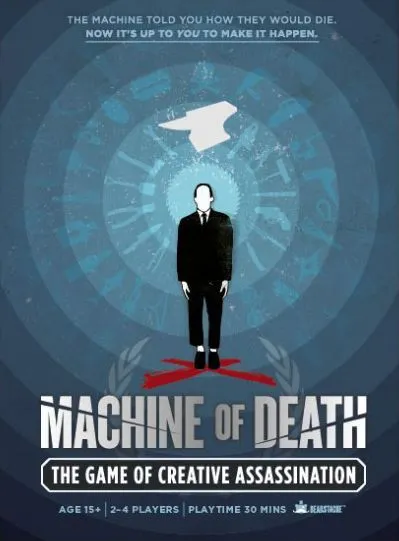
Machine of Death: The Game of Creative Assassination ist ein Brettspiel aus dem Jahr 2014 für 2–4 Personen, mit 30 Minuten pro Partie und ab 15 Jahren. Entwickelt wurde es von David Fooden, David Malki und Kris Straub; die wichtigsten Mechaniken sind Dice Rolling und Storytelling.
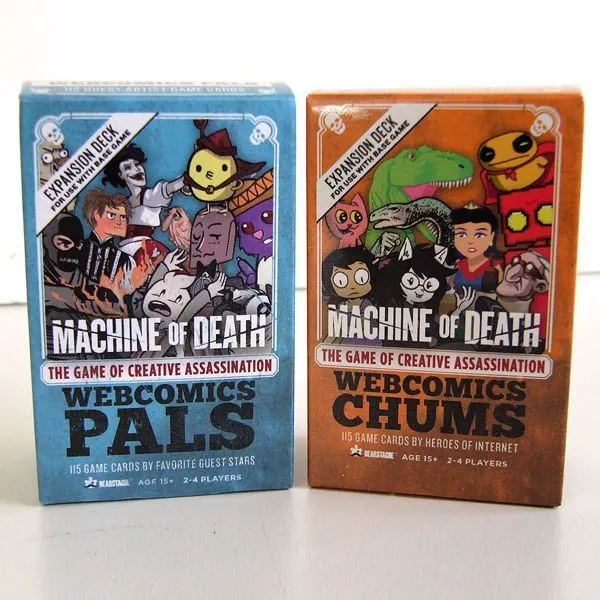




Auf Englisch
Machine of Death: The Game of Creative Assassination is a storytelling game set in a world in which a machine can predict how a person will die with 100% accuracy with only a small blood sample. However, the machine delights in being vague and twisted. A card reading "Old Age" could mean you die in your sleep at age 120, or it could mean you're run over tomorrow by an elderly driver who forgot to take his pills today. Players of the game take the role of assassins, who must use the various tools at their disposal -- from storytelling to a slew of items available from specialty Black Market shops -- to create a situation in which a target is killed in a way in line with their Death Prediction. The Machine of Death Game uses this basic idea, of assassins working in a world where cause of death is known to create various game modes. The General Gameplay of most modes works like this: A target is assigned, and given certain details (including Death Prediction, and extra Intel details, such as things they particularly like or dislike – to help predict their behavior). Players – assassins – are given Black Market Gift Cards. These are the items they are allowed to use in order to accomplish their goal: killing the target. Players use the Gift Cards to devise a plan. Each Black Market card provides an item to be used in an Action. Three actions should chain together in some way that results in the death of the target. The plan is greenlit, either by a Chief player, or via consensus, depending on game mode. The timer starts and the plan is put into action. This is represented by dice rolling to beat a "difficulty score." An unlikely plan hinging on a single item may need to roll a 6 for that Action, but a rock-solid intricate plan may need to only roll a 2 for each card. The skull face on the die also adds a frantic element (replacing the 1 face, if the skull is rolled it prompts the flipping of a Fate Coin to add additional randomness). In case of failure of any die roll, that Action didn't work, and the plan must be revised. While the timer continues running, the assassins draw a new Black Market item, amending their previous plan and rolling for a new Action. They may also call in "Specialists", who are characters with special skills (earned in previous rounds). If any three Actions are successful before the timer runs out, the target is killed. With the remaining time, the players may roll for Aftermath tasks (such as fleeing the scene or destroying the evidence). Completion of these tasks earns Specialist cards to be used in later rounds. This is the only way to replenish the group's overall Budget of playable cards. If the timer runs out before three Actions are completed, the target escapes. This is the end of the round. In the published rules, this also ends the game. This rule was subsequently revised, allowing players to make another attempt on the same target, or take the loss and move on to additional targets. Hard-core players may end the game at this point. The team wins if they can accomplish four successful kills before their total Budget of Black Market cards are exhausted. Game Variants: Chief Mode is where one player takes on the gamemaster role of the Chief, answering questions and deciding on the difficulty of the plan being created by the other players. Groups of 4 or more work best in this mode. In groups of 2-3 players, each player states their opinion, and the hardest value is the one used. Psychopath is similar to Cards Against Humanity or Apples to Apples. Each player holds a hand of Death Prediction cards that represent hostages. One psychopath announces a murder weapon (based on a drawn Black Market card), and players each toss in the hostage they believe will be most likely to be killed by that weapon. Designed for 4+ players. Speed Round is faster-paced and useful for introducing players to the death prediction concept. One Chief presents the Death Prediction Card of an assassination target, and players rush to play a Black Market or Specialist card that they think can kill the person in the predicted way. The Chief assigns a difficulty value to the fastest player's proposed plan, and the player rolls to see if they can pull it off. If they do, they earn that Death Prediction Card as a point; if they fail, another player may propose a plan. Mechanical Chief uses 14 regular playing cards to replace the subjective judgments of the Chief. Each Black Market card is dealt with a playing card, the value of which is kept hidden until the die is about to be rolled. This variant is good for faster play, and directs discussions toward justifying the revealed values within the story, rather than debating the merits of various plans. Teams is useful for very large groups. The players split into two rival assassination teams, and alternate attacking targets, with a single Chief moderating. Teams operate under spelling bee elimination rules (one team's failure, followed by the victory of the other, results in the first team's elimination). A target that a team fails to kill must then be attempted by the other team, and a continuous narrative persists throughout the entire game.
Laut Katalog unterstützt Machine of Death: The Game of Creative Assassination 2–4 Personen. Diese Spanne entspricht der vom Verlag angegebenen Spielerzahl, das Spiel lässt sich also für jede Gruppengröße innerhalb dieser Spanne aufbauen. Aufbau, einzelne Regeln und Wertungsdetails können je nach Personenzahl trotzdem abweichen; prüfe daher die genaue Konfiguration in der Anleitung deiner Ausgabe.
Die angegebene Spieldauer für Machine of Death: The Game of Creative Assassination beträgt 30 Minuten. Das ist die Schätzung des Verlags für eine vollständige Partie. Die tatsächliche Dauer hängt von der Gruppe, der Personenzahl und der Regelkenntnis ab: Erste Partien dauern meist länger, erfahrene Gruppen sind oft schneller fertig. Aufbau und Regelerklärung sind in dieser Schätzung nicht enthalten.
Im Katalog wird Machine of Death: The Game of Creative Assassination ab 15 Jahren empfohlen. Das ist die Empfehlung des Verlags und berücksichtigt Leseanforderungen, Regelkomplexität und Kleinteile, nicht nur das Thema. Jüngere Kinder können oft mit Hilfe eines Erwachsenen mitspielen; beachte die Altersangabe deiner Ausgabe und die Brettspielerfahrung deiner Gruppe.
Machine of Death: The Game of Creative Assassination hat bei BoardGameGeek eine Komplexitätswertung von 1,5 von 5 und gilt damit als leichtes Spiel. Die Wertung zeigt, wie viel Regelwissen, Planung und Entscheidungen eine typische Partie verlangt. Schwerere Spiele brauchen bei der ersten Erklärung mehr Zeit, daher hilft vor dem Spieleabend eine Vorbereitungsanleitung.
Machine of Death: The Game of Creative Assassination gehört zu diesen Kategorien: Card Game und Humor. Die wichtigsten Mechaniken sind Dice Rolling und Storytelling. Kategorien beschreiben Thema und Setting eines Spiels, Mechaniken dagegen, was die Spielenden in ihrem Zug tatsächlich tun. Jede Mechanik führt zu einer Katalogseite mit ähnlichen Spielen, falls du etwas Vergleichbares suchst.
Als Autoren von Machine of Death: The Game of Creative Assassination sind angegeben: David Fooden, David Malki und Kris Straub. Diese Angaben stammen aus den veröffentlichten Spieldaten und nennen die für das Spieldesign verantwortlichen Personen, nicht die Illustratoren oder Verlage. Die Autorenseiten auf MeepleRules sammeln weitere Titel derselben Autoren – praktisch, wenn dir ein Spiel gefällt und du ähnliche Spiele suchst.
Im Katalog ist Machine of Death: The Game of Creative Assassination als Grundspiel aufgeführt. Es lässt sich eigenständig mit dem Material aus der Schachtel spielen und benötigt keinen weiteren Titel. Erweiterungen, sofern es welche gibt, ergänzen neues Material oder neue Regeln und sind im Katalog separat mit einem Verweis auf dieses Grundspiel aufgeführt.