

- BGG-Rang
- BGG #3.399
- BGG-Bewertung
- 6,8
Tao Long: The Way of the Dragon
- 2 Spieler
- 10–30 Min.
- Komplexität 2,7/5
- 2017
Regelhilfe für Mangala
Verständliche Erklärungen zu Spielzügen, Karteneffekten und strittigen Situationen mit Verweisen auf offizielle Quellen und gespeichertem Fragenverlauf.
Für 2 Personen
Was möchtest du wissen?
Antworten stammen aus dem offiziellen Regelheft, mit Seitenangabe zum Nachprüfen.
Mangala ist ein Brettspiel für 2 Personen. Die wichtigsten Mechaniken sind Mancala.







Auf Englisch
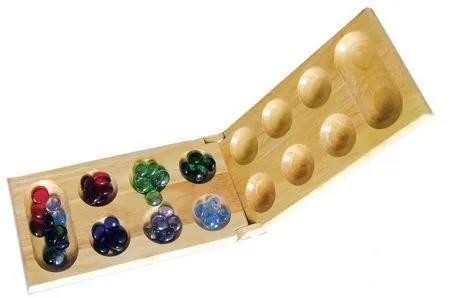
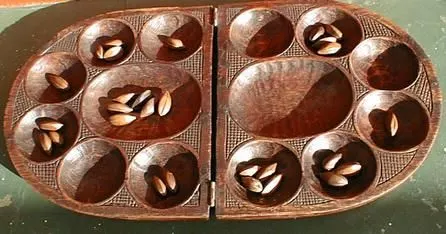
A mancala game. From Mancala World: http://mancala.wikia.com/wiki/Mangala_II "Mangala is a Turkish mancala game which was very popular in the 17th and 18th century. According to Metin And, a Turkish ethnologue, the game could be related to the "mancala" of The Arabian Nights (fifteenth night), one of the first literary accounts of mancala games. The game was depicted in Turkish paintings as early as in the 16th century. In Europe, it was first mentioned in 1694 by the English traveller Thomas Hyde. Mangala was also found by Edward Daniel Clarke in Balaklava, Crimea (now a suburb of Sevastopol) in 1801 and by Peter Emund Laurent on Chios Island (now Greece) in 1818. It might have influenced Mandoli (Hydra Island, Greece) and Ban-Ban (Bosnia). Mangala has almost the same rules as the Baltic German Bohnenspiel, which originated in Persia where it was known as Manqala or Manqalat. Two Ottoman Women playing Mangala (18th century) The classic Mangala is still known in Turkey. However, the Mangala played in Gaziantep in Southeast Anatolia is not related to it at all, but is a close variant of La'b madjnuni ("The Crazy Game"), which was played in Damascus (Syria) in the late 19th century. More games called "Mangala" (again with quite different rules) are popular among the Bedouins in Egypt. Mangala might be the first commercialized mancala game in a western country. A game called "mangola" (a common synonym for the Turkish Mangala at this time) was published by Jaques in England in 1863, after Walter Whitmore Jones claimed to have invented it. Jaques pattern book covering shows a thick wood board with two rows of six cells in which something like white beans are placed. The records of copyrights kept by the Stationers company, the Public Records Office at Kew, includes a volume covering 1862-64, which has an entry showing that the rules of Mangola were protected by copyright at that time. Richard Ballam, a board games collector, found an advertisement in the Illustrated London News (December 23, 1865) saying: "Mangola, a new game. By the author of Squails, Frogs & Toads etc. Wholesale Jaques & Son". Claiming foreign or nearly forgotten boardgames as own designs happens frequently in the game industry. (...) Rules Mangala is played on a board, which consists of 12 holes dug into the earth. Initially there are six glass beads ("boncuğu") or cowrie shells in each hole. On his turn a player distributes the contents of a hole, one by one, in a counter-clockwise direction into the succeeding holes. If the last bead falls in a hole on either side of the board, making a total of two, four or six beads including the last bead, its contents are captured. If this hole is preceded by other holes which contain two, four or six beads, their contents are also taken. A player must move if he can, but passes when his holes are empty. The game is finished when all holes are empty. The player who captured more beads wins the game."
Laut Katalog unterstützt Mangala 2 Personen. Das ist die vom Verlag angegebene Spielerzahl, das Spiel ist also genau für diese Anzahl von Mitspielenden ausgelegt. Varianten für andere Gruppengrößen sind, sofern vorhanden, in der Anleitung deiner Ausgabe beschrieben; prüfe sie, bevor du eine andere Konfiguration aufbaust.
Mangala hat bei BoardGameGeek eine Komplexitätswertung von 1,0 von 5 und gilt damit als leichtes Spiel. Die Wertung zeigt, wie viel Regelwissen, Planung und Entscheidungen eine typische Partie verlangt. Schwerere Spiele brauchen bei der ersten Erklärung mehr Zeit, daher hilft vor dem Spieleabend eine Vorbereitungsanleitung.
Mangala gehört zu diesen Kategorien: Abstract Strategy. Die wichtigsten Mechaniken sind Mancala. Kategorien beschreiben Thema und Setting eines Spiels, Mechaniken dagegen, was die Spielenden in ihrem Zug tatsächlich tun. Jede Mechanik führt zu einer Katalogseite mit ähnlichen Spielen, falls du etwas Vergleichbares suchst.
Im Katalog ist Mangala als Grundspiel aufgeführt. Es lässt sich eigenständig mit dem Material aus der Schachtel spielen und benötigt keinen weiteren Titel. Erweiterungen, sofern es welche gibt, ergänzen neues Material oder neue Regeln und sind im Katalog separat mit einem Verweis auf dieses Grundspiel aufgeführt.