

- BGG-Rang
- BGG #25
- BGG-Bewertung
- 8,2
Nemesis
- 1–5 Spieler
- 90–180 Min.
- Komplexität 3,5/5
- 2018
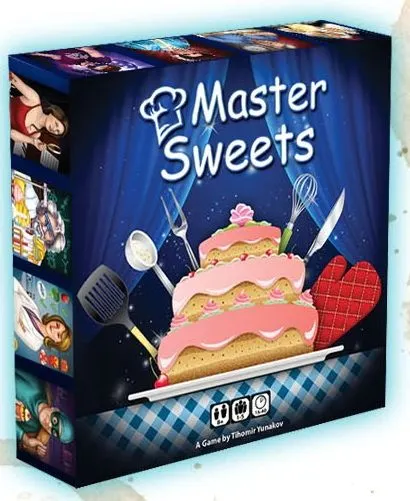
2019
Regelhilfe für Master Sweets: Second Edition
Verständliche Erklärungen zu Spielzügen, Karteneffekten und strittigen Situationen mit Verweisen auf offizielle Quellen und gespeichertem Fragenverlauf.
Für 1 Person
Was möchtest du wissen?
Antworten stammen aus dem offiziellen Regelheft, mit Seitenangabe zum Nachprüfen.
Master Sweets: Second Edition ist ein Brettspiel aus dem Jahr 2019 für 1–5 Personen, mit 10–35 Minuten pro Partie und ab 8 Jahren. Entwickelt wurde es von Tihomir Yunakov; die wichtigsten Mechaniken sind Variable Player Powers, Hand Management und Set Collection.


Auf Englisch
MasterSweets: The Card Game is an easy to learn, fast to play, family-friendly game with great repeatability for 1 to 5 players. The second edition of the MasterSweets comes with 8 different game modes: ”MasterSweets” - competitive ”Clash of Sweets” - player elimination ”Sweets Workshop” - cooperative ”Lonely in The Kitchen” – solo ”Endless Cookbook” – competitive ”Team Sweets” – team competitive (2 vs 2) ”The Best Clue” – clue competitive ”Sweets Puzzle” - competitive MasterSweets - core competitive game In "MasterSweets" you will take up the role of one of the 16 fancier confectioners, competing to present the best confectionery delights. MasterSweets uses unique game mechanic based on the set collection mechanic. In the game, a set of ingredient cards are ordered on the table- they form the cookbook. Each row or column of the cookbook represents one recipe. The players will try to collect the full set of ingredient cards that a recipe contains in order to complete it. But each player may also exchange a card from his hand with a card from the cookbook. This way the player changes the set of cards in the collections that all players are trying to collect. Clash of Sweets - player elimination game In “Clash of Sweets” each player will create his own unique cookbook and will try to steal his opponents‘ recipes. This way, he reveals other players‘ culinary secrets and their unique cookbooks decrease. After the last recipe from a player’s cookbook is stolen, the player must leave the game. The last surviving player with recipes that have not been revealed is the winner. Sweets Workshop - cooperative game In "Sweets Workshop" a royalty has noticed our masters of the sweets. She wants them to make incredible sweets for her birthday. Now the players must combine their efforts and team up in order to precisely fulfil all the royalty’s requirements. But they have not worked together before and the players have communication problems. In “Sweets workshop” each player holds the cards in his hand facing the rest of the players. The other players should give him clues about his cards. Lonely in The Kitchen - solo game To be a true master of the sweets, you need a lot of workouts. The best workout is when you are confronted with your own best achievements. The solo game mode "Lonely in The Kitchen" has the same gameplay as the core game “MasterSweets” for two players. The goal in the “Lonely in the kitchen” game is to collect more victory points at the end of the game than your fictional opponent George “The cake” (a dummy player). Endless Cookbook – competitive game "Endless cookbook" game mode keeps all rules from the main game mode "MasterSweets" except the following. Regardless of the number of players create the initial cookbook with a specific form. When a recipe is completed fill the just emptied positions in the cookbook with new cards from the drawing deck. This way the cookbook keeps its initial form during the whole game. The first player that has at least 35 points in his completed sweets is the winner. Team Sweets – team competitive game "Team sweets" game mode allows you to play the game modes "MasterSweets", "Clash of sweets" and "Endless cookbook" in team competitive game - 2 players vs 2 players. Before the end of the active player turn, he may pass (only if he want) one card from his hand facedown to his teammate's hand. Before the active player choice of a cart to be transferred is made, his teammate may tell to all players exactly which kind of card he wants to receive. Or may use a code name for example "Please give me a tree" as "tree" is a code name for chocolate. The Best Clue - competitive game In “The Best Clue” each player holds the cards in his hand facing the rest of the players. The player’s goal is to guess 5 cards from his hand. On his turn, the active player may give a clue to one of his opponents in order to receive a special card. He may use this special card to request a clue (from a type that he wants) for his cards from the other players. (The clue types in “The Best Clue” are the same as in game mode “Sweets Workshop”). In this way, the player that gives the most useless clues to his opponents and requests the most useful clues about his cards will be the winner. Sweets Puzzle - competitive game In game mode “Sweets Puzzle” each payer tries to build his own cookbook that is an exact copy of a part of the main cookbook. A player receives victory points from inseparable cards in his cookbook that represent an exact copy of a part of the MAIN cookbook. If in a player’s cookbook there are two or more separate groups of cards representing a copy of the MAIN cookbook then the player takes the victory points only from the group that gives the most points. The game ends when any player collects at least 25 points. This player is the winner. —description from the designer
Laut Katalog unterstützt Master Sweets: Second Edition 1–5 Personen. Diese Spanne entspricht der vom Verlag angegebenen Spielerzahl, das Spiel lässt sich also für jede Gruppengröße innerhalb dieser Spanne aufbauen. Aufbau, einzelne Regeln und Wertungsdetails können je nach Personenzahl trotzdem abweichen; prüfe daher die genaue Konfiguration in der Anleitung deiner Ausgabe.
Die angegebene Spieldauer für Master Sweets: Second Edition beträgt 10–35 Minuten. Das ist die Schätzung des Verlags für eine vollständige Partie. Die tatsächliche Dauer hängt von der Gruppe, der Personenzahl und der Regelkenntnis ab: Erste Partien dauern meist länger, erfahrene Gruppen sind oft schneller fertig. Aufbau und Regelerklärung sind in dieser Schätzung nicht enthalten.
Im Katalog wird Master Sweets: Second Edition ab 8 Jahren empfohlen. Das ist die Empfehlung des Verlags und berücksichtigt Leseanforderungen, Regelkomplexität und Kleinteile, nicht nur das Thema. Jüngere Kinder können oft mit Hilfe eines Erwachsenen mitspielen; beachte die Altersangabe deiner Ausgabe und die Brettspielerfahrung deiner Gruppe.
Master Sweets: Second Edition hat bei BoardGameGeek eine Komplexitätswertung von 1,0 von 5 und gilt damit als leichtes Spiel. Die Wertung zeigt, wie viel Regelwissen, Planung und Entscheidungen eine typische Partie verlangt. Schwerere Spiele brauchen bei der ersten Erklärung mehr Zeit, daher hilft vor dem Spieleabend eine Vorbereitungsanleitung.
Master Sweets: Second Edition gehört zu diesen Kategorien: Card Game. Die wichtigsten Mechaniken sind Variable Player Powers, Hand Management und Set Collection. Kategorien beschreiben Thema und Setting eines Spiels, Mechaniken dagegen, was die Spielenden in ihrem Zug tatsächlich tun. Jede Mechanik führt zu einer Katalogseite mit ähnlichen Spielen, falls du etwas Vergleichbares suchst.
Als Autoren von Master Sweets: Second Edition sind angegeben: Tihomir Yunakov. Diese Angaben stammen aus den veröffentlichten Spieldaten und nennen die für das Spieldesign verantwortlichen Personen, nicht die Illustratoren oder Verlage. Die Autorenseiten auf MeepleRules sammeln weitere Titel derselben Autoren – praktisch, wenn dir ein Spiel gefällt und du ähnliche Spiele suchst.
Im Katalog ist Master Sweets: Second Edition als Grundspiel aufgeführt. Es lässt sich eigenständig mit dem Material aus der Schachtel spielen und benötigt keinen weiteren Titel. Erweiterungen, sofern es welche gibt, ergänzen neues Material oder neue Regeln und sind im Katalog separat mit einem Verweis auf dieses Grundspiel aufgeführt.