
- BGG-Bewertung
- 4,3
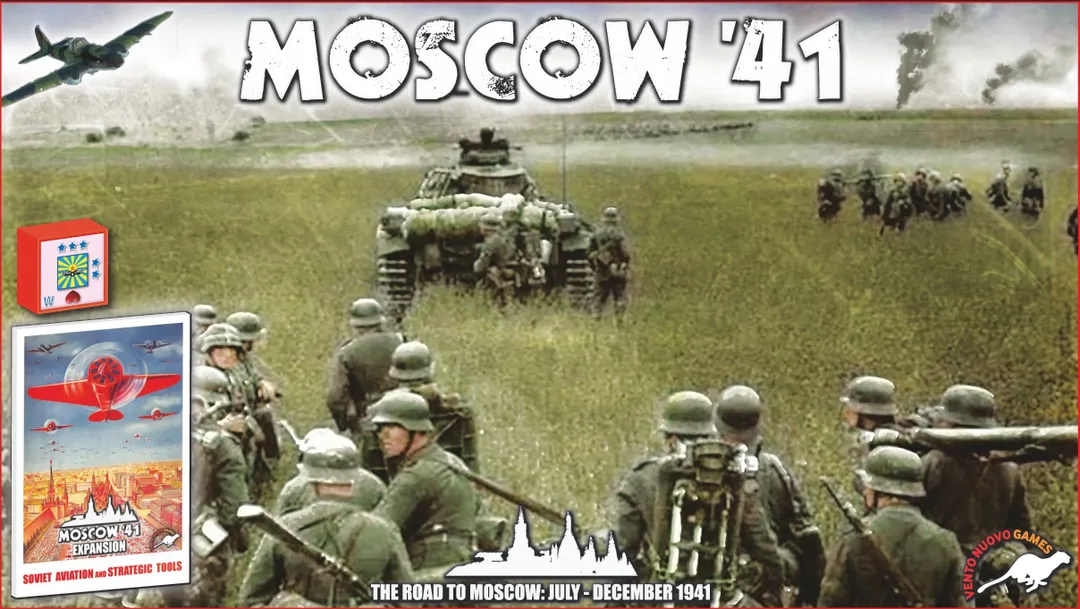
Moscow '41: Soviet Aviation and Strategic Tools
- 1–4 Spieler
- 60–240 Min.
- 2025

2016
Regelhilfe für Moscow '41
Verständliche Erklärungen zu Spielzügen, Karteneffekten und strittigen Situationen mit Verweisen auf offizielle Quellen und gespeichertem Fragenverlauf.
Für 1 Person
Was möchtest du wissen?
Antworten stammen aus dem offiziellen Regelheft, mit Seitenangabe zum Nachprüfen.
Moscow '41 ist ein Brettspiel aus dem Jahr 2016 für 1–2 Personen, mit 60–120 Minuten pro Partie und ab 14 Jahren. Entwickelt wurde es von Emanuele Santandrea; die wichtigsten Mechaniken sind Area Movement, Dice Rolling und Variable Set-up.





Auf Englisch
Released July 8, 2016 - 3 months ahead. Second Edition released in 2020, Expansion in 2025: Moscow '41: Soviet Aviation and Strategic Tools Moscow '41 is the first chapter of the Barbarossa Trilogy (the other two are Leningrad '41 and Kiev '41). MOSCOW '41 is a light/medium wargame covering the German Army Group Centre offensive aimed to seize Moscow, after having successfully defeated several Soviet armies in the great encirclement battles at the frontier and established two bridgeheads on the Dnieper. Although based on a historical event, the two players can modify the course of the operations, with the Germans trying to achieve a decisive victory before the winter comes, and the Soviets playing a fighting withdrawal, until ready to strike a decisive blow at the invaders. The game is recommended for two players, but has excellent solitaire suitability. Historical Introduction "At the beginning of each campaign, one pushes a door into a dark, unseen room. One can never know what is hiding inside." - Adolf Hitler, June '41 In December of 1940, Hitler made the decision to invade Russia and set the date for the middle of 1941. He had good reason to be confident that Russia would collapse under an uncompromising assault. Since the outbreak of hostilities, the German Wehrmacht had accomplished a stunning and unparalleled series of victories: Poland had fallen in one month, Denmark in one day; France, till then regarded as the strongest power in Europe, had capitulated in under six weeks, Holland in under six days; Belgium, Norway, Yugoslavia and Greece took less than three weeks each. The German military might was at its peak and the word Blitzkrieg had entered the language. Russia, on the other hand had taken over three months to bring Finland to heel, despite overwhelming strength of numbers. The Russian army had not yet recovered from Stalin's purges of 1937-1938 where 400 generals were “removed” including three field marshals and 13 Army commanders. It was well that Hitler could say, “Before three months have passed, we shall witness a collapse in Russia, the like of which has never been seen in history. We have only to kick in the front door and the whole rotten Russian edifice will come tumbling down.” On the 22nd of June, 1941, Operation Barbarossa - the invasion of Russia, began. Three million Axis troops in three Army Groups attacked on a front that stretched from the Baltic to the Black Sea: Army Group North under Field Marshal von Leeb was tasked with taking Leningrad; Army Group South under Field Marshal von Rundstedt was to capture Kiev and seize the Caucasus; Field Marshal von Bock's Army Group Centre, the one that concerns us, had Moscow as an objective, with Timoshenko undertaking the task of defending the capital. Initially, the operation succeeded beyond Hitler's wildest dreams. Within a day, the Russian Air Force was destroyed on the ground, then vast inroads were made on all fronts accompanied by large scale surrenders of encircled Russian troops. Army Group Centre with its four armies consisting of a total of 48 Divisions, of which nine were armoured, and backed by the Second Air Fleet, had reached the outskirts of Smolensk by the 15th July. This was two-thirds of the way to Moscow and it seemed that nothing could stop von Bock from blowing up the Kremlin within another three or four weeks... or could something stand in his way? Four things could now cause problems to von Bock: firstly, his supply line is stretched and had almost reached breaking point; secondly, Russian resistance is stiffening; thirdly, his infantry divisions are having difficulty keeping up with the Panzers and finally, a new Russian ally is about to enter the field: General Winter. Additional concerns may come in November, with three-quarters of a million experienced Siberian veterans freed by garrisoning Soviet Far East, thanks to Stalin's spies in Tokyo revealing Japanese intentions to attack America, and not Russia. As the German Commander, you must push on to Moscow before it is too late. As the Russian Commander you must re-evoke the Patriotic War and stop the invaders at any cost.
Laut Katalog unterstützt Moscow '41 1–2 Personen. Diese Spanne entspricht der vom Verlag angegebenen Spielerzahl, das Spiel lässt sich also für jede Gruppengröße innerhalb dieser Spanne aufbauen. Aufbau, einzelne Regeln und Wertungsdetails können je nach Personenzahl trotzdem abweichen; prüfe daher die genaue Konfiguration in der Anleitung deiner Ausgabe.
Die angegebene Spieldauer für Moscow '41 beträgt 60–120 Minuten. Das ist die Schätzung des Verlags für eine vollständige Partie. Die tatsächliche Dauer hängt von der Gruppe, der Personenzahl und der Regelkenntnis ab: Erste Partien dauern meist länger, erfahrene Gruppen sind oft schneller fertig. Aufbau und Regelerklärung sind in dieser Schätzung nicht enthalten.
Im Katalog wird Moscow '41 ab 14 Jahren empfohlen. Das ist die Empfehlung des Verlags und berücksichtigt Leseanforderungen, Regelkomplexität und Kleinteile, nicht nur das Thema. Jüngere Kinder können oft mit Hilfe eines Erwachsenen mitspielen; beachte die Altersangabe deiner Ausgabe und die Brettspielerfahrung deiner Gruppe.
Moscow '41 hat bei BoardGameGeek eine Komplexitätswertung von 2,9 von 5 und gilt damit als eher leichtes Spiel. Die Wertung zeigt, wie viel Regelwissen, Planung und Entscheidungen eine typische Partie verlangt. Schwerere Spiele brauchen bei der ersten Erklärung mehr Zeit, daher hilft vor dem Spieleabend eine Vorbereitungsanleitung.
Moscow '41 gehört zu diesen Kategorien: Wargame und World War II. Die wichtigsten Mechaniken sind Area Movement, Dice Rolling und Variable Set-up. Kategorien beschreiben Thema und Setting eines Spiels, Mechaniken dagegen, was die Spielenden in ihrem Zug tatsächlich tun. Jede Mechanik führt zu einer Katalogseite mit ähnlichen Spielen, falls du etwas Vergleichbares suchst.
Als Autoren von Moscow '41 sind angegeben: Emanuele Santandrea. Diese Angaben stammen aus den veröffentlichten Spieldaten und nennen die für das Spieldesign verantwortlichen Personen, nicht die Illustratoren oder Verlage. Die Autorenseiten auf MeepleRules sammeln weitere Titel derselben Autoren – praktisch, wenn dir ein Spiel gefällt und du ähnliche Spiele suchst.
Im Katalog ist Moscow '41 als Grundspiel aufgeführt. Es lässt sich eigenständig mit dem Material aus der Schachtel spielen und benötigt keinen weiteren Titel. Erweiterungen, sofern es welche gibt, ergänzen neues Material oder neue Regeln und sind im Katalog separat mit einem Verweis auf dieses Grundspiel aufgeführt.