

- BGG-Rang
- BGG #1.934
- BGG-Bewertung
- 7,3
Magic Realm
- 1–16 Spieler
- 60–240 Min.
- Komplexität 4,6/5
- 1979
2019
Regelhilfe für Mountaineers
Verständliche Erklärungen zu Spielzügen, Karteneffekten und strittigen Situationen mit Verweisen auf offizielle Quellen und gespeichertem Fragenverlauf.
Was möchtest du wissen?
Antworten stammen aus dem offiziellen Regelheft, mit Seitenangabe zum Nachprüfen.
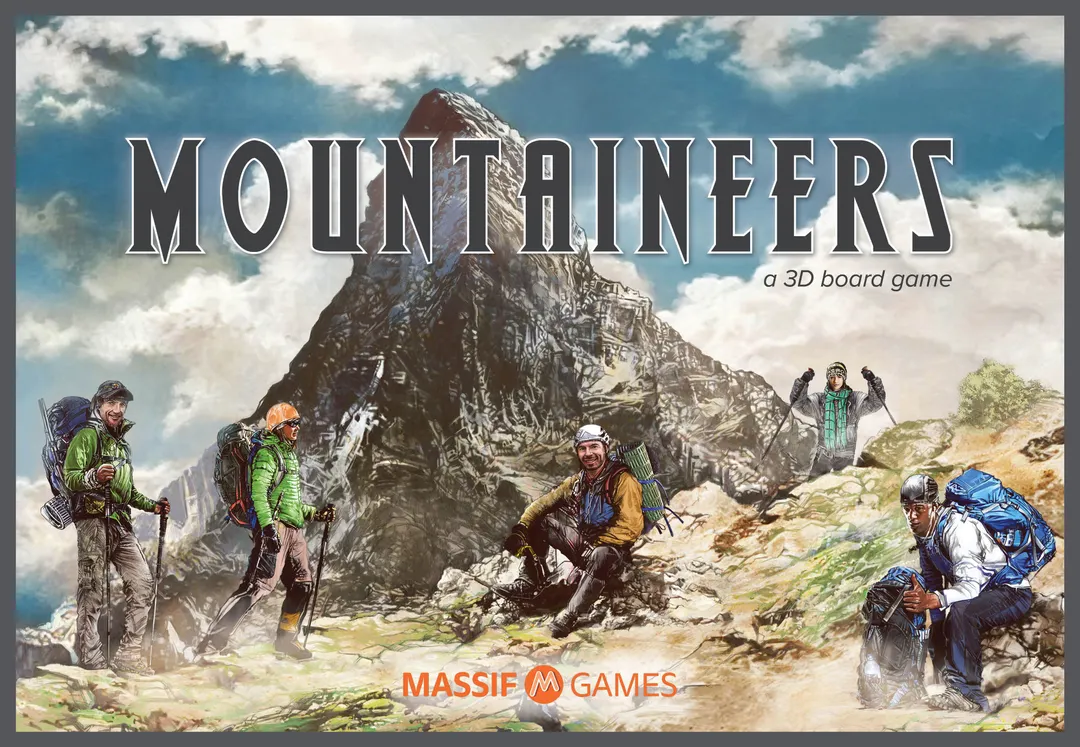
Mountaineers ist ein Brettspiel aus dem Jahr 2019 für 1–4 Personen, mit 30–120 Minuten pro Partie und ab 14 Jahren. Entwickelt wurde es von Corey Wright; die wichtigsten Mechaniken sind Variable Player Powers, Point to Point Movement und Area Majority / Influence.




Auf Englisch
Mountaineers is a strategic board game in which 1-4 players (up to 6 with the Deluxe or Collector's edition) compete against each other and AI climbers to earn climbing points (victory points) as they maneuver around a 18 in./45 cm tall rotating 3D modular game board. The theme of Mountaineers is lighthearted and fun, primarily focused on competitive route finding, resource management, character building and upgrades, while challenging players to react to various exciting (and sometimes comical) events that occur on the mountain. Strategy during both set-up and game play is important. At the beginning of a game, players need to choose four climbing routes, one character, and a starting position that work well together, in order to earn the maximum amount of points possible. However, as the game progresses, the mountain terrains fill up, making it more difficult to complete certain climbing routes. Additionally, various mountain conditions change (once per player), and event cards (drawn on each turn) require players to adapt their strategy, change their climbing routes, and purchase various combinations of gear upgrades to continue climbing. Resource management is important as players start with a limited number of thirty route markers and will on average draw only sixty supply tokens during a game. Depending on the game and the various difficulty of event cards used, players have to balance how often they spend supplies and route markers in order to climb efficiently and complete routes. Climbing strategy is also important. Players must be careful in what order they complete routes, how they maneuver on the mountain, and whether or not they pay extra to "lock in" certain route markers to avoid sabotage by other players. A typical turn involves drawing an event card, resolving the conditions of the event card (which may apply to other players), saving the event card for later use with your character, performing 0 to 2 regular actions, 0 to 1 special actions (if available), and special character actions (as allowed). Games with 1 to 4 players last ten rounds, each player drawing a total of ten event cards, and 5 to 6 player games last for eight rounds (with eight event cards/player). For 1 to 2 player games (and more challenging 3 to 5 player games), an "AI" mechanism can cause "automated climbers" to move around the mountain, placing route markers and blocking/sabotaging players. Players can also substitute more difficult event cards into the game, creating more flavor and challenge. The goal of a 2-6 player game is to have the most victory points at game end, and the goal of a one-player game is to have 55 victory points and four climbing routes complete at game's end. ••• While Mountaineers has a similar 3D appearance to its predecessor The Mountaineer, it is a vastly different game. For example, The Mountaineer was a roll-and-move game that required resource trading between players and had a large luck element. On the other hand, Mountaineers offers freedom and interesting choices to players every turn as players can choose when and how much to climb, and are not restricted by a luck element. Additionally, Mountaineers allows players to "lock" their routes, and provides mechanisms for advanced climbing techniques.
Laut Katalog unterstützt Mountaineers 1–4 Personen. Diese Spanne entspricht der vom Verlag angegebenen Spielerzahl, das Spiel lässt sich also für jede Gruppengröße innerhalb dieser Spanne aufbauen. Aufbau, einzelne Regeln und Wertungsdetails können je nach Personenzahl trotzdem abweichen; prüfe daher die genaue Konfiguration in der Anleitung deiner Ausgabe.
Die angegebene Spieldauer für Mountaineers beträgt 30–120 Minuten. Das ist die Schätzung des Verlags für eine vollständige Partie. Die tatsächliche Dauer hängt von der Gruppe, der Personenzahl und der Regelkenntnis ab: Erste Partien dauern meist länger, erfahrene Gruppen sind oft schneller fertig. Aufbau und Regelerklärung sind in dieser Schätzung nicht enthalten.
Im Katalog wird Mountaineers ab 14 Jahren empfohlen. Das ist die Empfehlung des Verlags und berücksichtigt Leseanforderungen, Regelkomplexität und Kleinteile, nicht nur das Thema. Jüngere Kinder können oft mit Hilfe eines Erwachsenen mitspielen; beachte die Altersangabe deiner Ausgabe und die Brettspielerfahrung deiner Gruppe.
Mountaineers hat bei BoardGameGeek eine Komplexitätswertung von 2,3 von 5 und gilt damit als eher leichtes Spiel. Die Wertung zeigt, wie viel Regelwissen, Planung und Entscheidungen eine typische Partie verlangt. Schwerere Spiele brauchen bei der ersten Erklärung mehr Zeit, daher hilft vor dem Spieleabend eine Vorbereitungsanleitung.
Mountaineers gehört zu diesen Kategorien: Exploration und Adventure. Die wichtigsten Mechaniken sind Variable Player Powers, Point to Point Movement und Area Majority / Influence. Kategorien beschreiben Thema und Setting eines Spiels, Mechaniken dagegen, was die Spielenden in ihrem Zug tatsächlich tun. Jede Mechanik führt zu einer Katalogseite mit ähnlichen Spielen, falls du etwas Vergleichbares suchst.
Als Autoren von Mountaineers sind angegeben: Corey Wright. Diese Angaben stammen aus den veröffentlichten Spieldaten und nennen die für das Spieldesign verantwortlichen Personen, nicht die Illustratoren oder Verlage. Die Autorenseiten auf MeepleRules sammeln weitere Titel derselben Autoren – praktisch, wenn dir ein Spiel gefällt und du ähnliche Spiele suchst.
Im Katalog ist Mountaineers als Grundspiel aufgeführt. Es lässt sich eigenständig mit dem Material aus der Schachtel spielen und benötigt keinen weiteren Titel. Erweiterungen, sofern es welche gibt, ergänzen neues Material oder neue Regeln und sind im Katalog separat mit einem Verweis auf dieses Grundspiel aufgeführt.