
- BGG-Rang
- BGG #3.170
- BGG-Bewertung
- 7,4
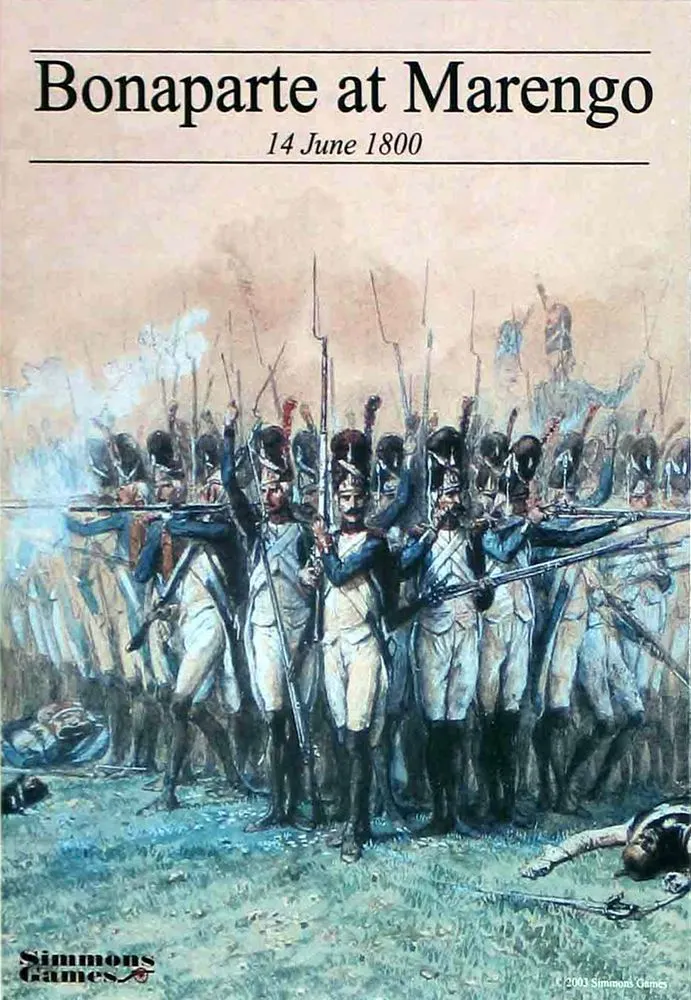
Bonaparte at Marengo
- 2 Spieler
- 120 Min.
- Komplexität 3,2/5
- 2003
2007
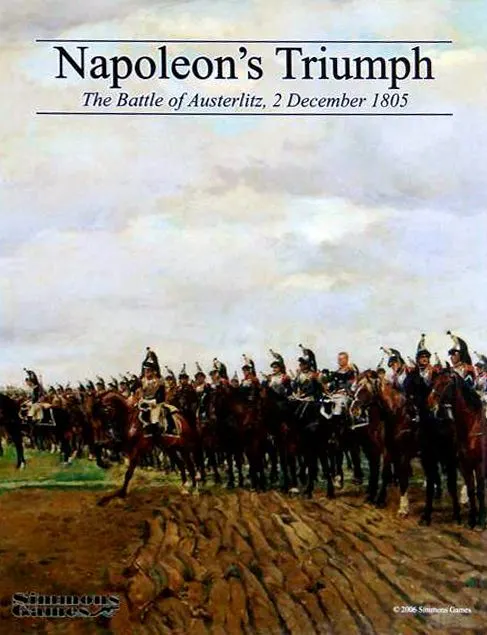
Regelhilfe für Napoleon's Triumph: The Battle of Austerlitz, 2 December 1805
Verständliche Erklärungen zu Spielzügen, Karteneffekten und strittigen Situationen mit Verweisen auf offizielle Quellen und gespeichertem Fragenverlauf.
Für 2 Personen
Was möchtest du wissen?
Antworten stammen aus dem offiziellen Regelheft, mit Seitenangabe zum Nachprüfen.
Napoleon's Triumph: The Battle of Austerlitz, 2 December 1805 ist ein Brettspiel aus dem Jahr 2007 für 2 Personen, mit 180 Minuten pro Partie und ab 12 Jahren. Entwickelt wurde es von Bowen Simmons; die wichtigsten Mechaniken sind Area Movement, Secret Unit Deployment und Simulation.


Auf Englisch
(From the publisher) Napoleon’s Triumph is built on the same foundations as its acclaimed predecessor, Bonaparte at Marengo, but is bigger and grander in scale. It uses two boards to make a double-size 44" x 34" map of the Austerlitz battlefield and has twice as many pieces as the earlier game, but defying the tradition that big wargames must also take a long time to play, Napoleon’s Triumph can be played from start to finish in a single evening. From Back of Box On December 2, 1805, on the battlefield of Austerlitz, an outnumbered French army led by their newly crowned emperor, Napoleon, waited to receive an expected attack by a Russian and Austrian army commanded by the Russian Czar, Alexander. Napoleon lured the Allies into attacking with their left wing, and when the Allies did so, a surprise French counter-attack smashed the Allied right and centre, and then surrounded and destroyed the Allied left in one of the most famous and decisive battles in military history. Napoleon's Triumph re-creates that historic battle. Befitting its epic subject, Napoleon's Triumph is played on a double-sized 44" x34" map of the battlefield. In spite of the game's size, it is easy to learn and fast to play. The rules are only nine pages long, and the playing time is only two hours. Napoleon's Triumph is unique among big wargames in that players can learn the game, set it up, and play it to completion in a single evening. The game system is derived from its award-winning forebear, Bonaparte at Marengo. Like that game, Napoleon's Triumph breaks with almost all of the standard wargame conventions. It has no hex grid and terrain effects chart; terrain effects are designed into the map itself. It has no combat results table; combat is resolved through strength differential. It has no dice; tension comes from limited information and the outcome only depends on the players' decisions. Napoleon's Triumph is a unique wargame experience. It is large, yet fast-playing. It has simple rules, but deep game play that rewards both boldness of conception and attention to detail. It stays close enough to history to engross wargamers and other students of the period, while still being entertaining enough for even non-wargamers to enjoy. Napoleon's Triumph is not only easy to learn and fast and exciting to play, it also is a great looking game due to its exceptional component quality. The map is mounted on a heavy board cut in the German style so that the playing surface is durable, stable, and flat, without the valleys of American-style mounted boards or the buckling of paper boards. To represent opposing armies, the game comes with 140 wooden blocks, blue for the French and red for the Allies. Painted on each block are symbols that identify the type and strengths of the unit. The senior commanders of the opposing armies are represented by 18 metal flags; stickers are applied to mark the nationality and name of each commander. In play, Napoleon's Triumph combines the visual appeal of 19th century battle maps and military minatures, with columns and rows of units lined for movement and attack, accented by flags to indicate corps. The effect is simply stunning.
Laut Katalog unterstützt Napoleon's Triumph: The Battle of Austerlitz, 2 December 1805 2 Personen. Das ist die vom Verlag angegebene Spielerzahl, das Spiel ist also genau für diese Anzahl von Mitspielenden ausgelegt. Varianten für andere Gruppengrößen sind, sofern vorhanden, in der Anleitung deiner Ausgabe beschrieben; prüfe sie, bevor du eine andere Konfiguration aufbaust.
Die angegebene Spieldauer für Napoleon's Triumph: The Battle of Austerlitz, 2 December 1805 beträgt 180 Minuten. Das ist die Schätzung des Verlags für eine vollständige Partie. Die tatsächliche Dauer hängt von der Gruppe, der Personenzahl und der Regelkenntnis ab: Erste Partien dauern meist länger, erfahrene Gruppen sind oft schneller fertig. Aufbau und Regelerklärung sind in dieser Schätzung nicht enthalten.
Im Katalog wird Napoleon's Triumph: The Battle of Austerlitz, 2 December 1805 ab 12 Jahren empfohlen. Das ist die Empfehlung des Verlags und berücksichtigt Leseanforderungen, Regelkomplexität und Kleinteile, nicht nur das Thema. Jüngere Kinder können oft mit Hilfe eines Erwachsenen mitspielen; beachte die Altersangabe deiner Ausgabe und die Brettspielerfahrung deiner Gruppe.
Napoleon's Triumph: The Battle of Austerlitz, 2 December 1805 hat bei BoardGameGeek eine Komplexitätswertung von 3,7 von 5 und gilt damit als mittelschweres Spiel. Die Wertung zeigt, wie viel Regelwissen, Planung und Entscheidungen eine typische Partie verlangt. Schwerere Spiele brauchen bei der ersten Erklärung mehr Zeit, daher hilft vor dem Spieleabend eine Vorbereitungsanleitung.
Napoleon's Triumph: The Battle of Austerlitz, 2 December 1805 gehört zu diesen Kategorien: Wargame und Napoleonic. Die wichtigsten Mechaniken sind Area Movement, Secret Unit Deployment und Simulation. Kategorien beschreiben Thema und Setting eines Spiels, Mechaniken dagegen, was die Spielenden in ihrem Zug tatsächlich tun. Jede Mechanik führt zu einer Katalogseite mit ähnlichen Spielen, falls du etwas Vergleichbares suchst.
Als Autoren von Napoleon's Triumph: The Battle of Austerlitz, 2 December 1805 sind angegeben: Bowen Simmons. Diese Angaben stammen aus den veröffentlichten Spieldaten und nennen die für das Spieldesign verantwortlichen Personen, nicht die Illustratoren oder Verlage. Die Autorenseiten auf MeepleRules sammeln weitere Titel derselben Autoren – praktisch, wenn dir ein Spiel gefällt und du ähnliche Spiele suchst.
Im Katalog ist Napoleon's Triumph: The Battle of Austerlitz, 2 December 1805 als Grundspiel aufgeführt. Es lässt sich eigenständig mit dem Material aus der Schachtel spielen und benötigt keinen weiteren Titel. Erweiterungen, sofern es welche gibt, ergänzen neues Material oder neue Regeln und sind im Katalog separat mit einem Verweis auf dieses Grundspiel aufgeführt.