

- BGG-Rang
- BGG #17.594
- BGG-Bewertung
- 7,5
Counter Spy
- 2 Spieler
- 10–20 Min.
- Komplexität 1,0/5
- 2023
2026
Regelhilfe für Restoration
Verständliche Erklärungen zu Spielzügen, Karteneffekten und strittigen Situationen mit Verweisen auf offizielle Quellen und gespeichertem Fragenverlauf.
Für 2 Personen
Was möchtest du wissen?
Antworten stammen aus dem offiziellen Regelheft, mit Seitenangabe zum Nachprüfen.
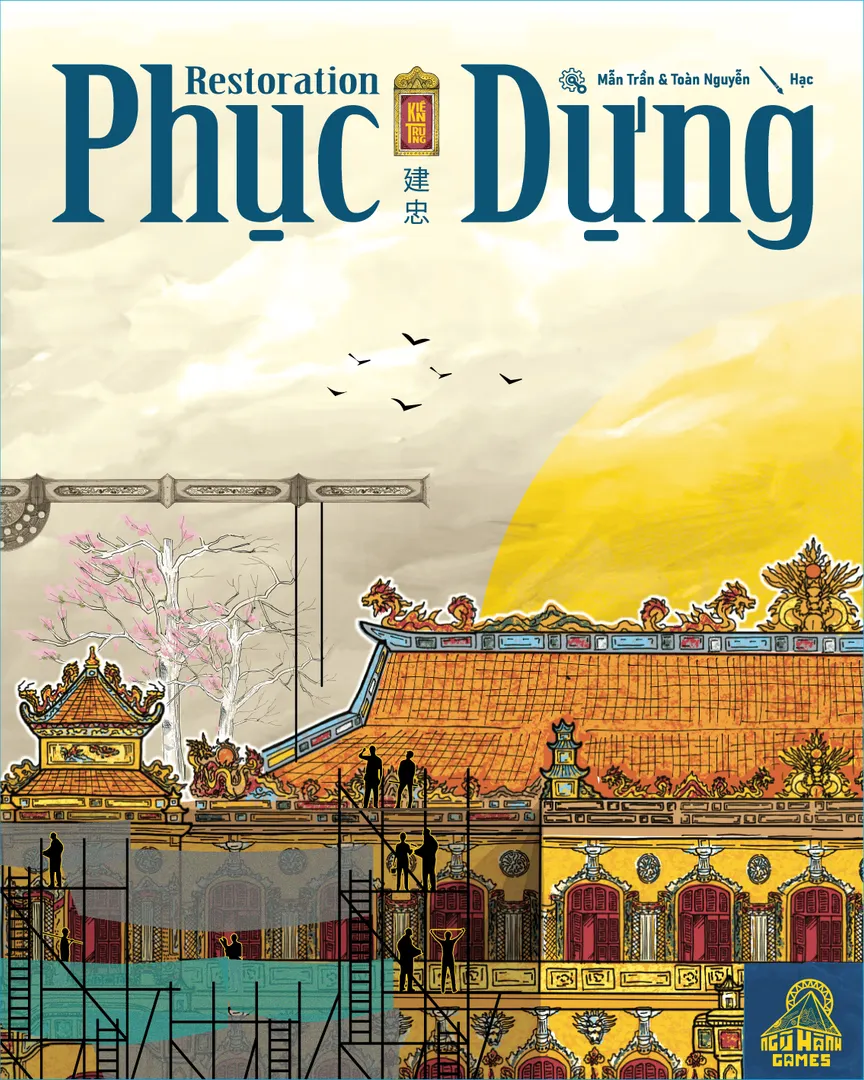
Restoration ist ein Brettspiel aus dem Jahr 2026 für 2–4 Personen, mit 45–60 Minuten pro Partie und ab 8 Jahren. Entwickelt wurde es von Toàn Nguyễn und Mẫn Trần; die wichtigsten Mechaniken sind Track Movement, Area Majority / Influence und Variable Set-up.





Auf Englisch
Overview Restoration / Phục Dựng is a competitive worker placement board game with light area majority elements inspired by the real-life restoration of Điện Kiến Trung, one of Vietnam’s most iconic historical landmarks. Players take the role of restoration teams contributing resources, artisans, and expertise to rebuild the palace across 3 rounds of play. By carefully placing workers, securing workshop influence, players compete to earn the most prestige and leave their mark on the reconstruction effort. Gameplay In Restoration / Phục Dựng, players take turns placing workers onto shared action spaces to gather materials, activate workshops, advance development tracks, gain prestige, and contribute to the palace restoration. The game revolves around a worker placement system enhanced by area majority competition. Certain workshop areas reward players who commit the most influence, allowing them to recruit powerful neutral workers called Artisans for the following round. Because these extra workers are temporary and highly contested, players must constantly balance immediate efficiency with long-term positioning. High interaction game: Players compete for valuable action spaces, race to secure workshop control, and carefully time their turns to maximize opportunities before opponents can react. One of the game’s signature systems is the Follow mechanic. After the active player performs an action, other players may partially follow that action, allowing everyone to stay involved even outside their own turn and significantly reducing downtime. As the game progresses, players build stronger engines through development tracks and prestige management, creating increasingly efficient combinations and tactical turns. The modular board setup also changes the strategic landscape from game to game, adding replayability and variety to each session. Key Mechanics Worker Placement with Neutral Workers Players place workers to activate locations and perform actions, but can also compete to gain temporary neutral workers (Artisans) for future rounds through area majority control. Area Majority Competition Several workshop zones reward players based on influence and positioning, creating tension and meaningful interaction without direct conflict-heavy mechanics. Follow Action System Whenever a player performs an action, other players may follow and gain partial benefits, keeping all players engaged throughout every turn and minimizing downtime. Personal Worker Placement Board Each player has access to a personal action space system, adding flexibility and reducing frustration from blocked public locations. Development & Prestige Tracks Players progress along development tracks to unlock stronger efficiencies and combinations, while prestige acts as both progression and an important strategic resource. Combo-Oriented Euro Design Actions can be chained together to create highly satisfying turns, rewarding careful planning, timing, and engine optimization. Modular Board System Variable setup and interchangeable map layouts provide high replayability.
Laut Katalog unterstützt Restoration 2–4 Personen. Diese Spanne entspricht der vom Verlag angegebenen Spielerzahl, das Spiel lässt sich also für jede Gruppengröße innerhalb dieser Spanne aufbauen. Aufbau, einzelne Regeln und Wertungsdetails können je nach Personenzahl trotzdem abweichen; prüfe daher die genaue Konfiguration in der Anleitung deiner Ausgabe.
Die angegebene Spieldauer für Restoration beträgt 45–60 Minuten. Das ist die Schätzung des Verlags für eine vollständige Partie. Die tatsächliche Dauer hängt von der Gruppe, der Personenzahl und der Regelkenntnis ab: Erste Partien dauern meist länger, erfahrene Gruppen sind oft schneller fertig. Aufbau und Regelerklärung sind in dieser Schätzung nicht enthalten.
Im Katalog wird Restoration ab 8 Jahren empfohlen. Das ist die Empfehlung des Verlags und berücksichtigt Leseanforderungen, Regelkomplexität und Kleinteile, nicht nur das Thema. Jüngere Kinder können oft mit Hilfe eines Erwachsenen mitspielen; beachte die Altersangabe deiner Ausgabe und die Brettspielerfahrung deiner Gruppe.
Restoration hat bei BoardGameGeek eine Komplexitätswertung von 2,7 von 5 und gilt damit als eher leichtes Spiel. Die Wertung zeigt, wie viel Regelwissen, Planung und Entscheidungen eine typische Partie verlangt. Schwerere Spiele brauchen bei der ersten Erklärung mehr Zeit, daher hilft vor dem Spieleabend eine Vorbereitungsanleitung.
Die wichtigsten Mechaniken von Restoration sind Track Movement, Area Majority / Influence und Variable Set-up. Mechaniken beschreiben, was die Spielenden in ihrem Zug tun, etwa würfeln, Karten draften oder Arbeiter einsetzen. Jede Mechanik führt zu einer Katalogseite mit ähnlichen Spielen, falls dir Restoration gefallen hat und du etwas Vergleichbares suchst.
Als Autoren von Restoration sind angegeben: Toàn Nguyễn und Mẫn Trần. Diese Angaben stammen aus den veröffentlichten Spieldaten und nennen die für das Spieldesign verantwortlichen Personen, nicht die Illustratoren oder Verlage. Die Autorenseiten auf MeepleRules sammeln weitere Titel derselben Autoren – praktisch, wenn dir ein Spiel gefällt und du ähnliche Spiele suchst.
Im Katalog ist Restoration als Grundspiel aufgeführt. Es lässt sich eigenständig mit dem Material aus der Schachtel spielen und benötigt keinen weiteren Titel. Erweiterungen, sofern es welche gibt, ergänzen neues Material oder neue Regeln und sind im Katalog separat mit einem Verweis auf dieses Grundspiel aufgeführt.