

- BGG-Rang
- BGG #24.446
- BGG-Bewertung
- 6,1
Cloak & Dagger
- 2–4 Spieler
- 30–60 Min.
- Komplexität 1,6/5
- 1984
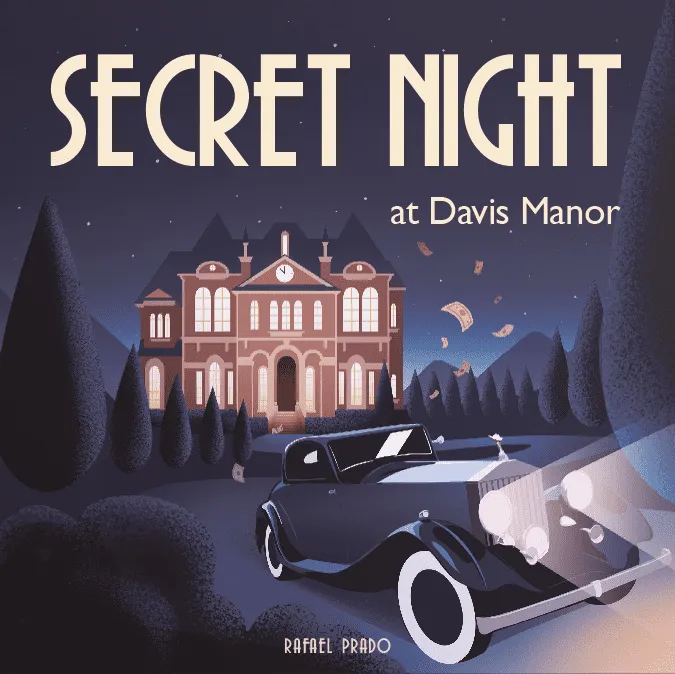
2019
Regelhilfe für Secret Night at Davis Manor
Verständliche Erklärungen zu Spielzügen, Karteneffekten und strittigen Situationen mit Verweisen auf offizielle Quellen und gespeichertem Fragenverlauf.
Was möchtest du wissen?
Antworten stammen aus dem offiziellen Regelheft, mit Seitenangabe zum Nachprüfen.
Secret Night at Davis Manor ist ein Brettspiel aus dem Jahr 2019 für 4–8 Personen, mit 60–120 Minuten pro Partie und ab 12 Jahren. Entwickelt wurde es von Rafael Prado; die wichtigsten Mechaniken sind Variable Player Powers, Roll / Spin and Move und Team-Based Game.






Auf Englisch
Secret Night at Davis Manor is a team-based board game set in 1928 York, England. It takes place in Davis Manor. Players secretly take on the role of police and thieves, and they must co-operate to achieve their objectives: The thieves have to take the money and escape with it in a vehicle, while the police have to arrest the thieves. Script: England, 1928, following a period of scarcity in the wake of the first world war, Europe is experiencing a period of artistic and economic splendor. In celebration of this new era of prosperity a grand dinner has been organised at the Davis Manor. The greatest Luminaries and elites of the time are set to attend, however all is not what it seems! The police have received warning that a master thief is planning to attend the event and steal the Davis Manor fortune. This thief is rumoured to never act alone, pulling off heists using hidden accomplices. Instead of cancelling the event a daring plan has been hatched! The chief inspector himself will attend the party, along with hidden detective agents. Using their skills, cunning and powers of deduction they will attempt to catch a thief! But be careful.. Not everyone is as they seem in Davis Manor and a lot can happen in the Secret Night. How to play resume: Roles: The Master Thief and the Chief Inspector reveal their roles and keep them shown.The rest of the players will keep their roles hidden. Characters: Each character has a special skill. The mansion: There are 16 rooms in the mansion.They are represented by their names on the perimeter of the Main Board. At the beginning of the game the object cards are shuffled (green circle at the back) and 16 of them are randomly placed face up in each room held by the Main Board. The rest of the object cards are stacked face down as a draw deck. Mechanics: Draw one card, spin the roulette to move the pawn around the board by the number rolled, and perform actions with object cards and/or the Action Square. During their movement, the player can do as many actions as they wants/are able to. The most common action is to perform a search. Being on a green search hex gives you the opportunity to take the card stored in the associated room slot on the edge of the Main Board. Once checked, you should keep one of the cards in your hand (at your choice) in the slot of the room hidden face down. Inventory: The maximum number of cards at the end of your turn is 3, and 1 must always be shown face up next to the player board (even if you only have 1 card in total). Action square: Once per turn, when you are next to another pawn, you may use the Action Square to perform an action: -To Trade cards with another player, either, 1 for 1 , 2 for 2 or 3 for 3. -To Steal a card: The target victim shuffles all his cards (shown and hidden) before he is robbed. The player performing the action then chooses 1 card blindly. -Push: Move a player up to 2 squares. If he encounters an obstacle: (wall, other player) stops. -Whisper a secret: Use it to have a private conversation (whispering to the ear) with another player. This can be useful for plotting strategies or bluffing. In addition to these actions, players may use the object cards. End of the game: The game ends at dawn (9 turns - 6:00 am) or when a team's score counter reaches 10 points. If the game ends in a tie and the Deceiver (the role for games with odd players) is not in play, the first team to score wins.
Laut Katalog unterstützt Secret Night at Davis Manor 4–8 Personen. Diese Spanne entspricht der vom Verlag angegebenen Spielerzahl, das Spiel lässt sich also für jede Gruppengröße innerhalb dieser Spanne aufbauen. Aufbau, einzelne Regeln und Wertungsdetails können je nach Personenzahl trotzdem abweichen; prüfe daher die genaue Konfiguration in der Anleitung deiner Ausgabe.
Die angegebene Spieldauer für Secret Night at Davis Manor beträgt 60–120 Minuten. Das ist die Schätzung des Verlags für eine vollständige Partie. Die tatsächliche Dauer hängt von der Gruppe, der Personenzahl und der Regelkenntnis ab: Erste Partien dauern meist länger, erfahrene Gruppen sind oft schneller fertig. Aufbau und Regelerklärung sind in dieser Schätzung nicht enthalten.
Im Katalog wird Secret Night at Davis Manor ab 12 Jahren empfohlen. Das ist die Empfehlung des Verlags und berücksichtigt Leseanforderungen, Regelkomplexität und Kleinteile, nicht nur das Thema. Jüngere Kinder können oft mit Hilfe eines Erwachsenen mitspielen; beachte die Altersangabe deiner Ausgabe und die Brettspielerfahrung deiner Gruppe.
Secret Night at Davis Manor hat bei BoardGameGeek eine Komplexitätswertung von 2,7 von 5 und gilt damit als eher leichtes Spiel. Die Wertung zeigt, wie viel Regelwissen, Planung und Entscheidungen eine typische Partie verlangt. Schwerere Spiele brauchen bei der ersten Erklärung mehr Zeit, daher hilft vor dem Spieleabend eine Vorbereitungsanleitung.
Secret Night at Davis Manor gehört zu diesen Kategorien: Murder / Mystery und Spies / Secret Agents. Die wichtigsten Mechaniken sind Variable Player Powers, Roll / Spin and Move und Team-Based Game. Kategorien beschreiben Thema und Setting eines Spiels, Mechaniken dagegen, was die Spielenden in ihrem Zug tatsächlich tun. Jede Mechanik führt zu einer Katalogseite mit ähnlichen Spielen, falls du etwas Vergleichbares suchst.
Als Autoren von Secret Night at Davis Manor sind angegeben: Rafael Prado. Diese Angaben stammen aus den veröffentlichten Spieldaten und nennen die für das Spieldesign verantwortlichen Personen, nicht die Illustratoren oder Verlage. Die Autorenseiten auf MeepleRules sammeln weitere Titel derselben Autoren – praktisch, wenn dir ein Spiel gefällt und du ähnliche Spiele suchst.
Im Katalog ist Secret Night at Davis Manor als Grundspiel aufgeführt. Es lässt sich eigenständig mit dem Material aus der Schachtel spielen und benötigt keinen weiteren Titel. Erweiterungen, sofern es welche gibt, ergänzen neues Material oder neue Regeln und sind im Katalog separat mit einem Verweis auf dieses Grundspiel aufgeführt.