
- BGG-Bewertung
- 7,4
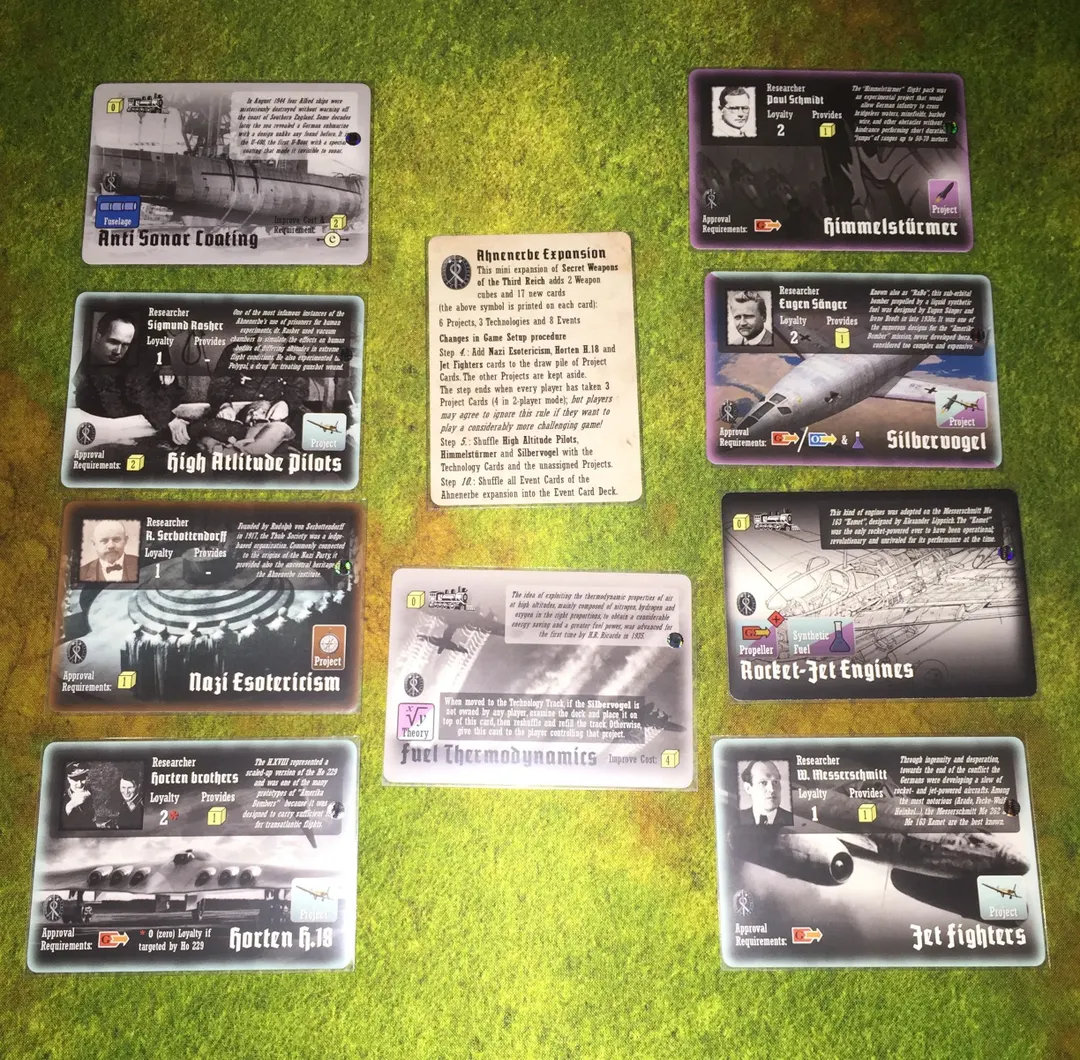
Secret Weapons of the Third Reich: Ahnenerbe Expansion
- 1–4 Spieler
- 120–180 Min.
- Komplexität 3,0/5
- 2015
2015
Regelhilfe für Secret Weapons of the Third Reich
Verständliche Erklärungen zu Spielzügen, Karteneffekten und strittigen Situationen mit Verweisen auf offizielle Quellen und gespeichertem Fragenverlauf.
Für 1 Person
Was möchtest du wissen?
Antworten stammen aus dem offiziellen Regelheft, mit Seitenangabe zum Nachprüfen.
Secret Weapons of the Third Reich ist ein Brettspiel aus dem Jahr 2015 für 1–4 Personen, mit 120–180 Minuten pro Partie und ab 12 Jahren. Entwickelt wurde es von Luca Cammisa; die wichtigsten Mechaniken sind Cooperative Game, Open Drafting und Worker Placement.



Auf Englisch
The date: March 1938. The vast majority of Austrians cheer the Anschluss of their country by the German Reich. Central Europe is falling into Nazi hands and all the best European scientists will soon compete under the aegis of Heinrich Himmler, for whom no scheme is too wild or too improbable — but which team has the imagination, the courage, and the drive to most successfully accomplish their goals? Secret Weapons of the Third Reich is a game for one to four players simulating the arms race of World War II from the German perspective. From secret submarine bases in Greenland to the mysterious Base 211 in Neuschwabenland, Antarctica, this game recreates the incredible tales of Nazi technology, from the famous V-1 buzz bombs and V-2 rockets to the unlikely flying saucers derived from the work of Nikola Tesla. Will players be able to deliver the Haunebu project to completion? Will Hans Kammler escape with his last battalion of flying saucers to the dark side of the moon? Will the secret submarine fleet sail to Antarctica to pursue the war after the war? Or could German scientists produce an atomic bomb to be dropped on New York by an electro-gravitational flying saucer or within the warhead of a futuristic intercontinental V-3? Would it even be possible to build a huge solar satellite gun to strike America? In the game, each player controls one or more research groups, each working on a secret weapon project. Each research group has a leading researcher, who provides an initial bonus (expressed in resource cubes or scientist cylinders) when the project is assigned. The researcher has a regime loyalty value that measures both the ability to make requisition attempts and the ability to resist opposing attempts. A player tries to get their projects approved, then completed. Certain requirements (resource cubes and/or scientist cylinders and technologies attached to projects) must be met and costs paid in order to reach the stage of development of a project. Each turn, approved projects generate specific amounts of resource cubes as funding. Completed projects award victory points (VP) and allow, in most cases, weapon production. Produced weapons award VP to the owning player in addition to helping to achieve a cooperative goal for all players. In fact, if together the players fail to reach a certain number of weapons produced by the end of the game, they all lose. The weapon production goal varies depending on the number of players. Play begins in 1938, one year before the outbreak of world war. At the start, players can only place research groups for their approved projects (project plants) in the portion of the map representing Germany and Austria. In 1939 and later, the conquests of Nazi Germany allow players to deploy their project plants in occupied European territories — but players will have to pay attention to the various locations because some areas allow only research and development, others only weapon production, and still others only research and development for U-Boat projects. Also, players must operate in a "state of warfare". This means that as time goes on they are more and more subject to enemy bombardments that can cause a great loss of resources and technologies. In addition, as starting in 1943 Allied and Soviet advances on Berlin make the map progressively smaller, players must face logistical issues never encountered during the early years of the war. Should a completed project or produced weapon fall into Allied hands, players not only lose VP, but the weapons production goal recedes as well! Thus a certain amount of player cooperation is a must. Each player must balance his personal interests with the common need to share technologies and resources in order to fulfill the common goal. Last, but not least, via events one player may secretly become the turncoat, working in the shadows to help the enemy, and winning the game if all players would otherwise lose.
Laut Katalog unterstützt Secret Weapons of the Third Reich 1–4 Personen. Diese Spanne entspricht der vom Verlag angegebenen Spielerzahl, das Spiel lässt sich also für jede Gruppengröße innerhalb dieser Spanne aufbauen. Aufbau, einzelne Regeln und Wertungsdetails können je nach Personenzahl trotzdem abweichen; prüfe daher die genaue Konfiguration in der Anleitung deiner Ausgabe.
Die angegebene Spieldauer für Secret Weapons of the Third Reich beträgt 120–180 Minuten. Das ist die Schätzung des Verlags für eine vollständige Partie. Die tatsächliche Dauer hängt von der Gruppe, der Personenzahl und der Regelkenntnis ab: Erste Partien dauern meist länger, erfahrene Gruppen sind oft schneller fertig. Aufbau und Regelerklärung sind in dieser Schätzung nicht enthalten.
Im Katalog wird Secret Weapons of the Third Reich ab 12 Jahren empfohlen. Das ist die Empfehlung des Verlags und berücksichtigt Leseanforderungen, Regelkomplexität und Kleinteile, nicht nur das Thema. Jüngere Kinder können oft mit Hilfe eines Erwachsenen mitspielen; beachte die Altersangabe deiner Ausgabe und die Brettspielerfahrung deiner Gruppe.
Secret Weapons of the Third Reich hat bei BoardGameGeek eine Komplexitätswertung von 3,9 von 5 und gilt damit als schweres Spiel. Die Wertung zeigt, wie viel Regelwissen, Planung und Entscheidungen eine typische Partie verlangt. Schwerere Spiele brauchen bei der ersten Erklärung mehr Zeit, daher hilft vor dem Spieleabend eine Vorbereitungsanleitung.
Secret Weapons of the Third Reich gehört zu diesen Kategorien: Science Fiction und World War II. Die wichtigsten Mechaniken sind Cooperative Game, Open Drafting und Worker Placement. Kategorien beschreiben Thema und Setting eines Spiels, Mechaniken dagegen, was die Spielenden in ihrem Zug tatsächlich tun. Jede Mechanik führt zu einer Katalogseite mit ähnlichen Spielen, falls du etwas Vergleichbares suchst.
Als Autoren von Secret Weapons of the Third Reich sind angegeben: Luca Cammisa. Diese Angaben stammen aus den veröffentlichten Spieldaten und nennen die für das Spieldesign verantwortlichen Personen, nicht die Illustratoren oder Verlage. Die Autorenseiten auf MeepleRules sammeln weitere Titel derselben Autoren – praktisch, wenn dir ein Spiel gefällt und du ähnliche Spiele suchst.
Im Katalog ist Secret Weapons of the Third Reich als Grundspiel aufgeführt. Es lässt sich eigenständig mit dem Material aus der Schachtel spielen und benötigt keinen weiteren Titel. Erweiterungen, sofern es welche gibt, ergänzen neues Material oder neue Regeln und sind im Katalog separat mit einem Verweis auf dieses Grundspiel aufgeführt.