
- BGG-Rang
- BGG #769
- BGG-Bewertung
- 7,5
Struggle of Empires
- 2–7 Spieler
- 180–240 Min.
- Komplexität 3,6/5
- 2004
2015
Regelhilfe für Ships
Verständliche Erklärungen zu Spielzügen, Karteneffekten und strittigen Situationen mit Verweisen auf offizielle Quellen und gespeichertem Fragenverlauf.
Für 2 Personen
Was möchtest du wissen?
Antworten stammen aus dem offiziellen Regelheft, mit Seitenangabe zum Nachprüfen.
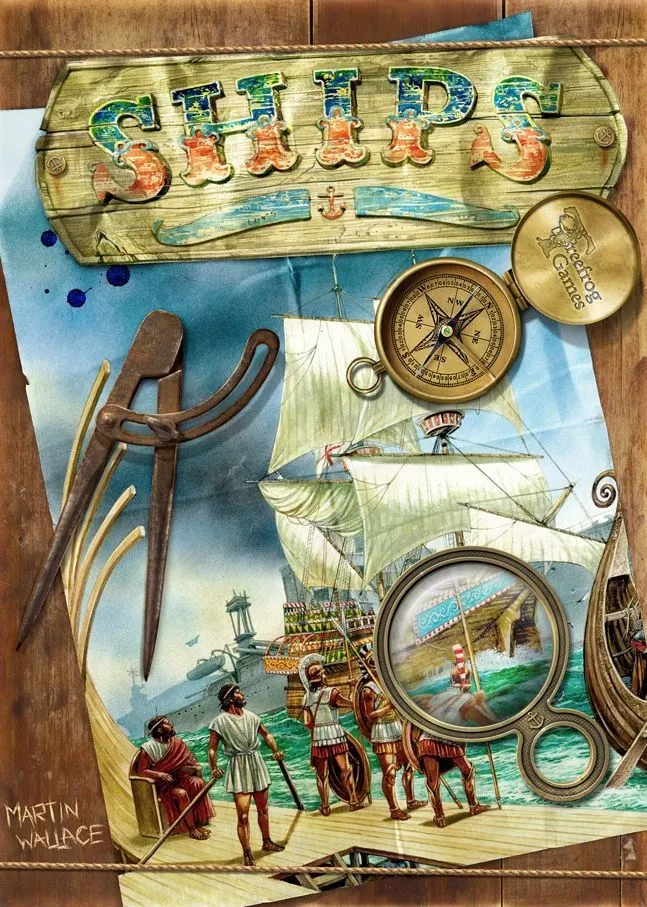
Ships ist ein Brettspiel aus dem Jahr 2015 für 2–4 Personen, mit 120 Minuten pro Partie und ab 13 Jahren. Entwickelt wurde es von Martin Wallace; die wichtigsten Mechaniken sind Area Movement, Area Majority / Influence und Action Points.



Auf Englisch
Ships deals with the history of shipping, from the time of the Phoenicians to the modern era. The game is divided into three ages, marked with different ship types. The first age is that of the galley, followed by the age of the galleon, then finally the steamship age. The board combines a track showing the development of ships, similar to that in Automobile, with a map of Europe and an area representing the rest of the world. Your turn is divided into two phases. In the first phase, you choose to either conduct commerce (such as selling goods, taxing locations or improving your warehouse) or take a card, selecting one from seven on display; the cards vary in their effects, granting money, victory points or special actions. In the second phase, you choose whether to place a ship, move a ship, or retrieve ships/merchants. When you place a ship, you do so in either the merchant box or the warship box in one of eleven levels. A merchant allows you to place a merchant cube on the board, giving you one or two goods counters to place in your warehouse. A warship lets you take control of a location at the cost of one food goods counter. Once all of your ships are on the board, you can either move them (paying money to advance its level and take the associated action) or retrieve it from the board so that you can place it elsewhere later. As ships are placed in a level, the cost of placing in the next level reduces — until finally somebody is willing to pay the cost to place in that level (which earns bonus points and possible additional income). When a ship is placed in the first galleon level, galleys become redundant; similarly, someone placing in the first steamship level makes galleons redundant. During the galleon and steamship ages, you can pay extra to move more ships, so having money in hand gives you a greater range of options and allows you to use your fleet more efficiently. When placing ships, you can initially place only in "1" locations, which are grouped around the eastern Mediterranean Sea. Once someone pays to move to a "2" location, which are grouped around the western Mediterranean, that area opens to others, with the other areas being Northern Europe (3), the Americas (4), East Indies (5) and the Pacific (6). As soon as a new area opens, players score points for merchants and control discs in the present area, with the points earned being the same as the number of the area. Ships includes six types of goods: food, oil, metal, wine, cloth and spices. Each has a monetary value as well as a special power. Food can be used to take control of locations, thus building an empire. Oil can be used to gain extra actions. Metal helps to advance your ships along the outer track. Wine can be converted to goods of a lower value. Cloth can be converted to victory points, while spices have the highest monetary value. You have to decide whether to cash your goods in for money or use their power. NOTE: this description is out-of-date.
Laut Katalog unterstützt Ships 2–4 Personen. Diese Spanne entspricht der vom Verlag angegebenen Spielerzahl, das Spiel lässt sich also für jede Gruppengröße innerhalb dieser Spanne aufbauen. Aufbau, einzelne Regeln und Wertungsdetails können je nach Personenzahl trotzdem abweichen; prüfe daher die genaue Konfiguration in der Anleitung deiner Ausgabe.
Die angegebene Spieldauer für Ships beträgt 120 Minuten. Das ist die Schätzung des Verlags für eine vollständige Partie. Die tatsächliche Dauer hängt von der Gruppe, der Personenzahl und der Regelkenntnis ab: Erste Partien dauern meist länger, erfahrene Gruppen sind oft schneller fertig. Aufbau und Regelerklärung sind in dieser Schätzung nicht enthalten.
Im Katalog wird Ships ab 13 Jahren empfohlen. Das ist die Empfehlung des Verlags und berücksichtigt Leseanforderungen, Regelkomplexität und Kleinteile, nicht nur das Thema. Jüngere Kinder können oft mit Hilfe eines Erwachsenen mitspielen; beachte die Altersangabe deiner Ausgabe und die Brettspielerfahrung deiner Gruppe.
Ships hat bei BoardGameGeek eine Komplexitätswertung von 3,5 von 5 und gilt damit als mittelschweres Spiel. Die Wertung zeigt, wie viel Regelwissen, Planung und Entscheidungen eine typische Partie verlangt. Schwerere Spiele brauchen bei der ersten Erklärung mehr Zeit, daher hilft vor dem Spieleabend eine Vorbereitungsanleitung.
Ships gehört zu diesen Kategorien: Exploration, Nautical und Transportation. Die wichtigsten Mechaniken sind Area Movement, Area Majority / Influence und Action Points. Kategorien beschreiben Thema und Setting eines Spiels, Mechaniken dagegen, was die Spielenden in ihrem Zug tatsächlich tun. Jede Mechanik führt zu einer Katalogseite mit ähnlichen Spielen, falls du etwas Vergleichbares suchst.
Als Autoren von Ships sind angegeben: Martin Wallace. Diese Angaben stammen aus den veröffentlichten Spieldaten und nennen die für das Spieldesign verantwortlichen Personen, nicht die Illustratoren oder Verlage. Die Autorenseiten auf MeepleRules sammeln weitere Titel derselben Autoren – praktisch, wenn dir ein Spiel gefällt und du ähnliche Spiele suchst.
Im Katalog ist Ships als Grundspiel aufgeführt. Es lässt sich eigenständig mit dem Material aus der Schachtel spielen und benötigt keinen weiteren Titel. Erweiterungen, sofern es welche gibt, ergänzen neues Material oder neue Regeln und sind im Katalog separat mit einem Verweis auf dieses Grundspiel aufgeführt.