
- BGG-Rang
- BGG #17.123
- BGG-Bewertung
- 7,3
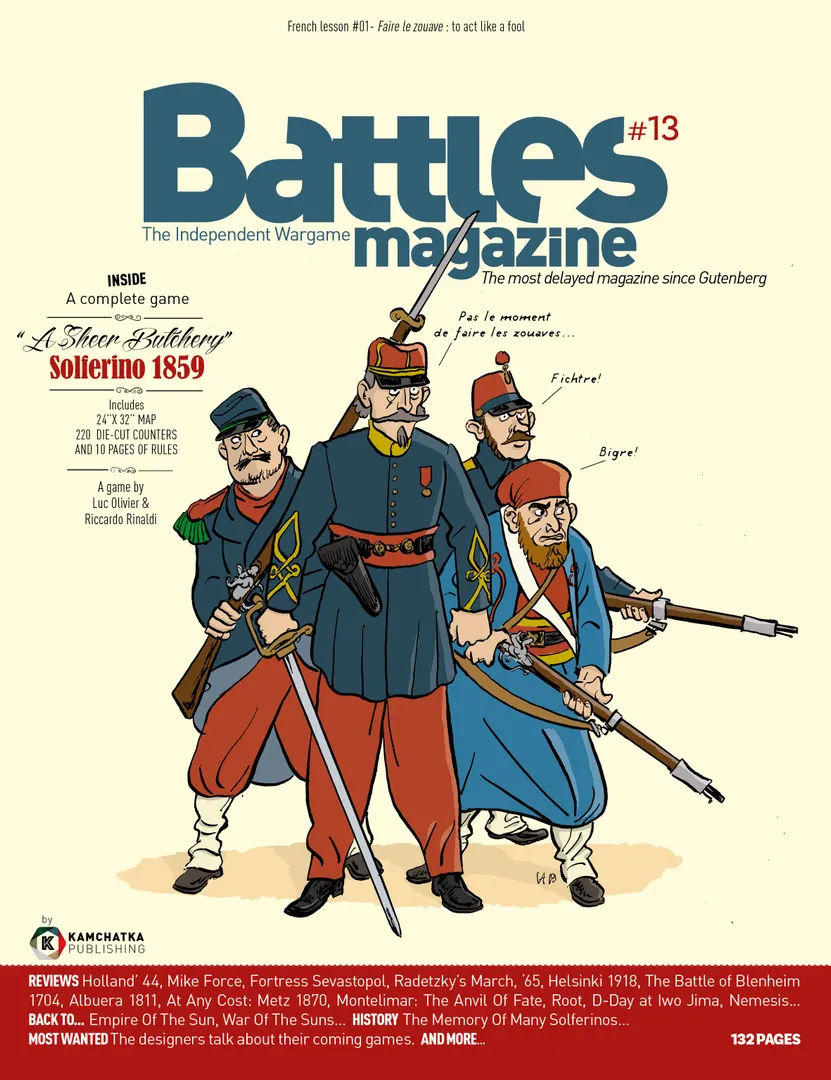
A Sheer Butchery: Solferino 1859
- 2 Spieler
- 180–300 Min.
- Komplexität 2,9/5
- 2019
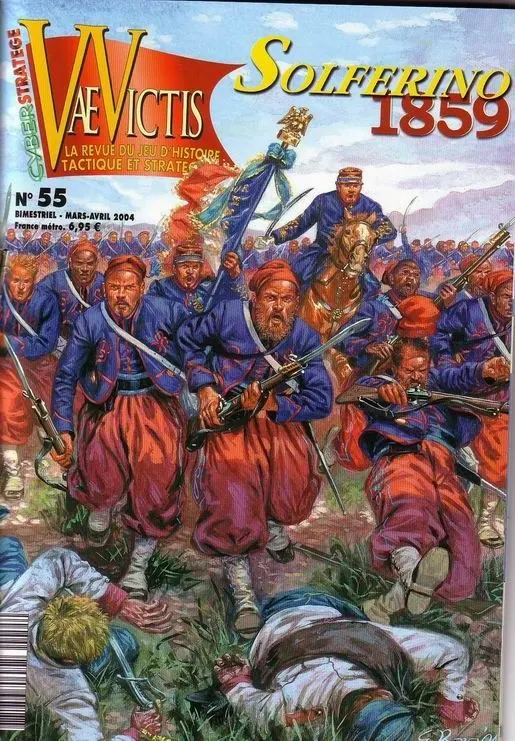
2004
Regelhilfe für Solferino 1859
Verständliche Erklärungen zu Spielzügen, Karteneffekten und strittigen Situationen mit Verweisen auf offizielle Quellen und gespeichertem Fragenverlauf.
Für 2 Personen
Was möchtest du wissen?
Antworten stammen aus dem offiziellen Regelheft, mit Seitenangabe zum Nachprüfen.
Solferino 1859 ist ein Brettspiel aus dem Jahr 2004 für 2 Personen, mit 120 Minuten pro Partie und ab 12 Jahren. Entwickelt wurde es von Luc Olivier und Riccardo Rinaldi; die wichtigsten Mechaniken sind Dice Rolling und Hexagon Grid.

Auf Englisch
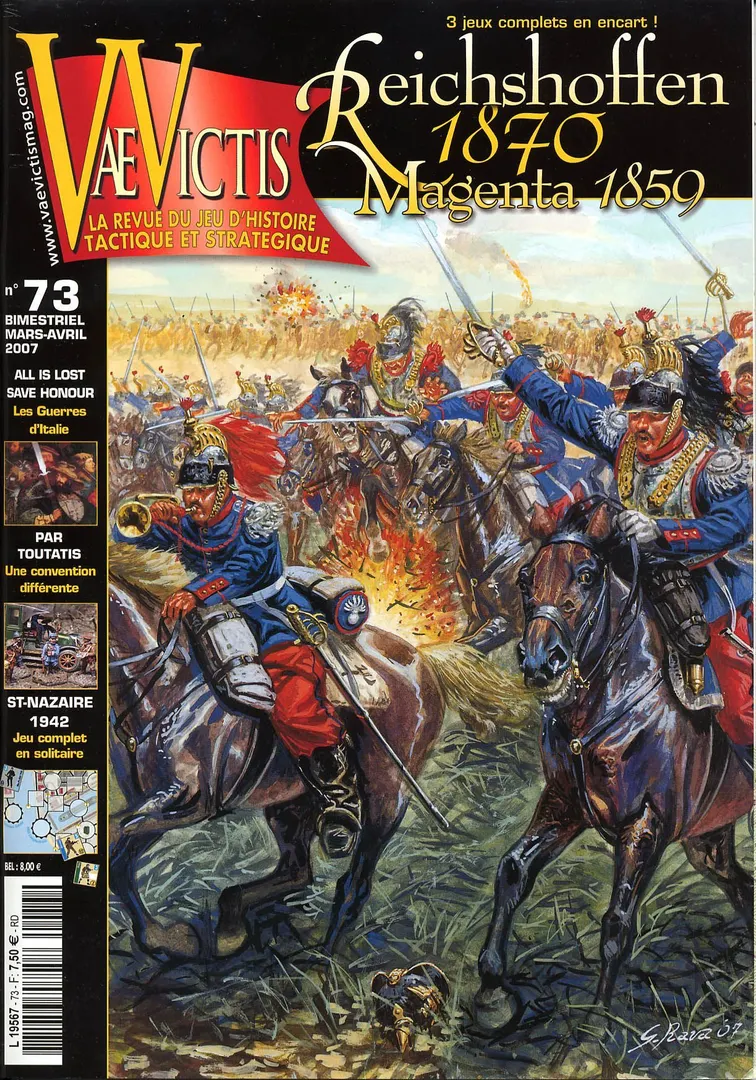
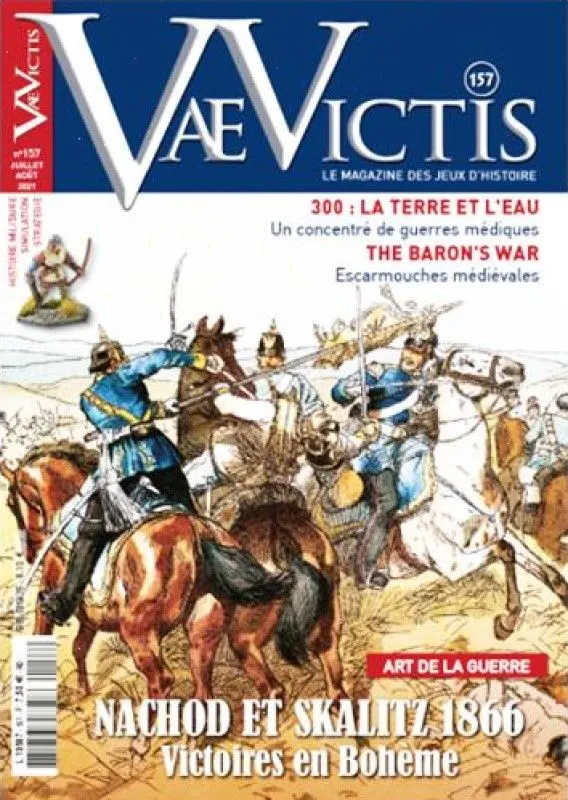
Solferino portrays the final battle of the Second Italian War of Independence, a nominal French victory that persuaded Napoleon III to make peace without much attention to the aims of his Italian allies. It was the last battle in Europe (maybe in the world) in which three monarchs commanded armies: the little Napoleon for the French, Victor Emmanuel for the Sardinians and Franz Joseph I for the Austrians. The scale is 600 meters per hex, 1 hour per turn. Units are infantry and cavalry brigades and corps-level artillery batteries. Units are rated for attack strength, movement factor and cohesion, which represents both morale and the number of losses that the unit can take before dissolving (2 for most infantry and cavalry, 3 for a few, 1 for artillery). Stacking is limited to one unit of any type plus one additional artillery unit per hex. Facing is of no importance for movement but does affect combat: Units may attack only through their 3 front hexes and are penalized if attacked from the flank or rear. Command and control are of great importance. Most units are attached to higher level formations (corps for the French and Austrians, divisions for the Italians). A unit is in command only if it is within range of its corps/division headquarters and the HQ either is within range of its monarch or passes an initiative test. Out-of-command units aren't helpless but are barred from entering hexes adjacent to enemy units' fronts. The royal and imperial personages, particularly Victor Emmanuel and Franz Joseph, are not very mobile, thus limiting forward movement in what is essentially a huge meeting engagement. The movement sequence uses the "chit pull" mechanism. Activation chits for each formation (plus a chit for each side representing all of its unattached units) are placed into a cup and drawn to determine which corps's or division's units may move next. The player who wins the initiative (usually the French) has the slight advantage of being able to select the first formation that will move each turn, without having to draw. Combat is somewhat unusual, employing a system that makes attacks hard and bloody. The attacker's strength is compared to the defense value of the terrain occupied by the defender (1 for clear hexes, 2 for woods, villages and upper slopes, 3 for towns); the defender's strength doesn't matter. At first glance, the combat results table looks very favorable. There are two catches: First, unless an HQ stacks with one of the attackers and passes an initiative test, attacks cannot be combined. The brigades go in one by one. Second, the defender gets to use its own strength for defensive fire against each successive attack before the attacker may fire. A not untypical result of an uncoordinated attack is that each attacker in turn suffers disorder and is forced to fall back without doing any damage. Coordinated attacks work much better - the defender must divide its strength among the attacking units, while they get to add theirs - but, as noted, require the presence of an HQ, which risks the loss of its commander in the process. (He will be replaced, but by a less effective subordinate.) Artillery can help by softening up the target, but there aren't a lot of batteries. (Most of the guns present are abstractly incorporated in the infantry brigade strengths.). Worse yet, they move slowly, have trouble obtaining good lines of sight and are easily eliminated if they get too near the enemy. As the battle goes on, formations will become demoralized through the loss of more than half of their initial steps. Once demoralized, they can do little except retreat off the field. Players gain a Victory Point for occupying each of 7 towns and one for every two enemy corps or divisions demoralized. A side can also win instantly by eliminating the enemy Emperor (Napoleon or Franz Joseph), though only a rather careless player will expose his monarch to attack. The battle starts at dawn (5:00 am) and will usually end abruptly in the late afternoon when a thunderstorm sweeps the field. If the storm holds off, the last turn is 6:00 pm. Whether or not it arrives, oppressive heat almost certainly will, slowing units and lowering their morale. This game was announced as the first of the series, and a later issue of Vae Victis had a pair of sequels, covering the battles of Magenta (1859, the other big battle of the same war) and Reichshoffen (1870, Franco-Prussian War). There were, however, no more, either because the difficulties of attack frustrated aggressive players or simply owing to a lack of widespread interest in mid-19th Century European wars. Solferino gives us a glimpse of what the American Civil War might have been like if every general had been a McClellan.
Laut Katalog unterstützt Solferino 1859 2 Personen. Das ist die vom Verlag angegebene Spielerzahl, das Spiel ist also genau für diese Anzahl von Mitspielenden ausgelegt. Varianten für andere Gruppengrößen sind, sofern vorhanden, in der Anleitung deiner Ausgabe beschrieben; prüfe sie, bevor du eine andere Konfiguration aufbaust.
Die angegebene Spieldauer für Solferino 1859 beträgt 120 Minuten. Das ist die Schätzung des Verlags für eine vollständige Partie. Die tatsächliche Dauer hängt von der Gruppe, der Personenzahl und der Regelkenntnis ab: Erste Partien dauern meist länger, erfahrene Gruppen sind oft schneller fertig. Aufbau und Regelerklärung sind in dieser Schätzung nicht enthalten.
Im Katalog wird Solferino 1859 ab 12 Jahren empfohlen. Das ist die Empfehlung des Verlags und berücksichtigt Leseanforderungen, Regelkomplexität und Kleinteile, nicht nur das Thema. Jüngere Kinder können oft mit Hilfe eines Erwachsenen mitspielen; beachte die Altersangabe deiner Ausgabe und die Brettspielerfahrung deiner Gruppe.
Solferino 1859 hat bei BoardGameGeek eine Komplexitätswertung von 2,8 von 5 und gilt damit als eher leichtes Spiel. Die Wertung zeigt, wie viel Regelwissen, Planung und Entscheidungen eine typische Partie verlangt. Schwerere Spiele brauchen bei der ersten Erklärung mehr Zeit, daher hilft vor dem Spieleabend eine Vorbereitungsanleitung.
Solferino 1859 gehört zu diesen Kategorien: Wargame und Post-Napoleonic. Die wichtigsten Mechaniken sind Dice Rolling und Hexagon Grid. Kategorien beschreiben Thema und Setting eines Spiels, Mechaniken dagegen, was die Spielenden in ihrem Zug tatsächlich tun. Jede Mechanik führt zu einer Katalogseite mit ähnlichen Spielen, falls du etwas Vergleichbares suchst.
Als Autoren von Solferino 1859 sind angegeben: Luc Olivier und Riccardo Rinaldi. Diese Angaben stammen aus den veröffentlichten Spieldaten und nennen die für das Spieldesign verantwortlichen Personen, nicht die Illustratoren oder Verlage. Die Autorenseiten auf MeepleRules sammeln weitere Titel derselben Autoren – praktisch, wenn dir ein Spiel gefällt und du ähnliche Spiele suchst.
Im Katalog ist Solferino 1859 als Grundspiel aufgeführt. Es lässt sich eigenständig mit dem Material aus der Schachtel spielen und benötigt keinen weiteren Titel. Erweiterungen, sofern es welche gibt, ergänzen neues Material oder neue Regeln und sind im Katalog separat mit einem Verweis auf dieses Grundspiel aufgeführt.