
- BGG-Rang
- BGG #34
- BGG-Bewertung
- 8,1
Root
- 2–4 Spieler
- 60–90 Min.
- Komplexität 3,8/5
- 2018
2016
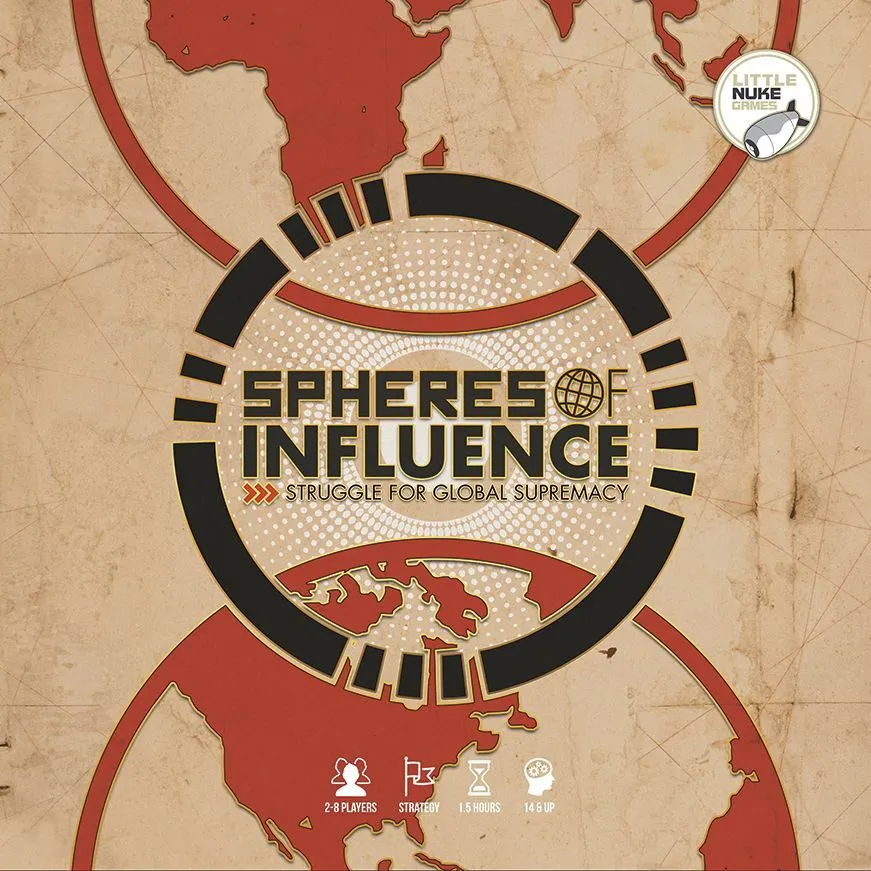
Regelhilfe für Spheres of Influence: Struggle for Global Supremacy
Verständliche Erklärungen zu Spielzügen, Karteneffekten und strittigen Situationen mit Verweisen auf offizielle Quellen und gespeichertem Fragenverlauf.
Für 2 Personen
Was möchtest du wissen?
Antworten stammen aus dem offiziellen Regelheft, mit Seitenangabe zum Nachprüfen.
Spheres of Influence: Struggle for Global Supremacy ist ein Brettspiel aus dem Jahr 2016 für 2–8 Personen, mit 90 Minuten pro Partie und ab 14 Jahren. Entwickelt wurde es von Josh Lamont; die wichtigsten Mechaniken sind Dice Rolling, Point to Point Movement und Area Majority / Influence.




Auf Englisch
Spheres of Influence: Struggle for Global Supremacy is a 2-8 player free-for-all light wargame, set on a modern world map. Players will take control of one of the games 8 mighty factions as they compete over the world's spheres of influence, capitals and oil reserves. Will a mighty caliphate rise to power? Will the communist curtain once again fall? Or will western democracy sweep the world? In games with fewer than 5 players, each player will control 1-4 factions simultaneously, coordinating their efforts against the other players' coalitions. Each faction will begin the game with only a single, semi-randomly determined territory under its control. From this one space, factions will aggressively expand. The gameplay of Spheres of Influence is divided into a set number of rounds, with each round being split into 2 phases: the mobilization phase and the turn phase. During the mobilization phase, factions take turns placing units based on how powerful they are. During this phase, the global turn deck is also formed. This deck will be used to determine the turn order and frequency of action for each faction during the upcoming turn phase. To form it, each faction contributes a number of their turn cards (based on the number of oil fields they control) to a single, shared deck of turn cards. This deck is then shuffled and place down on the table. During the turn phase, one at a time the top card of the turn deck is revealed. Whichever faction's card was just flipped, that faction takes a turn, performing a single action with its units on a single space (moving, attacking, annexing or passing). Once that action is complete, that turn ends and the next turn card is revealed, with the process repeating itself. This makes turns both fast (with many turns lasting only a couple of seconds) and suspenseful, since none of the factions know precisely when their turns will be. It also ensures more incremental game developments - factions cannot sweep across all of Asia in a single turn and players can respond to attacks or betrayals much sooner. Once the last turn card in the global turn deck has been revealed, a round ends and another round begins. Combat is resolved by a simple dice mechanic fused with a "situational" modifier that loosely simulates the increased difficulty of attacking a defended coastline, breaking a naval blockade, or striking a fortified position. Along the way, powerful special cards can be played, allowing players to strike with submarines, deploy heavy armor, paradrop troops around enemy defenses, and launch devastating nuclear attacks. Games have either 5 or 6 rounds depending on the number of factions. Once the final round is complete, the faction who controls the most spheres of influence wins the game for its owner. Games typically last about an hour and a half, and experienced players can sometimes finish in just a single hour.
Laut Katalog unterstützt Spheres of Influence: Struggle for Global Supremacy 2–8 Personen. Diese Spanne entspricht der vom Verlag angegebenen Spielerzahl, das Spiel lässt sich also für jede Gruppengröße innerhalb dieser Spanne aufbauen. Aufbau, einzelne Regeln und Wertungsdetails können je nach Personenzahl trotzdem abweichen; prüfe daher die genaue Konfiguration in der Anleitung deiner Ausgabe.
Die angegebene Spieldauer für Spheres of Influence: Struggle for Global Supremacy beträgt 90 Minuten. Das ist die Schätzung des Verlags für eine vollständige Partie. Die tatsächliche Dauer hängt von der Gruppe, der Personenzahl und der Regelkenntnis ab: Erste Partien dauern meist länger, erfahrene Gruppen sind oft schneller fertig. Aufbau und Regelerklärung sind in dieser Schätzung nicht enthalten.
Im Katalog wird Spheres of Influence: Struggle for Global Supremacy ab 14 Jahren empfohlen. Das ist die Empfehlung des Verlags und berücksichtigt Leseanforderungen, Regelkomplexität und Kleinteile, nicht nur das Thema. Jüngere Kinder können oft mit Hilfe eines Erwachsenen mitspielen; beachte die Altersangabe deiner Ausgabe und die Brettspielerfahrung deiner Gruppe.
Spheres of Influence: Struggle for Global Supremacy hat bei BoardGameGeek eine Komplexitätswertung von 2,4 von 5 und gilt damit als eher leichtes Spiel. Die Wertung zeigt, wie viel Regelwissen, Planung und Entscheidungen eine typische Partie verlangt. Schwerere Spiele brauchen bei der ersten Erklärung mehr Zeit, daher hilft vor dem Spieleabend eine Vorbereitungsanleitung.
Spheres of Influence: Struggle for Global Supremacy gehört zu diesen Kategorien: Wargame, Territory Building und Negotiation. Die wichtigsten Mechaniken sind Dice Rolling, Point to Point Movement und Area Majority / Influence. Kategorien beschreiben Thema und Setting eines Spiels, Mechaniken dagegen, was die Spielenden in ihrem Zug tatsächlich tun. Jede Mechanik führt zu einer Katalogseite mit ähnlichen Spielen, falls du etwas Vergleichbares suchst.
Als Autoren von Spheres of Influence: Struggle for Global Supremacy sind angegeben: Josh Lamont. Diese Angaben stammen aus den veröffentlichten Spieldaten und nennen die für das Spieldesign verantwortlichen Personen, nicht die Illustratoren oder Verlage. Die Autorenseiten auf MeepleRules sammeln weitere Titel derselben Autoren – praktisch, wenn dir ein Spiel gefällt und du ähnliche Spiele suchst.
Im Katalog ist Spheres of Influence: Struggle for Global Supremacy als Grundspiel aufgeführt. Es lässt sich eigenständig mit dem Material aus der Schachtel spielen und benötigt keinen weiteren Titel. Erweiterungen, sofern es welche gibt, ergänzen neues Material oder neue Regeln und sind im Katalog separat mit einem Verweis auf dieses Grundspiel aufgeführt.