
- BGG-Rang
- BGG #24.728
- BGG-Bewertung
- 5,6
Dominoes
- 2–10 Spieler
- 30 Min.
- Komplexität 1,4/5
- 1500
2004
Regelhilfe für Tara: Ireland's Royal Board Game
Verständliche Erklärungen zu Spielzügen, Karteneffekten und strittigen Situationen mit Verweisen auf offizielle Quellen und gespeichertem Fragenverlauf.
Für 2 Personen
Was möchtest du wissen?
Antworten stammen aus dem offiziellen Regelheft, mit Seitenangabe zum Nachprüfen.
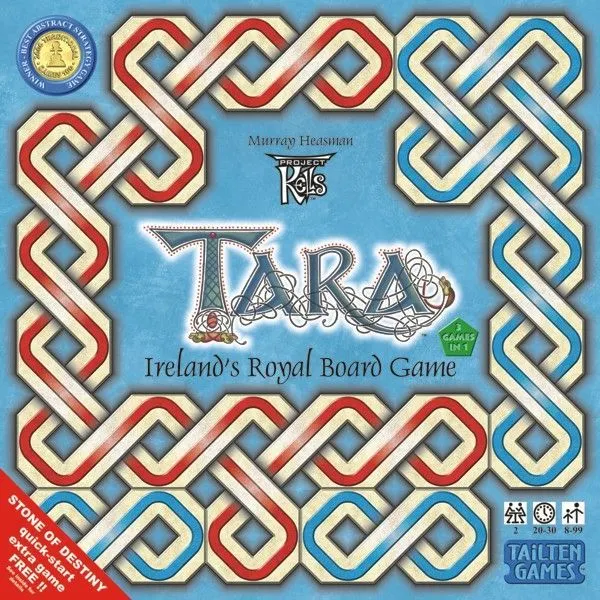
Tara: Ireland's Royal Board Game ist ein Brettspiel aus dem Jahr 2004 für 2 Personen, mit 20–30 Minuten pro Partie und ab 8 Jahren. Entwickelt wurde es von Murray Heasman; die wichtigsten Mechaniken sind Tile Placement, Pattern Building und Pattern Recognition.
Auf Englisch
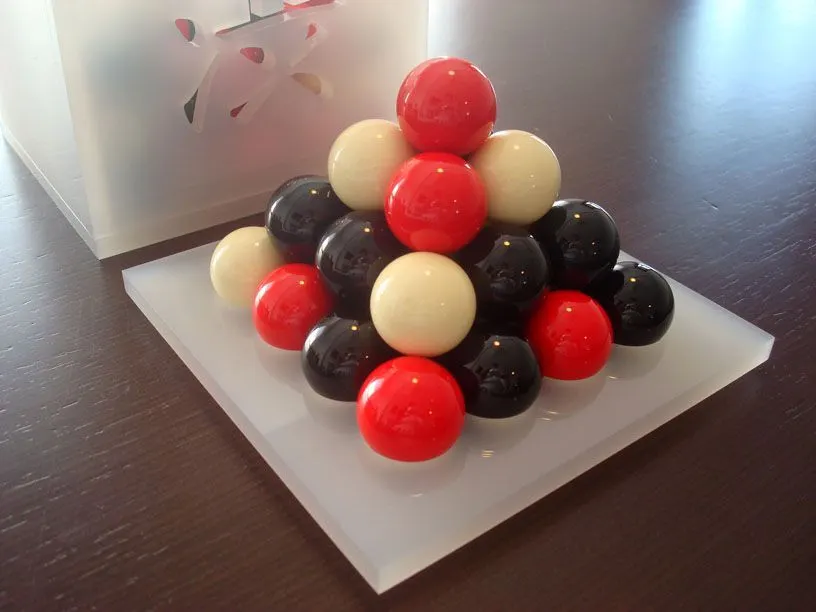
(second edition, TG552) Inspired by the Book of Kells and its mesmerizing patterns woven amongst the vellum pages, Project Kells evolved. Standing atop the Hill of Tara and contemplating the conjoined ringforts of Forradh and Teach Chormac, the games of Sacred Hill and High Kings of Tara were born. Steeped in the ancient legends of Ireland’s Celtic heritage and royal past, these unique games of pure strategy are appreciated by young and old alike. Tailten Games won the Games Magazine award for BEST ABSTRACT GAME 2006; the Spiele für Zwei - Spiele Akademie 2005 (Austria); Index 100 - Showcase 2005 in Ireland; and the award for 'Best Irish-Style Traditional Gift' 2005 in Ireland for Project Kells. According to the designer, Murray Heasman,"The game takes five minutes to learn, yet a lifetime to master." The sheer beauty of this game alone makes it a gift to treasure--but the three separate games each pose a daunting task for any strategic or abstract gamer. In all there are eight variants to stimulate the mind, so take it to your own level. From a more simple Sacred Hill, a go-like game with its' elemental challenges, to an all-out-brain-burner in the form of Poisoned Chalice... Project Kells combines the best of beauty, gameplay, theme, and replay value. You’ll be amazed at the possibilities. Once you’ve learned the basics, be prepared to delve deeper, because you’re likely to be already hooked on this game. Scoring with knots (instead of kingdoms) will get you addicted. This first game: Sacred Hill introduces the basic elements of play. The aim of both games is the same -- to have the least number of kingdoms by the time the game is ended, a kingdom being a group of linked ring forts. There are two phases to the game. In manoeuvres (first phase) you are building a network of unconnected ring forts scattered around the board. In Battle (second phase) you are adding ring forts next to your own, linking them together with bridge tiles, to form larger (and fewer) kingdoms. This starts to magically create the Celtic knotwork. Isolated ring forts that are besieged must be captured. No ties are possible with either ringfort scoring or knot scoring.=== The second game: High Kings of Tara introduces the kings. Each player has three which do the work of building your ring forts. They move like the knight in chess and add many more twists and turns to the game, taking it to another dimension. Kings can capture enemy ring forts and kings; they can also be immobilized. Your own kings cannot work in tandem and they must always move to a vacant hill whenever possible. Ties are possible, but the duality of scoring pursuits (ringforts versus captured kings) usually prevents this possibility. This is especially true in tournament scoring... Those who feel that they have mastered those variants are encouraged to try the real brain burner of the bunch. Poisoned Chalice Played at right angles to each other, each player tries to exert total control over each other from a position of inferiority. The end scoring is the same as in the Sacred Hill variant, but in this endeavor the limitations of placement create challenging strategic obstacles for both opponents. It is possible to exert control over an opponent in such a way that at times they are limited to one possibility for tile placement. However, there are twists that occur if a piece is captured (surrounded) on the board (like in 'go'). No ties are possible with either ringfort scoring or knot scoring. This is very probably the same game [system] as The High Kings of Tara.
Laut Katalog unterstützt Tara: Ireland's Royal Board Game 2 Personen. Das ist die vom Verlag angegebene Spielerzahl, das Spiel ist also genau für diese Anzahl von Mitspielenden ausgelegt. Varianten für andere Gruppengrößen sind, sofern vorhanden, in der Anleitung deiner Ausgabe beschrieben; prüfe sie, bevor du eine andere Konfiguration aufbaust.
Die angegebene Spieldauer für Tara: Ireland's Royal Board Game beträgt 20–30 Minuten. Das ist die Schätzung des Verlags für eine vollständige Partie. Die tatsächliche Dauer hängt von der Gruppe, der Personenzahl und der Regelkenntnis ab: Erste Partien dauern meist länger, erfahrene Gruppen sind oft schneller fertig. Aufbau und Regelerklärung sind in dieser Schätzung nicht enthalten.
Im Katalog wird Tara: Ireland's Royal Board Game ab 8 Jahren empfohlen. Das ist die Empfehlung des Verlags und berücksichtigt Leseanforderungen, Regelkomplexität und Kleinteile, nicht nur das Thema. Jüngere Kinder können oft mit Hilfe eines Erwachsenen mitspielen; beachte die Altersangabe deiner Ausgabe und die Brettspielerfahrung deiner Gruppe.
Tara: Ireland's Royal Board Game hat bei BoardGameGeek eine Komplexitätswertung von 2,1 von 5 und gilt damit als eher leichtes Spiel. Die Wertung zeigt, wie viel Regelwissen, Planung und Entscheidungen eine typische Partie verlangt. Schwerere Spiele brauchen bei der ersten Erklärung mehr Zeit, daher hilft vor dem Spieleabend eine Vorbereitungsanleitung.
Tara: Ireland's Royal Board Game gehört zu diesen Kategorien: Territory Building, Abstract Strategy und Medieval. Die wichtigsten Mechaniken sind Tile Placement, Pattern Building und Pattern Recognition. Kategorien beschreiben Thema und Setting eines Spiels, Mechaniken dagegen, was die Spielenden in ihrem Zug tatsächlich tun. Jede Mechanik führt zu einer Katalogseite mit ähnlichen Spielen, falls du etwas Vergleichbares suchst.
Als Autoren von Tara: Ireland's Royal Board Game sind angegeben: Murray Heasman. Diese Angaben stammen aus den veröffentlichten Spieldaten und nennen die für das Spieldesign verantwortlichen Personen, nicht die Illustratoren oder Verlage. Die Autorenseiten auf MeepleRules sammeln weitere Titel derselben Autoren – praktisch, wenn dir ein Spiel gefällt und du ähnliche Spiele suchst.
Im Katalog ist Tara: Ireland's Royal Board Game als Grundspiel aufgeführt. Es lässt sich eigenständig mit dem Material aus der Schachtel spielen und benötigt keinen weiteren Titel. Erweiterungen, sofern es welche gibt, ergänzen neues Material oder neue Regeln und sind im Katalog separat mit einem Verweis auf dieses Grundspiel aufgeführt.